


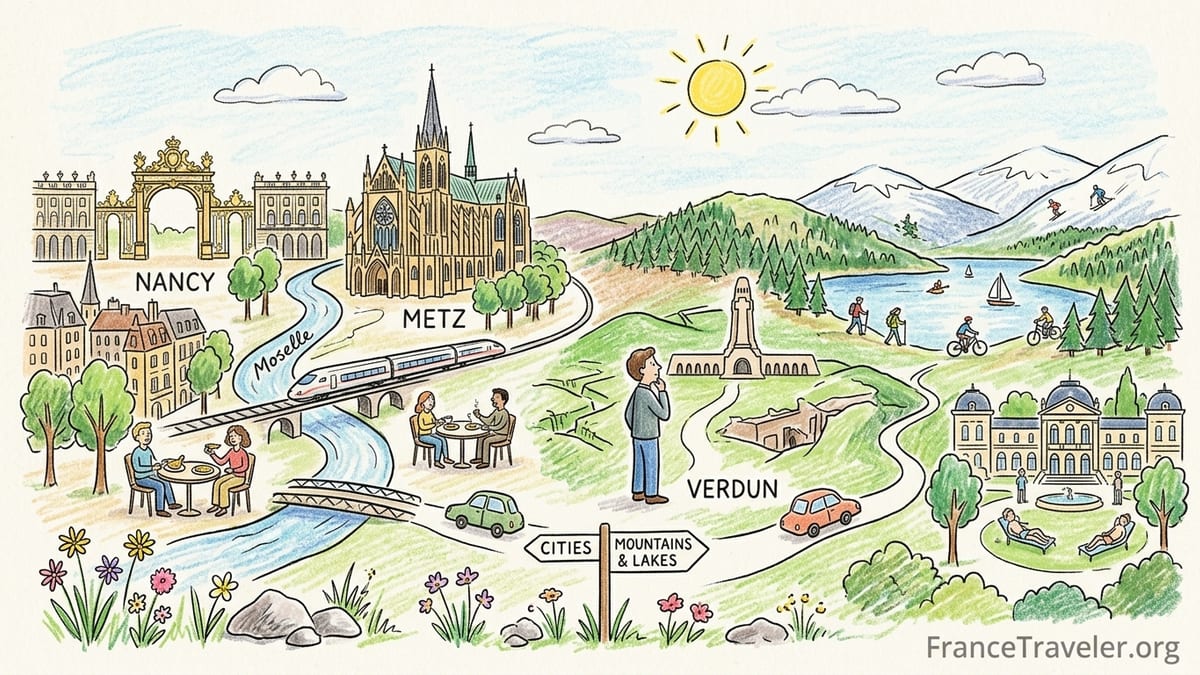
Lorraine is one of France’s most varied regions. In just a few days you can move from café terraces on Baroque squares to silent World War I forests, and from cutting-edge art museums to lakeside paths in the Vosges mountains. The trick is choosing the right base. Should you stay in Nancy, Metz, Verdun or the Vosges, or combine a couple of them in one itinerary? This guide compares the main options, so you can match your accommodation choice to the trip you really want.
Start with the trip you are really planning
Before you book a hotel or apartment in Lorraine, decide what kind of trip you are organizing. A car-free weekend from Paris looks very different from a week-long family holiday focused on nature, or a reflective journey through the First World War battlefields. Lorraine is compact in distance, but the experience in each base is distinct.
Nancy and Metz work best as classic city-break hubs, with walkable centres, good rail links and plenty of restaurants, museums and evening life. They suit travelers arriving by TGV from Paris or other major French cities, people who prefer not to drive, and anyone who enjoys exploring on foot with lots of café stops built into the day.
Verdun is the natural base for those who want to go deeper into the Battle of Verdun and the Meuse-Argonne sector instead of rushing through on a single coach tour. An overnight or multi-night stay lets you visit forts, ossuaries, museums and forest trails without watching the clock, and gives you quiet evenings to process what you have seen.
Gérardmer and wider Vosges bases such as La Bresse or Xonrupt-Longemer shift the mood completely. Here the focus is on lakes, forests, hiking, cycling and winter sports. Rail access becomes thinner and a car quickly turns from “nice-to-have” into “very useful”. Finally, spa towns like Vittel and Contrexéville offer a slow, rural base built around thermal parks, classic Belle Époque hotels and gentle excursions by train and regional bus.
Nancy: walkable Art Nouveau city-break hub
Nancy is arguably the easiest entry point to Lorraine for international visitors. The historic centre is compact and highly walkable, with the main train station right in town. France’s official tourism information notes that trains from Paris Est reach Nancy in around 1 hour 30 minutes by TGV, which makes it very realistic as a car-free weekend from the French capital. Step off the train and in about five minutes on foot you can be standing in front of Place Stanislas.
Walkability is one of Nancy’s biggest selling points. Central attractions such as Place Stanislas, Place de la Carrière, the Old Town around the Palais des Ducs de Lorraine and the Parc de la Pépinière sit within a tight radius. You can wander from Art Nouveau shopfronts to Art Deco cinemas and 18th-century mansions without needing public transport. Many hotels and apartment rentals cluster between the station and Place Stanislas, so you can realistically do an entire 2 or 3-night stay on foot, even with children.
Nancy is also the French capital of Art Nouveau, thanks to the École de Nancy movement. For accommodation, that means plenty of period apartment buildings, decorative façades and small guesthouses set in early 20th-century villas. In practice, your sightseeing days tend to follow an easy city-break structure: morning coffee on Place Stanislas, a visit to the Musée des Beaux-Arts or the Musée de l’École de Nancy, a long lunch in the old town, then an afternoon stroll through leafy suburbs to spot wrought-iron balconies and stained glass. In December, the Saint-Nicolas festivities and Christmas markets add evening atmosphere with lights and stalls spread across several squares.
For rail access, Nancy is well connected within the Grand Est region. Regular TER trains run to Metz (often around 35 to 45 minutes), to Épinal and Saint-Dié-des-Vosges, and along the line toward Lunéville and the Vosges foothills. This means you can base yourself in Nancy without a car and still take realistic day trips to Metz, to smaller Art Nouveau towns like Lunéville, or to family attractions such as the Fraispertuis-City amusement park via summer shuttle buses from nearby towns. Parking is widely available in underground car parks around the centre, but spaces around Place Stanislas and in the old town are in demand; if you are driving, consider choosing a hotel with its own garage.
In the evening, Nancy feels lively but not overwhelming. The streets between Place Stanislas and Rue Saint-Jean are lined with brasseries, wine bars and casual restaurants, some with outdoor seating even on cooler nights thanks to heaters. You will find everything from classic Lorraine dishes like quiche Lorraine and pâté lorrain to modern bistros and a sprinkling of Michelin-noted addresses. For families, the combination of traffic-calmed streets, the big playground in Parc de la Pépinière and frequent ice-cream stops makes Nancy a comfortable base with kids. It particularly suits first-time visitors to Lorraine, travelers without a car and anyone who wants a structured, museum-and-café style city break.
Metz: art, cathedral views and a gateway to northern Lorraine
Metz offers a different urban atmosphere from Nancy, with more of the trip oriented around the rivers and its vast Gothic cathedral. The city is still very walkable, but the experience stretches along the Moselle riverfront and through larger open squares. Metz-Ville station is on the eastern edge of the centre; from there it is a straightforward walk to most hotels, the cathedral and the river. The Centre Pompidou-Metz, a major contemporary art outpost of the Paris museum, stands in a new cultural district near the station and is one of the city’s headline attractions.
Art and architecture shape the day in Metz. A typical itinerary might start at Saint-Étienne Cathedral, known for its towering nave and stained glass, then move through the medieval streets of the Colline Sainte-Croix toward the riverside promenades. After lunch at a brasserie on Place Saint-Jacques or near Marché Couvert, you can walk or take a short local bus back to Centre Pompidou-Metz for an afternoon of contemporary exhibitions. The museum complex sits next to dedicated parking and the main station, so staying in that part of town makes it convenient to arrive by train and explore on foot.
Metz has especially good access to northern Lorraine and cross-border areas. Trains run to Thionville and the Luxembourg border, as well as to Nancy and smaller towns along the Moselle. If you are interested in the Maginot Line, regional roads north of Metz give you straightforward driving access to several fortifications. The presence of the Lorraine TGV station outside town with shuttle links into Metz also underlines its role as a transport hub for the northern part of the region.
Restaurant choice is wide, particularly around the cathedral, Place Saint-Jacques and the riverside. You will find traditional winstub-style restaurants with regional dishes, relaxed wine bars and a handful of higher-end venues. Evenings feel lively around the squares and calmer along the river, so you can choose your preferred atmosphere. Many city-centre hotels either have arrangements with nearby car parks or their own small garages, which are useful if you are using Metz as a base for day trips by car to places like Amnéville’s leisure complex or Moselle vineyards.
Metz suits travelers who want to mix culture with day trips across northern Lorraine, and anyone heading on to Luxembourg, Belgium or Germany. Compared with Nancy, it can feel slightly more businesslike in parts of the week, but the blend of cathedral, modern art and riverfront gives it strong appeal for couples and culture-focused visitors. Families who like big open spaces and riverside walking paths will also be comfortable here, especially if they plan to combine Metz with a few days in the Vosges.
Verdun: staying overnight for the battlefields
For travelers focused on World War I history, Verdun is not just a stop but a base. The city itself sits on the Meuse river and has its own cathedral and citadel, but what draws most visitors are the surrounding forts, cemeteries, memorials and preserved battlefield zones that mark the 1916 Battle of Verdun and related fighting. Many experienced visitors recommend spending at least one or two full days in the area, which is hard to manage comfortably as a rushed day trip from Paris or even from Nancy.
Staying overnight in Verdun changes the rhythm completely. Instead of trying to fit Fort Douaumont, Fort Vaux, the Douaumont Ossuary and the main memorial museum into a single day, you can spread visits out and add quieter, less-visited sites such as forest trails through old trench lines or walks along former front-line ridges. An overnight stay also allows you to visit the underground Citadel of Verdun and the town itself without feeling that every hour has to be spent at one of the headline sites. For many travelers, that slower pace is important for reflection.
Verdun has a functioning rail station with regional services, but frequencies can be limited compared with Nancy or Metz, and onward buses to the main battlefield sites are sparse. In practice, a car or organized tour often becomes the easiest way to explore the surrounding area. Many visitors who arrive by train arrange a local guided tour that includes Fort Douaumont, the ossuary and selected trench sectors, or they hire a car for a day or two. If you plan to rely on taxis or rideshare services, it is wise to check availability with the local tourist office in advance, especially outside peak summer months.
Within Verdun, accommodation ranges from simple chain hotels near the riverfront to small independent hotels and guesthouses closer to the old centre. Parking is generally easier than in Nancy or Metz, with many hotels offering on-site or nearby spaces and street parking more readily available. Evening atmosphere is calm rather than lively, with restaurants concentrated along the river and in the old streets near the cathedral. You will find straightforward French bistros, pizzerias and a few more refined options, but this is not a major nightlife destination.
Verdun is suitable for historically minded travelers, solo visitors on remembrance journeys, and families with older children or teenagers who have a strong interest in history. It is less ideal as a general sightseeing base for very young families or visitors looking primarily for shopping and restaurant variety. As part of a wider Lorraine trip, Verdun combines well with either Nancy or Metz by car, forming a meaningful two-centre itinerary.
Gérardmer and the Vosges: lakes, hiking and winter sports
Choosing Gérardmer or another Vosges base such as La Bresse brings you into a very different Lorraine, defined by lakes, forests and mountain roads rather than Baroque squares and cathedrals. Gérardmer itself lies on a scenic lake framed by wooded slopes, with a compact town centre, lakeside promenade and ski area above the town. It is a classic French four-season resort: boating and swimming in summer, hiking and mountain biking in the shoulder seasons, and downhill and cross-country skiing in winter.
Public transport gets you close to the Vosges, but rarely to your final viewpoint or trailhead. TER Grand Est trains connect Nancy with Saint-Dié-des-Vosges and Remiremont, and from there regional buses run up the valleys to places like Gérardmer. In summer, additional leisure shuttles and tourist buses often operate between lakes and viewpoints. However, services may be infrequent outside school holidays and weekends, and connections can be tight. For flexibility, especially if you plan to explore multiple lakes such as Gérardmer and Longemer or drive the Route des Crêtes, a car is highly recommended.
Accommodation in Gérardmer and the wider Vosges range covers lakeside hotels, chalet-style residences, campsites and rental apartments on the slopes. Parking is usually straightforward, with many properties offering free on-site spaces. In peak winter weeks and during major events such as the Gérardmer Fantasy Film Festival or busy summer weekends, demand rises and it becomes worth booking well in advance, especially for lake-view rooms and family apartments close to the centre.
Evenings in Gérardmer are relaxed, with a cluster of restaurants around the town centre and along the lakefront. Expect a mix of Savoyard-style mountain dishes such as cheese fondues and raclettes, local Vosges specialties featuring cured meats and munster cheese, and casual pizzerias and crêperies. There are some bars, but nightlife is modest compared with larger cities. For families, the combination of lakeside walks, boat rentals, playgrounds and accessible hiking trails makes the Vosges an appealing choice, provided you are comfortable driving on mountain roads.
The realistic day-trip radius from a Vosges base depends heavily on whether you have a car. With one, you can combine Lorraine with Alsace by driving across the mountains to towns like Colmar or the Alsace Wine Route in around 1.5 to 2 hours, or explore smaller Vosges villages and viewpoints in half-day loops. Without a car, day trips are more limited to nearby towns reachable by bus and train connections, such as Saint-Dié-des-Vosges, Remiremont or Épinal, and to activities around your own lake.
Vittel, Contrexéville and rural spa bases
Vittel and Contrexéville, in the southern part of Lorraine, offer a very different rhythm again. These classic spa towns grew up around thermal springs and still centre on expansive parks, long promenades and Belle Époque architecture. They suit travelers who want a quiet base with greenery, light activity and perhaps a wellness stay built around treatments or access to spa complexes, rather than a packed sightseeing schedule.
From a transport perspective, they are more rural than Nancy or Metz but not completely cut off. Vittel has a TER Grand Est station, with seasonal direct trains from Paris Est on certain days of the week between spring and autumn, and local services connecting through to regional hubs. Contrexéville, just a short distance away, has its own station on the same line and benefits from coordinated rail and regional bus services. Official tourism and rail information highlight that the historic Paris to Vittel and Contrexéville route has been relaunched in recent years, restoring a direct connection for spa visitors on specific days between early April and early November.
Once in town, you can easily get around on foot. Both Vittel and Contrexéville have compact centres with the thermal park, main hotels and most restaurants within a ten to fifteen-minute radius. The focus is on gentle walking, time in the spa facilities, perhaps a round of golf or tennis, and low-key excursions into the surrounding countryside. Cycling routes and small walking trails extend into the nearby hills and farmland, and regional buses or a short drive take you to neighbouring villages and viewpoints.
Restaurants in these spa towns tend to be linked to hotels or located near the casino and park areas. Choices are more limited than in Nancy or Metz, but you can still expect a selection of brasseries, traditional French menus and cafés. Evenings are quiet, with some activity around the casino and seasonal cultural events, but limited late-night options. For many visitors, that calm is part of the appeal.
These rural spa bases suit couples seeking a rest-oriented break, older travelers who appreciate flat, walkable environments and on-site facilities, and anyone integrating a wellness stay into a longer Grand Est itinerary. They are also a gentle option for families with young children who enjoy parks and swimming pools, though older children and teenagers may find the pace slow unless you combine a spa base with more active days in the Vosges or in one of the cities.
How to decide: rail access, car needs and day-trip radius
When choosing where to stay in Lorraine, three practical questions help narrow things down: how you are arriving, whether you want or need a car, and how much you value variety of restaurants and evening atmosphere. Nancy and Metz stand out for sheer rail convenience. Both sit directly on major lines from Paris Est and other French and international destinations, and both have central stations a short walk from key sights and many hotels.
Travelers arriving by train and planning to stay mostly car-free will find Nancy the easiest base for a first visit, with Metz a close second. A three or four-night stay in Nancy, entirely on foot, still allows a full day in Metz by train, another day exploring Nancy’s museums and Art Nouveau, and perhaps a short excursion to nearby small towns. Metz, likewise, can anchor a car-free trip focused on its cathedral, Centre Pompidou-Metz and riverside walks, with day trips by train to Nancy or to nearby Moselle towns.
Verdun, the Vosges and the spa towns are simpler with a car. You can reach Verdun by train, but visiting scattered battlefield sites comfortably, especially beyond the main forts and ossuary, is much easier when you can follow back roads, stop at small memorials and adjust your timing. In the Vosges, a car multiplies your options, turning Gérardmer from a lake-and-town-only break into a base for panoramic drives, hut lunches along the Route des Crêtes and visits to multiple valleys. Vittel and Contrexéville are manageable without a car if you plan to focus on spa facilities and the park, but a vehicle helps if you want to explore surrounding countryside or link them with other parts of Lorraine.
Restaurant choice and evening atmosphere are richest in Nancy and Metz, moderate in Verdun and Gérardmer, and quietest in the spa towns. If you enjoy choosing a different cuisine each night or lingering in wine bars, lean toward Nancy or Metz. If your ideal evening is a simple meal followed by a walk along a lake or river, Verdun, Gérardmer or Vittel may fit better. For day-trip radius, think in concentric circles: from Nancy or Metz, most regional cities and many smaller towns are reachable in one hour by train or car, while from Gérardmer a realistic day out by car might be a loop across to Alsace and back, and from Verdun a drive down the Meuse heights to St-Mihiel and other WWI sites.
Best base combinations for 3, 5 and 7 days
For a 3-day trip, it usually makes sense to choose a single base. If you are coming from Paris by TGV and want a classic urban break, pick Nancy for two or three nights. You can spend one full day exploring the city, including Place Stanislas, the museums and Art Nouveau quarters, and use the other day for a quick train hop to Metz or for a countryside excursion booked through local providers. If your main interest is contemporary art and cathedral architecture, Metz works just as well as a standalone base for three days.
If you have 3 days and a car and your priority is World War I history, consider spending all three nights in Verdun. Use one full day for the main Verdun battlefield circuit, from Fort Douaumont and Fort Vaux to the ossuary and memorial, and another for the Meuse-Argonne or St-Mihiel areas. With a third day you can explore the town’s citadel and cathedral or detour through small villages on the Meuse heights. Splitting your time between two places in such a short window risks spending too long on the road.
For a 5-day trip, combining two bases starts to make sense. A classic pairing without a car is Nancy and Metz: for example, three nights in Nancy followed by two in Metz, linked by a simple TER train. This gives you enough time for both cities, plus a day trip from each. With a car, you might divide five days between Nancy (two or three nights) and Verdun (two or three nights), or between Nancy and Gérardmer for a city-and-mountains balance. In each case, keep transfers short: these bases are typically 1.5 to 2.5 hours apart by car.
On a 7-day itinerary, you can comfortably include three different sides of Lorraine. One option is a triangle of Nancy, Verdun and Gérardmer if you have a car: start with urban culture in Nancy, move to the battlefields around Verdun, then finish with lakes and forests in the Vosges. Another is a more relaxed combination of Metz, Nancy and a spa town such as Vittel or Contrexéville, using trains and regional buses wherever possible. For example, you could spend two nights in Metz, three in Nancy and two in Vittel, with the final days dedicated to slow walks in thermal parks and time in spa facilities.
When planning multi-base trips, factor in check-in and check-out times and travel between bases. Shifting hotel every night cuts into sightseeing and rest, especially if you rely on public transport. As a guideline, try to stay at least two nights in each base, and use cities like Nancy or Metz as your arrival and departure anchors thanks to their strong rail links.
FAQ
Q1. If I am coming from Paris without a car, which base in Lorraine is easiest?
Nancy is usually the easiest, with TGV trains from Paris Est taking around 1 hour 30 minutes and the station located directly beside the compact, walkable centre.
Q2. Can I visit both Nancy and Metz comfortably in a single weekend?
Yes, if you base in one city and take a day trip to the other by TER train. However, you will only get an overview of each, so prioritize based on your interests.
Q3. Do I need a car to explore the Verdun battlefields properly?
A car is not absolutely essential but is very helpful. Without one, you will need to rely on limited local buses, taxis or guided tours to reach forts and memorials spread across the countryside.
Q4. Is Gérardmer a good choice for a winter sports break?
Yes. Gérardmer has its own ski area, cross-country trails and winter infrastructure, making it a practical choice for a few days of modest downhill and Nordic skiing in the Vosges.
Q5. Are Vittel and Contrexéville suitable for families with young children?
They can be, especially for calm holidays centred on parks, swimming and easy walks, but older children may prefer bases with more varied activities, such as Gérardmer or one of the cities.
Q6. How many nights should I plan in Verdun if I care deeply about World War I history?
Two or three nights gives you time for the main Verdun sites, additional battlefield walks and nearby Meuse-Argonne or St-Mihiel areas, without feeling rushed.
Q7. Can I combine Lorraine with Alsace on a single trip?
Yes. With a car, you can base in the Vosges and drive across to Colmar or the Alsace Wine Route, or link Nancy or Metz with Strasbourg by train for a multi-city itinerary.
Q8. Is parking difficult in Nancy and Metz?
Parking is more structured than difficult. Both cities offer numerous underground car parks and hotel garages, but you should allow for paid parking costs in central areas.
Q9. Which base has the liveliest evening atmosphere?
Nancy and Metz have the broadest choice of restaurants, bars and café terraces in the evening, while Verdun, Gérardmer and the spa towns are generally calmer and quieter.
Q10. For a one-week stay, is it better to stay in one base or several?
For seven days, two or three bases work well, such as Nancy and Verdun, or Nancy, Gérardmer and a spa town, as long as you keep travel times between them modest.