


Lorraine is one of those French regions that quietly has everything: glamorous Art Nouveau streets in Nancy, cutting-edge culture in Metz, some of Europe’s most powerful First World War sites around Verdun, and dark evergreen peaks and lakes in the Vosges. The surprise for first-time visitors is not what to do, but how quickly the driving adds up if you try to “do it all” in a long weekend. This guide sets out a practical framework for planning 3, 5 or 7 days in Lorraine, showing how many bases you really need, when to rely on trains instead of a car, and how to give Nancy, Metz, Verdun and the Vosges the time they deserve without turning your holiday into a road trip endurance test.
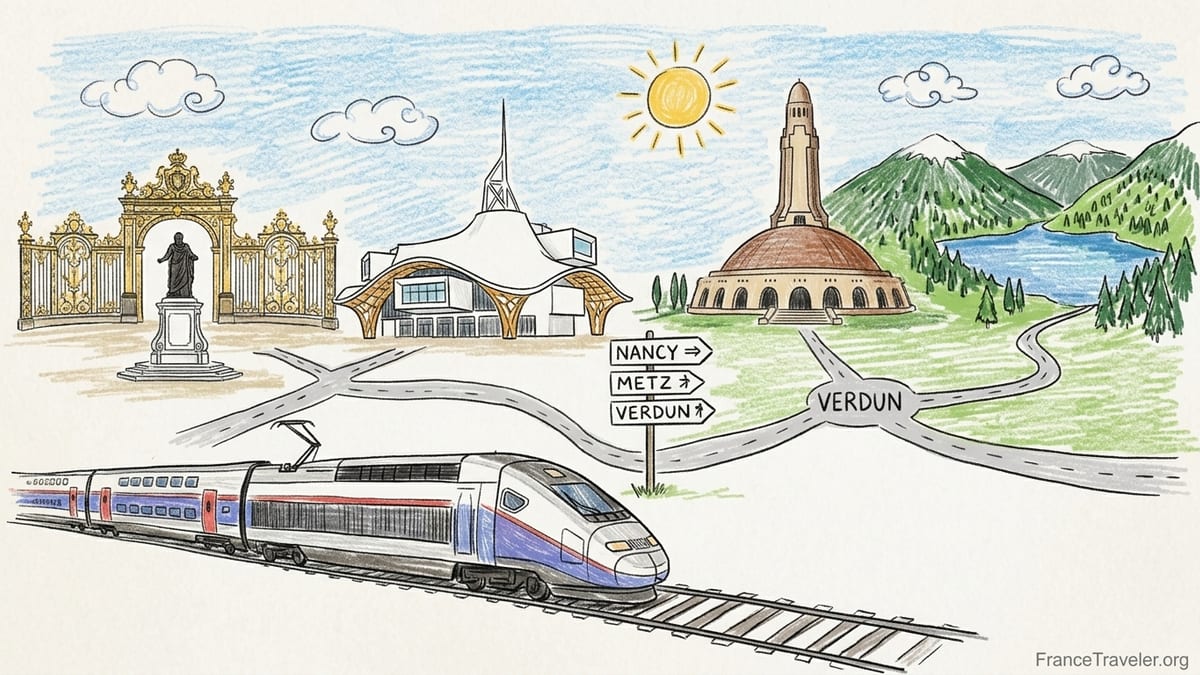
How Lorraine Fits Together: Distances, Trains and Smart Bases
On the map, Lorraine looks compact. In practice, the region stretches from the Belgian border near Verdun down to the Vosges mountains, and distances add up if you zigzag back and forth. Nancy and Metz, the two main cities, sit about 60 kilometres apart, linked by frequent trains that usually take around 35 to 45 minutes. Verdun lies roughly 1 hour 15 minutes by car from Metz and a bit longer from Nancy, on mainly motorway and national roads. Gérardmer, a classic Vosges resort on the largest natural lake in the massif, is about 1 hour 15 minutes by car from Nancy and about 1 hour 45 minutes from Metz. These are comfortable single hops, but trying to combine them all in two or three days means more time looking at windscreen wipers than at stained glass or mountain lakes.
A good Lorraine itinerary starts with the number of bases, not the number of sights. For a short 3-day stay, the most efficient strategy is a single base city, either Nancy or Metz, plus one long day trip, or Verdun as a focused base for memory tourism with one city tacked on by train. With 5 days, two bases work well, for example Nancy plus Metz, or Nancy plus the Vosges around Gérardmer. Once you reach 7 days, you can reasonably use up to three bases, but many travellers will still be happier with just two for example Nancy or Metz for the urban part and Gérardmer for the mountains shifting hotels only once in the middle of the trip.
Trains handle much of the city-to-city movement. High-speed and regional services connect Paris to Nancy and Metz in roughly 1 hour 30 minutes to 1 hour 50 minutes, often with several departures per day, and local TER trains bridge Nancy with Metz and smaller towns. Inside Nancy, the tram and buses cover most of what visitors need, while Metz is compact enough that you can walk from the main station to Centre Pompidou-Metz and on to the old town. A rental car becomes truly useful when you start adding Verdun’s scattered battlefield sites or the Vosges lakes and high ridges, where bus services are limited outside peak seasons.
For many visitors, the sweet spot is to arrive and depart by train, spend the first half of the trip car-free in the cities, then pick up a rental car only on the day you head toward Verdun or the Vosges. That keeps parking, tolls and fuel costs contained, and it makes evenings in Nancy or Metz more relaxed: you walk to dinner under the lamplight of Place Stanislas or along Metz’s riverfront instead of navigating unfamiliar ring roads after dark.
How Many Days Each Place Deserves
The hardest planning question in Lorraine is not whether to include Nancy, Metz, Verdun or the Vosges, but how much time to give each without overloading your schedule. Nancy, long a laboratory for Art Nouveau, rewards at least a full day and ideally two unhurried days. One day lets you see the UNESCO-listed trio of 18th-century squares centred on Place Stanislas and visit one major Art Nouveau site such as Villa Majorelle or the École de Nancy museum. A second day lets you follow a self-guided Art Nouveau walking circuit from the tourist office, explore neighbourhoods like Saurupt and Nancy Thermal, and take time for café and pastry stops instead of sprinting between façades.
Metz deserves similar respect. One full day is the bare minimum to experience the Gothic cathedral and its famed stained glass, stroll along the Moselle, and spend a meaningful block of time at Centre Pompidou-Metz, which typically hosts one or two major contemporary art exhibitions alongside smaller shows. A second day in Metz allows for a slower rhythm: perhaps a morning market, an afternoon in the museum’s galleries, and an evening at a performance if your dates match the cultural calendar. Reducing either Nancy or Metz to a two-hour photo stop in between motorways wastes what makes them special people-watching in their squares, discovering side streets of Art Nouveau or Wilhelminian architecture, and settling into local restaurants instead of grabbing another service-station sandwich.
Verdun is where travellers often misjudge timing. The town itself has a riverside centre and the moving Quay of the Citadel, but the heart of Verdun tourism lies in a vast ring of First World War sites north and east of town: Fort Douaumont and Fort Vaux, the Ossuary at Douaumont, the destroyed villages, and the battlefield zones that today resemble a landscape of soft green waves hiding shell craters and trenches. To visit only the main memorials in a very compressed way, you might manage in a long half-day, but most visitors who care about the subject will want at least a full day and ideally a day and a half to two days. That allows for time in the Verdun Memorial Museum, unhurried visits to the forts, and moments of quiet at the cemeteries instead of rushing from car park to car park.
The Vosges, anchored here by Gérardmer and nearby lakes, deserve at least one complete day and are best with two or three if you enjoy walking, cycling or winter sports. Lake Gérardmer itself is a glacial lake of roughly 115 hectares at about 660 metres altitude, ringed by forests and served by a mix of free shoreline paths and a supervised paid beach with changing facilities and pedal-boat rentals in season. Spending a day there means time to walk or cycle around the lake, pause for a waterside lunch, perhaps rent a kayak or stand-up paddleboard in the afternoon, then drive or take a shuttle up toward the ridgeline for viewpoints before sunset. With only a few afternoon hours, you likely see just the car park and the main promenade instead of the broader landscape of the Vosges.
Three-Day Lorraine: Choosing a Clear Focus
Three days in Lorraine is enough to fall for the region, but not enough to chase every highlight. The key is to choose a clear lens instead of attempting a sampler of everything. One approach is “Cities First”: base yourself in Nancy or Metz for all three nights, travel in and out by train, and rely on walking and public transport. From Nancy, you might spend Day 1 on Place Stanislas and the historic centre, Day 2 on Art Nouveau, and then use a half-day to hop by train to Metz, returning in the evening. From Metz, you could reverse the emphasis: Metz’s cathedral and modern arts hub one day, Nancy as the concentrated Art Nouveau pilgrimage the next, again linked by a short train journey.
A second three-day model is “Verdun plus one city,” more suitable for travellers with a strong interest in First World War history. In this version you might arrive in Paris early, take the train to Metz and pick up a rental car there, then drive on to Verdun for two nights. That gives you a full day between the forts, memorials and the Verdun Memorial Museum, with time in the evening along the Meuse. On the third day, you raid your remaining hours by driving back to Metz or Nancy, drop the car, and give yourself a concentrated afternoon and evening in one city, catching a late train back to Paris or staying a final night there before flying home.
Both models make a deliberate sacrifice. In three days you will not combine cities, Verdun, and the Vosges without long motorway sprints. Accepting that limitation is what keeps the trip pleasant. It is better to savour Villa Majorelle’s staircase details and then relax with a raspberry tart on a Nancy terrace than to stare at your watch before running for the next parking ticket deadline, knowing there is a two-hour drive still ahead.
Concrete costs also favour focus. A three-day car rental picked up in Paris and used to bounce from city to city before looping back might easily add several hundred euros in rental fees, tolls and fuel, plus hotel parking charges. A concentrated city stay using trains between Nancy and Metz and a single car rental day for Verdun or the Vosges will usually be noticeably cheaper and far more relaxing. Even when fuel prices drop, the mental cost of daily packing, unpacking and navigation remains.
Five Days: Adding Verdun or the Vosges Without Overload
Five days finally give enough breathing room to connect two of Lorraine’s pillars thoughtfully: the cities and either Verdun or the Vosges. A popular framework for first-time visitors is “Cities plus Verdun.” In this model, you might arrive in Nancy or Metz by train, spend two days sinking into urban life, then rent a car for two days around Verdun, with a final day back in the city. For example, you could sleep three nights in Nancy, use one day for the old town and squares, another for Art Nouveau sites and parks, then pick up a car and drive to Verdun early on Day 3. Sleep in Verdun that night, spend Day 4 completing the battlefield and museum circuit, then return the car in Metz on Day 5 and explore its cathedral and galleries before your evening departure.
Alternatively, five days can pair a city with the mountains and lakes. Think of this as “Nancy and the Vosges” or “Metz and Gérardmer.” One practical pattern is three nights in Nancy and two in Gérardmer. From Nancy, local trains give you a taste of regional towns, but you will likely rent a car when you head into the Vosges. Once in Gérardmer, you can leave the car parked for much of the day: stroll the lakefront in the morning, swim or rent pedal boats at the supervised beach, then walk part of the lakeside trail in the afternoon. In winter, lifts and shuttle buses connect the town to the ski slopes, turning the same base into an easy winter-sports hub.
What five days still does not handle well is a full triangle of Nancy, Metz and Verdun plus the Vosges. Trying to pack that combination in requires almost daily hotel changes and long drives that will likely leave you with fragmentary impressions of each place. The emotional weight of Verdun’s memorials also argues against treating them as a quick stop between a morning at a cathedral and an evening at a lakeside terrace. Having an entire day for the Verdun sector means you can pause, absorb, and reflect without watching the clock for your next check-in time.
With five days, meals and budgets also start to play into planning. Having at least two nights in each base city or town lets you try a mix of simple brasseries, bakeries and one or two more ambitious dinners rather than relying on convenient chains near motorway exits. In Nancy, for instance, you might balance a night of traditional quiche Lorraine and mirabelle tart with a more contemporary bistro that draws on the region’s beer and charcuterie. In Gérardmer, you can sample mountain dishes like tartiflette or local smoked meats one night and opt for a lighter lakefront fish dish the next, instead of eating hastily grabbed paninis between petrol stations.
Seven Days: Cities, Memory Tourism and Mountains in Balance
A full week in Lorraine is where the region’s breadth becomes a pleasure instead of a planning problem. Seven days allow you to combine the urban culture of Nancy and Metz, the solemn history of Verdun, and the outdoor world of the Vosges without constant movement. Most travellers will find two or at most three bases enough for a week: for example, four nights split between Nancy and Metz for city and culture, plus three nights at Gérardmer or another Vosges base. Verdun can sit between them for one or two nights, or be handled as a very long day trip by car from Metz if you prefer fewer hotel moves.
One balanced seven-day framework starts with three nights in Nancy, followed by two nights in Verdun and two in Gérardmer. You arrive in Nancy by train, settle into a central hotel, and spend the first day on the UNESCO-listed squares and parks, the second on Art Nouveau routes and museums, and the third on a quick TER trip to Metz or a side visit to a smaller Lorraine town. On Day 4 you pick up a rental car and drive to Verdun, stopping at quieter countryside villages en route. Day 5 is fully devoted to Verdun’s forts, ossuary and memorial museum, with a relaxed dinner back in town. On Day 6 you cross the region diagonally into the Vosges, reach Gérardmer by early afternoon and stretch your legs along the lake. Day 7 can then be completely about the outdoors: a mountain walk, lakeside cycling, or in winter a half-day on skis before heading out for your next destination.
Another seven-day model puts city-and-culture at the core. Think of this as “Nancy and Metz in depth plus day trips.” In this version you base three nights in Nancy and four in Metz, or vice versa, handling Verdun as a concentrated full-day excursion by rental car from Metz and the Vosges as a one-day mountain escape by car or organized transport from Nancy. This approach suits travellers who prefer urban comforts restaurants, bookshops, evening performances over multiple hotel changes and rural evenings. It also works better for off-season travel when some mountain lifts and lake activities may run on limited schedules, as you still have museums and exhibitions as your daily anchors.
Crucially, a week gives you space for unscheduled time. You might decide to spend an extra afternoon following an Art Nouveau walking itinerary in Nancy after spotting a neighbourhood that catches your eye, or linger in Metz’s riverside gardens with a takeaway picnic instead of rushing to the next sight. You can also respond more calmly to weather. If a day in the Vosges begins with rain and low cloud, you might shift your high-ridge hike to the following day and instead choose a lower lakeside walk, a spa session in a nearby thermal town, or quiet reading in a mountain café.
Financially, seven days make weekly apartment rentals or long-stay hotel offers more attractive, especially in cities. Staying put in a small apartment in Nancy’s centre or in Metz’s Imperial Quarter for four or five nights might cost no more than three nights in a chain hotel plus the accumulated expenses of constant restaurant meals and parking fees. In the Vosges, many chalets and guesthouses quote prices per week, and while you may not stay the full seven nights in the mountains, even a four-night stay can unlock discounts compared with short one-night bookings.
Models for Different Types of Travellers
First-time visitors usually benefit from a structure that showcases Lorraine’s variety without overcomplication. A strong first-timer model with five to seven days could be three nights in Nancy, two in Verdun and two in Gérardmer. This pattern introduces you to Nancy’s heritage squares and Art Nouveau, places Verdun’s history at the centre for a couple of days, and then finishes with the restorative landscapes of the Vosges. A shorter three-day first visit might simply be Nancy plus a rail day trip to Metz, giving you a reason to return for Verdun and the mountains.
WWI-history travellers, on the other hand, will flip the emphasis. They might choose Verdun as their primary base, with three or four nights there to explore not only the major forts and ossuary but also the Meuse-Argonne area, smaller cemeteries and lesser-known positions in the forest, using a rental car for flexibility. In this model, Nancy or Metz serves as either the arrival and departure point or as a one- or two-night bookend focused on rest and reflection rather than sightseeing checklists. Because battlefield days can be emotionally heavy, building in at least one lighter day in a city park or riverside promenade helps balance the trip.
City-and-culture travellers will likely ignore the mountains altogether on a first visit and see Verdun as optional. They might spend three nights in Nancy and two in Metz over five days, or four and three over a week, traveling between them by train. Their days will revolve around interiors and neighbourhoods: Art Nouveau house museums, contemporary exhibitions at Centre Pompidou-Metz, theatre or opera performances when available, and café-hopping in the old quarters. A car becomes unnecessary or even inconvenient in this model, as parking costs can add up near historic centres and public transport is sufficient for local movement.
Families will care more about simple logistics, playgrounds, and easy food options than about squeezing in every museum. A family-friendly five-day model might see two or three nights in Nancy, visiting the squares, parks and perhaps a tram ride for novelty, then two or three nights in Gérardmer, where children can paddle at the supervised lakeside beach, ride pedal boats, and walk short woodland trails without long car journeys. Verdun can be included for older children with interest in history, but even then, keeping the battlefield programme to one carefully chosen day with a good mix of outdoor and indoor stops usually works better than multiple intense days.
Active and outdoor travellers will treat towns mostly as gateways. Their ideal week might include one or two nights in either Nancy or Metz for initial orientation and supplies, then five or six nights in the Vosges, either all in one place such as Gérardmer or split between different valleys. That structure allows for hiking to lakes like Longemer and Retournemer, road cycling along ridge roads, trail running, or winter skiing and snowshoeing, all without repeated long transfers. Many mountain accommodations provide early breakfasts, storage for bikes or skis, and local advice about trail conditions, making a single extended stay more rewarding than a string of one-night hotel stops.
Practical Planning: Bases, Transport and Seasonality
Deciding how many bases to use is partly about temperament, but also about the realities of check-in times and packing. Each hotel move usually consumes half a day when you count packing, checking out, driving, parking, and checking in again. In a three-day trip, adding even one hotel change can eat into your limited hours. For 3 days, plan on 1 base. For 5 days, 1 or 2 bases is ideal. For 7 days, aim for 2 bases with a possible third only if your routes are very direct, such as Nancy, Verdun, and Gérardmer in sequence without backtracking.
As you sketch your itinerary, mark which days are car days and which are train or walking days. City blocks such as “Nancy deep dive” or “Metz galleries and cathedral” work best with no car, taking advantage of compact centres and public transport. Verdun and the Vosges, by contrast, are easier with a car, since battlefield sites and lakes are spread across countryside where public buses are sparse or seasonal. A schedule that alternates modes city on foot, then car-based countryside, then city again reduces the feeling of living in the driver’s seat, and allows different travellers in a group to enjoy different parts of the trip more fully.
Seasonality matters, especially for the Vosges and some Verdun sites. In summer, Gerardmer’s lakeside facilities are usually fully open, with lifeguarded swimming zones, rental pedal boats and small electric craft, and busy lakefront cafés. Public holiday weekends can be crowded, so booking accommodation several months ahead is wise if you want lakeside rooms or family apartments. In winter, the focus shifts uphill to ski areas and snowshoe trails, and some lakeside services operate on reduced schedules, although the scenery remains dramatic. Spring and autumn bring quieter paths, ideal for walking or cycling, but you should check ahead which mountain lifts or activity providers are open on your intended dates.
Verdun and its memorials are visitable year-round, but shorter winter daylight and colder weather might limit how many outdoor stops feel comfortable in a day. Planning a long lunch break inside the Verdun Memorial Museum on a cold day, or starting at the Ossuary and forts in the morning and finishing with indoor museum time in the afternoon, helps make the day more manageable. In summer, carrying water and sun protection becomes important, as many battlefield clearings offer limited shade even though the surrounding forest looks dense.
Finally, consider arrival and departure flows. Paris provides the main international gateway for many visitors, with direct high-speed trains to Nancy and Metz. Some choose to rent a car immediately in Paris and drive, but for a trip focused on Lorraine, it often makes more sense to step straight onto the train, arrive rested in Nancy or Metz, and only then rent a car locally for the countryside phases. That way, you avoid the stress of Paris ring roads on your first day and keep toll and fuel costs aligned with the days when a car adds real value.
The Takeaway
Lorraine rewards travellers who accept its breadth instead of racing to conquer it. Three days ask you to pick a side: either immersive city time in Nancy and Metz, or a Verdun-centred journey with a single city window. Five days let you add either the battlefields or the Vosges without constant hotel changes, while seven days finally open up a satisfying blend of cities, memory tourism and mountain lakes. Throughout, the trick is to keep bases few, to use trains where they are strongest, and to bring in a rental car only when distances and rural sites require it.
Verdun merits at least a full day and for many travellers up to two, not as a rushed stop at one ossuary but as a landscape of forts, destroyed villages and museums that tell a story best absorbed at human speed. The Vosges deserve at least one entire day simply to feel what makes Lake Gérardmer and its forested ridges so beloved, and even active travellers with a week to spare will find more trails and lakes than they can cover. Nancy and Metz, meanwhile, are not motorway exits, but living cities whose Art Nouveau façades, Gothic stonework and contemporary galleries repay slow mornings and long evenings.
Approach Lorraine as a region to inhabit rather than a checklist to complete. Sit a little longer on Place Stanislas before catching your train, give yourself time to walk the lakeshore rather than just photograph it, and leave at least one thing undone so that your route across northeastern France is the beginning of a relationship with Lorraine, not the final word.
FAQ
Q1. Can I visit Nancy and Metz in one day using the train?
Yes, it is feasible to see both in a day because the train ride between them is often around 35 to 45 minutes, but that turns each city into a quick sample. For a richer experience, it is better to give at least one full day to each, either on separate days or with an overnight stay.
Q2. How many days do I really need in Verdun for the WWI sites?
You can see the main memorials in a long half-day, but most visitors interested in history appreciate at least a full day, and often a day and a half to two days, to combine the Verdun Memorial Museum, the major forts and cemeteries without feeling rushed.
Q3. Do I need a car to explore Lorraine, or can I rely only on trains?
Trains work very well for moving between major cities such as Nancy and Metz, and for getting to and from Paris. For Verdun’s battlefield sector and for the Vosges mountains and lakes, a rental car is much more practical because sites are widely spread and local public transport can be limited.
Q4. Is it realistic to add the Vosges on a three-day Lorraine trip?
It is technically possible, but usually not enjoyable. Reaching Gérardmer and back from either Nancy or Metz already takes a large portion of a day. With only three days, most travellers are better off focusing on cities or on Verdun plus one city, and saving the Vosges for a longer visit.
Q5. When is the best season to combine cities, Verdun and the Vosges?
Late spring through early autumn works best for combining all three, because lake activities and mountain trails in the Vosges are more accessible and daylight is longer for battlefield visits. Winter is ideal for a mix of city culture and Vosges snow activities, with Verdun remaining visitable but colder and shorter in daylight.
Q6. How many hotel bases should I plan for a seven-day Lorraine itinerary?
Two bases are usually enough for a week, for example one in the city such as Nancy or Metz and one in the Vosges around Gérardmer. A third base in Verdun can work if you place it logically in sequence, but more than three bases tend to fragment the trip.
Q7. Is Nancy or Metz better as a first base in Lorraine?
Both are excellent. Nancy shines for Art Nouveau and atmospheric squares, while Metz combines a major Gothic cathedral with a high-profile contemporary art centre. If your train from Paris arrives earlier at one than the other, that can be the tie-breaker, and you can still visit the second city on a day trip.
Q8. Can families with young children enjoy Verdun, or is it too intense?
Families with older children who already have some context for the First World War often find Verdun very meaningful. With younger children, it can be emotionally heavy and logistically demanding, so many families either shorten the Verdun programme to one carefully chosen day or focus more of their time on the cities and the Vosges lakes.
Q9. Are the Vosges worth visiting if we are not serious hikers?
Yes. Around Gérardmer and nearby lakes there are plenty of short, mostly flat lakeside walks, supervised swimming areas in season, pedal-boat rentals and scenic drives that require little or no strenuous hiking. The atmosphere of the forests and water is a major part of the appeal, even on very gentle outings.
Q10. How should I split my time between Nancy and Metz on a five-day city-focused trip?
For a five-day city-and-culture trip, a good balance is three nights in Nancy and two in Metz, or the reverse. That gives you at least one full day in each city plus one extra day to repeat a favourite area, visit a smaller museum, or make a quick side trip without feeling that you are constantly in transit.