


I arrived in Lorraine on a grey afternoon TGV from Paris, stepping off at Nancy’s central station with a four-night plan, a small suitcase, and what I realised later was a very imperfect itinerary. I split my stay between Nancy and Metz, travelling by regional train and one short rental-car loop through Verdun and the Vosges. In the end, I saw four very different faces of Lorraine: elegant Nancy, monumental and more modern Metz, the sombre hills above Verdun, and the quieter green world around the Vosges lakes. What follows is both a guide and a debrief of what worked, what did not, and how I would structure the trip next time.
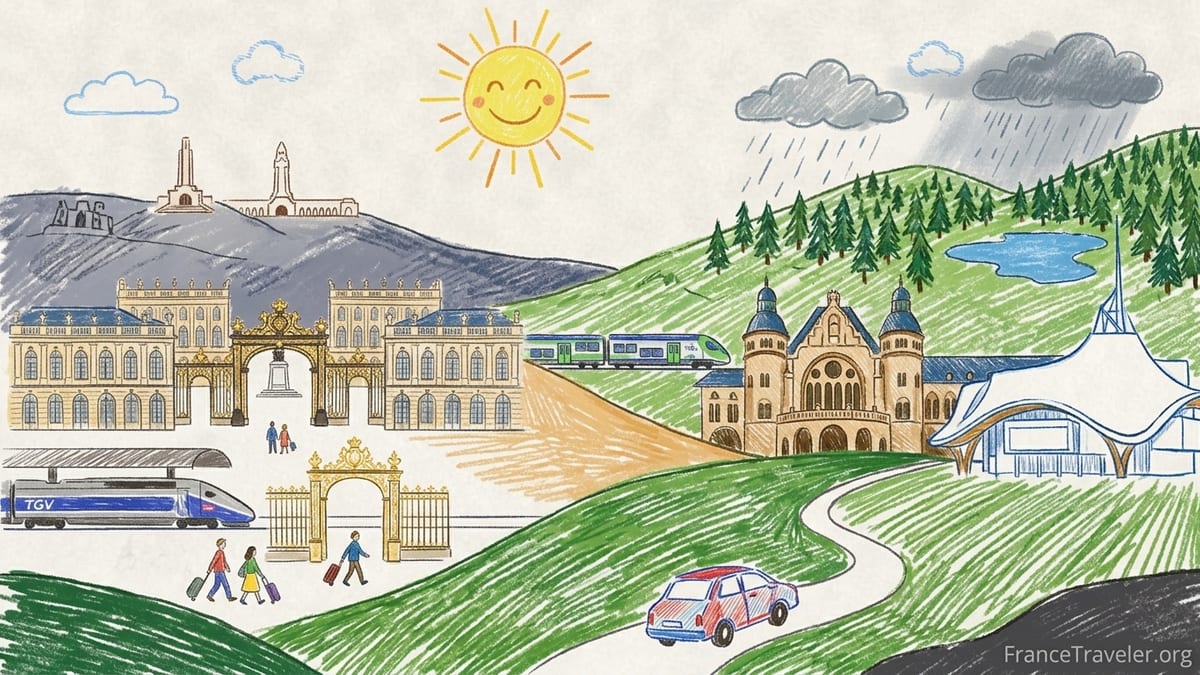
Setting Up the Trip: Trains, Bases and First Impressions
I used Nancy as my initial base, arriving from Paris Gare de l’Est by direct TGV. The journey took around 1 hour 30 minutes, with trains sliding into Nancy’s central station just a few minutes’ walk from Place Stanislas. The convenience is striking: one minute you are stepping off a high-speed train, the next you are wheeling a suitcase past café terraces and the gilded gates of what many consider one of Europe’s most beautiful squares. I stayed two nights in Nancy, two nights in Metz, and added a one-day loop by rental car to cover Verdun and the edge of the Vosges. In hindsight, that loop tried to do too much in a single day.
Within Lorraine, I relied mostly on regional TER trains between Nancy and Metz, which run roughly every 30 to 60 minutes during the day and take about 35 to 45 minutes. The ride is short yet surprisingly revealing. Leaving Nancy, the line passes low industrial suburbs and allotment gardens, then a patchwork of gentle farmland and small towns before rolling into Metz, where the tracks slide past the bold roofline of Centre Pompidou-Metz and the grand stone bulk of the 19th century station. That contrast between cities, and between city and countryside, became the theme of the trip.
For Verdun and the Vosges, I rented a small car from near Nancy station for 48 hours. Verdun itself is reachable by train and bus, but the main battlefield sites such as the Verdun Memorial and Fort Douaumont sit on the hills above town and are far more practical with a car. Likewise, the lakes and passes of the Vosges, including destinations like Gérardmer and the Ballons des Vosges Regional Nature Park, are linked by buses but on limited schedules, especially outside peak summer. A car made it possible to string several stops together in one day, even if I underestimated driving fatigue and time lost on winding mountain roads.
Weather played its part from the start. Nancy greeted me with low clouds and a chill wind in early autumn, temperatures around 12 to 15 degrees Celsius in the day, dropping into single digits at night. Two days later Metz was bathed in soft sunshine. By the time I reached the hills around Verdun and the Vosges, mist, drizzle and sudden bright spells took turns, changing the mood of the landscape from one hour to the next. Lorraine rarely feels extreme, but it can feel very different within the span of an afternoon.
Nancy: Golden Squares and Art Nouveau Surprises
Nancy is often summarized as “Place Stanislas and Art Nouveau,” and that shorthand is accurate yet incomplete. My hotel was five minutes’ walk from the square, so my first evening began with the natural pilgrimage to Place Stanislas. Enclosed by harmonious 18th century facades and ornate wrought-iron gates edged in gold leaf, the square is traffic-free and feels both theatrical and surprisingly lived-in. Children chased each other around the fountains, terraces filled with after-work drinks, and by dusk the lighting warmed the pale stone into soft amber. I had expected a handsome French square. I had not expected it to feel quite so coherent or so human in scale.
The next morning I walked the short distance to the Musée des Beaux-Arts, also on Place Stanislas, partly for the paintings and partly for its collection linked to the École de Nancy movement. Inside, rooms of European art open onto spaces where Art Nouveau glassware, furniture and decorative objects show off the region’s craftsmanship. Later, in a drizzle, I headed toward the dedicated Musée de l’École de Nancy and Villa Majorelle in the western part of the city. Even before reaching them, everyday streets hinted at the period: bowed balconies, organic ironwork and floral stone carvings on residential buildings that would be easy to miss without looking up.
What surprised me most about Nancy was how far the beauty extended beyond its postcard square. An Art Nouveau walking leaflet from the tourist office turned the city into an open-air gallery. Streets around Rue Félix Faure or Saurupt revealed whole blocks of sinuous façades. Even less polished areas, such as those near the station, contained individual architectural gems. Yet despite this, Nancy felt compact and manageable. I rarely needed public transport within the centre, and walking from the train station to Place Stanislas, the old town around Place Saint-Epvre, and the Parc de la Pépinière behind it was easy in a single afternoon.
There were small frustrations. Restaurant hours followed the familiar French pattern: many kitchens closed between roughly 2 pm and 7 pm, and on one rainy afternoon I found myself wandering slightly hangry, rejected by several brasseries that had already shut their lunch service. Evenings, though, the city centre had a relaxed, local energy. Terraces around Place Stanislas and nearby streets were busy but not hectic, and by 11 pm the atmosphere tended toward quiet conversation rather than nightlife. For some travellers that calm will be ideal; others expecting late-night buzz might find it subdued.
Metz: Monumental Stone, Light and Contemporary Lines
Arriving in Metz by TER from Nancy is a study in contrast. The train rolls into one of France’s most admired stations, a long sandstone building that reflects the city’s early 20th century annexation by the German Empire. Stepping out, you face broad avenues, bold lines and an urban scale that immediately feels more monumental than Nancy’s intimate centre. Crossing under the tracks toward Centre Pompidou-Metz, the city suddenly flips into contemporary mode, with the museum’s sweeping wooden roof, white forms and glass surfaces drawing the eye from blocks away.
Inside Centre Pompidou-Metz, the real attraction is as much the architecture as the exhibitions. The museum’s three rectangular galleries run like beams through the building, their ends jutting beyond the roof with huge picture windows aimed at Metz’s landmarks. From these, you can frame the Gothic Saint-Étienne Cathedral, the station or the Parc de la Seille like photographs in the landscape. The roof’s timber lattice, inspired by a traditional Chinese hat, creates dappled light on the plaza, and walking its perimeter you feel how intentional the dialogue is between old and new city. It was far more interesting as a piece of architecture than I had imagined from photos alone.
The cathedral, however, is where Metz truly startled me. Saint-Étienne is famous for its stained glass and often described as a “lantern” of Gothic architecture. Inside, the effect is almost disorienting: vast walls of coloured glass, some medieval, some from the 20th century by artists like Marc Chagall, pour filtered light into a space that seems taller than its footprint should allow. Compared with Nancy’s classical stone, Metz’s cathedral and surrounding old town are all about verticality and drama. I found myself returning twice, once in bright sun and once on a cloudier morning, just to see how the light changed the interior.
Beyond these headline sites, walking in Metz revealed another layer: the Imperial Quarter and old ramparts. Streets lined with sturdy buildings in yellow Jaumont stone suddenly give way to German-style mansions, rounded turrets and wider boulevards. A short walk brought me to the riverside near the Temple Neuf, a church on an island in the Moselle that looks almost storybook from certain angles, especially in late afternoon light. Parks and river paths softened the city’s monumental feeling, and within a day or two I began to appreciate Metz as a place where several eras of architecture coexist more visibly than in Nancy.
On the practical side, I noticed Metz’s evenings felt quieter in some central streets than Nancy’s, at least mid-week. Around the cathedral and Place Saint-Louis there were lively terraces, but by 10:30 pm several areas had already wound down. Restaurant hours again required planning. A couple of places near Centre Pompidou-Metz offered continuous service or later hours, but in the old town I ran up against 2 pm lunch cut-offs and needed to adjust to earlier dinners than I might have chosen elsewhere. That said, the overall impression was of a city that takes its time rather than a nightlife hub.
Verdun: Roads, Battlefields and Emotional Fatigue
From Nancy, I drove to Verdun early one morning, taking the A31 and A4 motorways for most of the approximately 120 kilometre route. Under light traffic and in dry weather, the journey took about 1 hour 30 minutes, plus a brief coffee stop at a service area. Leaving the motorway at the Verdun exit, the road narrowed and began to climb toward the wooded ridges where the First World War battlefield unfolded. Almost immediately, the landscape changed character: denser forest, fewer villages, and occasional war cemeteries appearing without warning beyond the trees.
My plan was ambitious: town centre, Verdun Memorial, Fort Douaumont, a cemetery and a short hike between trench lines, all in a single day. I quickly realised this was unrealistic. The Verdun Memorial, one of the main interpretive centres for the battle, deserves at least two slow hours on its own. Displays of soldiers’ belongings, weaponry and personal letters are detailed and, in some cases, harrowing. Outside, the view over the former battlefield is deceptively peaceful, with rolling green slopes hiding shell craters under the grass. By the time I left, I already felt mentally fatigued.
A short drive away, Fort Douaumont and other positions on the heights add another layer of intensity. Dark corridors, concrete chambers and the knowledge of what took place here during months of fighting can be overwhelming. Standing on the roof of the fort, looking out at quiet woods in hazy afternoon light, I found myself unable to take in much more information. I had planned to add a longer walk and more small sites, but in the end I limited myself to a brief stop at a cemetery and then rolled back down toward Verdun town for an early evening meal.
This was my main mistake in Lorraine: I had allocated a single day to Verdun, treating it as a side trip instead of its own destination. The result was a feeling of rushing through one of Europe’s most powerful historical landscapes. Emotionally, the experience was also more demanding than I had expected. By late afternoon I wanted somewhere quieter and more neutral simply to process it all, but had to face a drive back toward my next base instead. Next time I would either give Verdun at least one night, or deliberately choose fewer sites and accept that some would remain unseen.
The Vosges: Lakes, Passes and Quieter Villages
On my second day with the rental car I pointed the nose toward the Vosges, leaving Lorraine’s cities behind for a loop toward one of the region’s lakes and passes. From Nancy to the area around Gérardmer, often described as the largest natural lake in the Vosges at around 660 metres altitude, the drive took roughly 1 hour 30 minutes to 2 hours depending on stops. Initially, the road passed familiar suburban zones and light industry, but beyond Épinal the landscape folded into forested hills, pastures and smaller villages with steep roofs and flowered balconies.
Reaching the lake, the atmosphere was very different from Nancy and Metz. Even in shoulder season, the waterside promenade had a holiday feel: pedal boats pulled up on pebbled shores, small sailing boats on the water, and cafés with simple terrace menus heavy on tartes flambées and regional dishes. Behind that, footpaths climbed quickly into woods of spruce and beech. Trails around the lake’s edge offered easy walking, while routes toward higher viewpoints hinted at the more serious hiking of the Ballons des Vosges Regional Nature Park, with well-marked circuits to passes like the Col de la Schlucht and summits such as the Ballon d’Alsace.
Here, the quiet was of a different order. Away from the lakefront, villages felt almost suspended between seasons. Afternoon closures became more pronounced: bakeries shutting by early afternoon, restaurants with limited evening service on certain weekdays, and supermarkets closing earlier than in the cities. I misjudged this more than once, ending up with a picnic from the last open boulangerie instead of the warm restaurant meal I had imagined after a hike. Parking was generally easy and often free around trailheads and lake car parks, though in peak summer spaces closest to the water reportedly fill quickly on sunny weekends.
Driving mountain roads introduced its own fatigue. Distances on the map looked modest, but hairpin bends, slow-moving farm traffic and occasional roadworks stretched journeys. What I had planned as a leisurely loop of lakes and viewpoints became a more concentrated triangle of one lake, one high pass and a return route, with fewer spontaneous detours than I had hoped. The compensation was in the changing light: late afternoon sun striping through tall forests, mists rising from hollows after a brief shower, and views from the ridges where Lorraine’s wooded hills fell away toward the plains.
Between Cities and Countryside: Rhythm, Weather and Museum Fatigue
Spending time in both Nancy and Metz, then driving out into Verdun’s heights and the Vosges, made the internal contrasts of Lorraine impossible to ignore. Nancy’s centre felt walkable, elegant and animated in the early evening, with a dense cluster of cultural sites like the Musée des Beaux-Arts, Musée de l’École de Nancy and Villa Majorelle all within a short tram or bus ride. It is easy to fill a day or two with architecture and museums without ever leaving the urban grid. Metz, while also compact, presented its heritage on a grander scale, anchored by the cathedral, the Imperial Quarter and the striking silhouette of Centre Pompidou-Metz.
That abundance of cultural sites did produce another form of fatigue: museum overload. On one rainy day I tried to combine the Musée des Beaux-Arts in Nancy in the morning with Centre Pompidou-Metz and the Musée de la Cour d’Or in Metz in the same afternoon. By the time I reached the latter, a museum devoted to the city’s archaeological and historical collections, my attention span was spent. Panels blurred, details slipped away, and what should have been a fascinating visit became a dutiful march through galleries. In retrospect, it would have been better to limit myself to one major museum per day and leave space for simple walks or café time in between.
Weather changes within short distances shaped mood and planning. On a single day it was possible to leave Metz under clear skies, encounter low cloud and drizzle near Verdun, and then catch bright clear pockets in the Vosges within a few hours of driving. Travellers should pack for cool evenings and the possibility of rain, even in late spring and early autumn, and accept that views from higher passes may be partially hidden behind mist at times. That variability, however, also lends the region a certain softness, with landscapes often shrouded or revealed in a way that feels distinct from the sharper light further south in France.
Perhaps the most striking difference was how much quieter rural Lorraine became after leaving the cities. Between Nancy and Metz, the train passed active industrial zones and commuter towns. Around Verdun, roads sometimes yielded ten-minute stretches without seeing another vehicle, especially on side routes connecting smaller memorials. In the Vosges, once off the main approaches to the more popular lakes, I drove through hamlets where the loudest sound was usually cowbells or wind in the trees. For travellers used to denser regions of France, this relative emptiness will either feel wonderfully calm or slightly disorienting.
Mistakes, Frustrations and What I Would Change
Looking back, a few choices stand out as mistakes. The most significant was compressing Verdun’s battlefields into a single day and trying to pair them with a substantial drive on either side. The emotional impact of the Verdun Memorial, Fort Douaumont and associated cemeteries is cumulative and heavy. By early afternoon I found myself saturated, yet still facing a list of “must see” sites and a return drive. In the end I did less than planned and still felt exhausted. If I could redo it, I would book at least one overnight in or near Verdun, split the visits over two half days and allow space for quiet reflection in between.
Using one city as a base for too many day trips was another miscalculation. Staying in Nancy while making a long triangular drive to Verdun and a corner of the Vosges in quick succession meant more time on the road and less time actually on foot in villages or on trails. The distances themselves were not extreme, but the combination of motorway stretches, smaller regional roads and then winding mountain routes added up. I arrived back in town more tired than fulfilled on at least one evening. A better approach would have been a simple pattern of two bases plus one or two short hops, instead of forcing everything into reach of a single hotel room.
On the smaller scale, I underestimated the strictness of restaurant hours outside the big cities. In Nancy and Metz, it was usually possible to find at least one brasserie or chain open outside classic meal times, especially near stations and main squares. In Verdun’s surrounding hills and the Vosges villages, by contrast, missing the midday window often meant no hot meal until evening. One day, a hike ran long and I returned to the village around 2:30 pm to find every restaurant closed and the small supermarket about to shut. Lunch became a mix of bread, cheese and fruit eaten on a bench. Pleasant in its own way, but not what I had imagined.
There were also minor dislikes. A few of Nancy’s more famous Art Nouveau addresses, such as certain restaurants, felt both crowded and a little overpriced for the quality of the food, trading heavily on their architectural setting. In Metz, modern developments around the station and Centre Pompidou-Metz sometimes felt half-finished, with empty ground-floor spaces and broad pavements that lacked the life of the old town. None of these were serious problems, but they were reminders that even much-loved destinations are real cities, not curated open-air museums.
The Takeaway: How I Would Structure Lorraine Next Time
If I were to plan this Lorraine trip again, I would keep the same ingredients but change the proportions. I would still arrive by TGV into Nancy, stay two or three nights, and give myself time to enjoy Place Stanislas at different hours, follow an Art Nouveau walking route and visit at most one major museum per day. From there I would take the TER to Metz for at least two nights, concentrating on the cathedral, the Imperial Quarter, Centre Pompidou-Metz and riverside walks, again resisting the temptation to overpack the schedule with museums.
For Verdun, I would now plan one or two nights based either in Verdun town or on the heights, renting a car locally if possible. The first half day would focus on the Verdun Memorial and a small number of nearby sites. The second half day would add Fort Douaumont and one or two cemeteries or viewpoints, with space in between for unstructured time. This slower pacing would respect both the geography and the emotional weight of the place far better than my rushed original circuit.
The Vosges would become its own short chapter rather than a hurried detour. Instead of attempting an ambitious loop, I would pick a single base town near a lake or trail network, perhaps Gérardmer or a similar resort, for two or three nights. From there, day hikes to lakes, ridges and passes could be tailored to the weather and energy levels without long daily drives. Knowing now how early shops and restaurants can close, I would plan ahead for meals and carry backup picnic supplies so that a missed lunch window becomes part of the adventure rather than a stress point.
In the end, what I learned in Lorraine is that this region rewards depth more than breadth. Nancy’s elegance, Metz’s mix of Gothic stone and bold modern lines, Verdun’s sombre hills and the green calm of the Vosges are all close on the map but profoundly different in feel. Rushing between them blurs those distinctions. Allowing time to notice how the light falls on Place Stanislas at night, how stained glass transforms Metz Cathedral’s interior, how quiet the forests above Verdun can be, or how a Vosges lake reflects passing clouds will leave a more lasting impression than any checklist. Next time, I will travel less in kilometres and more in hours spent simply being there.
FAQ
Q1. How many days do I need to see Nancy and Metz properly?
For a first visit, plan at least two full days in Nancy and two full days in Metz. This allows one major museum or site per day, plus time to walk the historic centres, enjoy evening terraces and avoid the feeling of rushing between attractions.
Q2. Is it better to use trains or rent a car in Lorraine?
For travel between Nancy and Metz, and for staying within each city, trains and walking are usually best. Regional TER services are frequent and fast between the two. A rental car becomes useful if you want to explore Verdun’s battlefields in depth or hike in the Vosges, where sites are more spread out and public transport schedules are limited.
Q3. Can I visit Verdun as a day trip from Nancy or Metz?
It is physically possible by car, but often unsatisfying. The main memorials and forts deserve unhurried visits, and the emotional impact can be intense. Many travellers find that at least one overnight in or near Verdun allows a more thoughtful experience and reduces driving fatigue.
Q4. What is the train journey like between Nancy and Metz?
The TER train ride takes roughly 35 to 45 minutes and runs through gentle countryside with small towns and fields between the two cities. Trains usually arrive directly into each city’s central station, both of which are within walking distance of key sights, so it is a convenient and relaxed way to travel.
Q5. Do I need a car to enjoy the Vosges from Lorraine?
You can reach some Vosges towns by train and bus, but services may be infrequent, especially outside peak seasons. A car gives far more flexibility for reaching lakes, trailheads and high passes in a single day. If you prefer not to drive, consider focusing on one base with good public transport links and planning a smaller number of hikes.
Q6. Are Nancy and Metz lively in the evenings?
Both cities have pleasant evening atmospheres, with café and restaurant terraces busy around the main squares and old town streets. Nancy tends to feel slightly more animated later into the evening near Place Stanislas and surrounding areas, while Metz’s centre can become quieter earlier, especially on weekdays. Nightlife is present but not the main draw in either city.
Q7. How strict are restaurant hours in Lorraine?
In city centres you will generally find lunch service from around 12 pm to 2 pm and dinner from about 7 pm to 10 pm, with kitchens closed in between. Outside the cities, especially in smaller villages near Verdun and in the Vosges, missing the midday window often means no hot meal until evening. It is wise to plan mealtimes and carry snacks or picnic supplies for more remote days.
Q8. When is the best time of year to visit Lorraine?
Late spring and early autumn are particularly appealing, with mild temperatures and fewer crowds. Summer brings warmer weather and more activity around Vosges lakes but can be busier. Winters are colder and darker, though city sights remain open and the region has a quieter, more introspective feel, especially around Verdun.
Q9. How does the weather vary between the cities and the countryside?
Nancy and Metz often share similar temperatures, but nearby hills, Verdun’s heights and the Vosges can be cooler and wetter. It is common to encounter sunshine in one place and low clouds or drizzle in another within a short drive. Layers, a light waterproof jacket and good walking shoes are recommended year-round.
Q10. What are the main differences between Nancy and Metz for visitors?
Nancy is known for its harmonious 18th century architecture, centred on Place Stanislas, and a strong Art Nouveau heritage woven through residential neighbourhoods. Metz feels more monumental, with its towering Gothic cathedral, visible layers of French and German influence in the Imperial Quarter and a striking modern side around Centre Pompidou-Metz. Experiencing both offers a clear sense of Lorraine’s varied history and identity.