


I did not go to Verdun to tick off another World War I site. I went because the name had hovered at the edge of my understanding of history for years, paired with words like “meat grinder” and “attrition” that never quite translated into anything human. Spending one full day moving between the Verdun Memorial, the Douaumont Ossuary, the surrounding battlefield, the Underground Citadel and the World Centre for Peace forced me to confront that gap between abstract knowledge and the physical reality of where so many lives were lost.
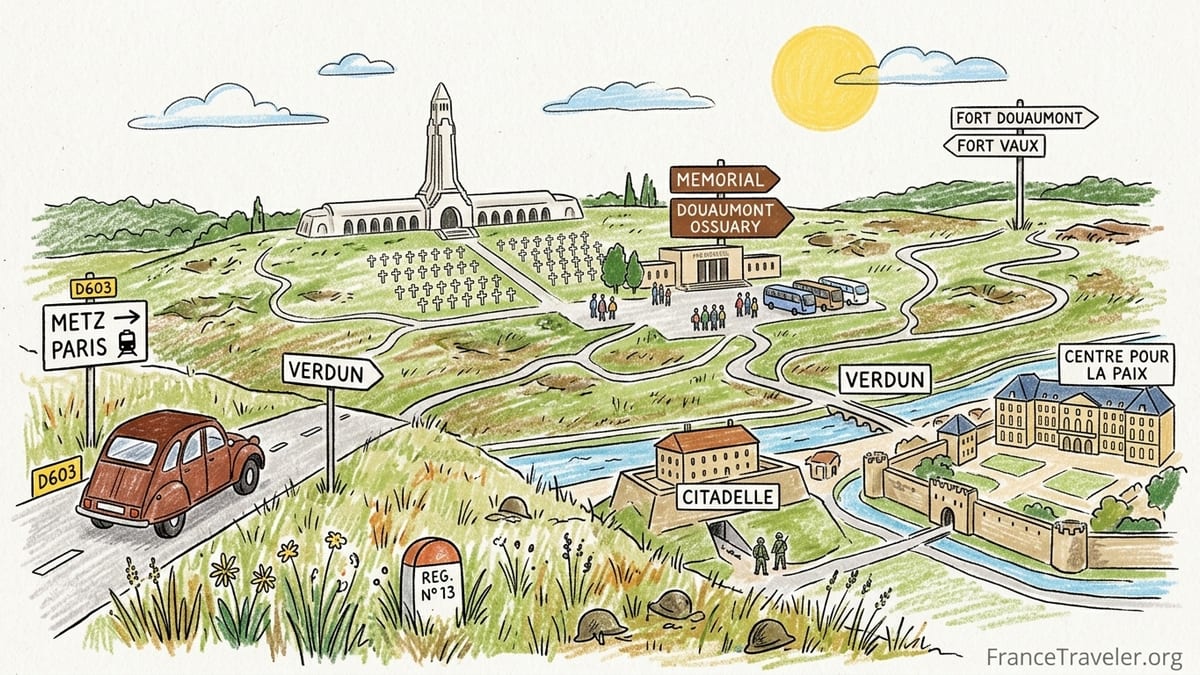
Getting to Verdun and Planning a One-Day Visit
I visited Verdun in September 2026 as a day trip from Metz, where I was staying. I rented a small car from Metz railway station and drove the roughly 60 kilometers along the A31 and D603, which took just under an hour in light morning traffic. Trains also connect Paris to Verdun with a change, and there are organized battlefield tours, but having a car made it possible to move between the dispersed sites on my own schedule.
I left Metz at about 8:15 a.m. and was parked at the Verdun Memorial a little after 9:30 a.m., just after it opened at 9:30 a.m. in the high season. According to the 2026 schedules published by the Memorial and the local tourist office, the Verdun Memorial, Fort Douaumont and Fort Vaux all operate from 9:30 a.m. to either 5:30 p.m. or 6:30 p.m. depending on the season, with last entry at the Memorial 45 minutes before closing. I aimed to have my most content-heavy visit first, before fatigue set in.
I decided to focus on four main sites: the Verdun Memorial, the Douaumont Ossuary and the surrounding battlefield landscape, the Underground Citadel back in Verdun itself, and finally the World Centre for Peace in the former episcopal palace. Trying to add forts, trenches or smaller cemeteries would have meant rushing, and I wanted to see whether it was realistic to absorb these central places in one day without turning the experience into a checklist.
In practical terms, the day was physically manageable for an adult of average fitness: mostly indoor visits with moderate walking and a bit of staircase climbing, broken up by short drives of 5 to 20 minutes between sites. Emotionally, it proved far more demanding than the distances on the map suggested, something I had underestimated when planning the itinerary.
First Stop: Verdun Memorial as an Anchor
I started at the Verdun Memorial because both France’s official tourism information and local staff describe it as the best introduction to the battlefield. The building stands directly on the former battlefield near Fleury-devant-Douaumont, about 8 kilometers northeast of Verdun itself, with a large dedicated car park immediately next to the entrance. On my visit there was free parking on asphalt with clear bays for cars and separate space for coaches. Even at 9:30 a.m. there were already several tour buses pulling in, so arriving early helped avoid queues at the ticket desk.
I bought a standard adult ticket for the Memorial alone at the reception desk, paying by card. The Memorial offers combined tickets that include Fort Douaumont and, in some seasons, Fort Vaux, valid over 72 hours, which would be useful if you are staying longer. Prices published for 2026 show separate adult admission and reduced rates for young people, students, jobseekers, serving military personnel, teachers and visitors with disability cards, plus free entry for children under 8. I chose not to overcomplicate things and simply bought a single-site ticket, knowing I wanted to spend a solid two hours inside.
Inside, the Memorial is built as a three-level narrative rather than a room-by-room display of objects. The lower galleries open with immersive projections of the landscape before 1916 and then during the battle. There are artillery shells, uniforms and personal effects, but what stayed with me were small, specific items like a dented mess tin or a letter home visible under glass. Audio, films and maps mix French and German perspectives, underlining that Verdun was a Franco-German confrontation that left both sides shattered.
What I learned here, more than any figure about millions of shells fired, was how compressed the battlefield really was. Large wall maps show the French and German lines only a few kilometers apart, yet the intensity of the fighting concentrated in this limited space makes the casualty figures easier to grasp. Walking between glass cases and windows that look out over gently rolling grass and trees, I was surprised at how ordinary the modern landscape appears. Without the displays and the occasional crater, you could mistake it for any rural corner of northeastern France.
Douaumont Ossuary and the Surrounding Battlefield
From the Memorial, it is only about 2 kilometers to the Douaumont Ossuary, a five-minute drive along a simple two-lane road that threads through former battlefield ground. I followed brown tourist signs and was in the ossuary car park shortly before midday. Parking here was also straightforward, with large gravel and paved areas that were free of charge on my visit, shared between private cars and tourist coaches. The white tower of the ossuary rises above rows of aligned crosses that belong to the French national cemetery in front.
Entry to the ossuary building itself is controlled through a ticket desk located near the main door. Current information from the ossuary and local tourism office lists opening hours varying by month, with earlier closing times in winter and extended hours in the summer, often starting mid-morning and running into late afternoon. Inside, you can access a small exhibition area, the central nave with its stained-glass windows and flags, and climb part of the tower via stairs. I did not go up the tower in order to spend more time on the ground level and outside among the graves.
The most sobering moment of my day occurred when I walked around the back of the ossuary building. Through low windows at ground level, bone-filled chambers are visible, containing the remains of unidentified French and German soldiers recovered from the battlefield. I knew in theory that the ossuary held remains of tens of thousands of men, but seeing the indistinguishable tangle of bones behind glass strips the idea of any romance or abstraction. It is not melodramatic to say that the scale is hard to absorb quickly; I found myself stepping back to the grass, needing a few minutes simply to stand and look out over the cemetery in silence.
Weather shaped this part of the visit more than I expected. The day was overcast with intermittent light rain, typical for early autumn in the Meuse. Low clouds flattened the colors of the stone and grass, creating a subdued, almost monochrome palette that felt fitting. It was not physically challenging: walking between the cemetery rows involves only gentle slopes and well-maintained paths, though some areas became muddy. Emotionally, though, an hour among the crosses and ossuary windows was draining, especially knowing that fields and woods in all directions conceal more mass graves and unexploded ordnance.
Between Sites: Driving Through a Former Killing Ground
One of the most important things I learned in Verdun did not happen inside a museum or a formal memorial. It took shape on the short drives between sites. From the ossuary, I followed small departmental roads that threaded past signs to Fort Douaumont and Fort Vaux, through lightly forested areas and open meadows. Distances are short: it is roughly 5 kilometers from the ossuary back towards the city, and 8 to 10 kilometers into central Verdun depending on which route you take. Yet nearly every bend in the road passes a marker, a small monument to a regiment or division, or a sign pointing to another shell hole or destroyed village.
Before my visit, when I saw maps that grouped Verdun’s sites under a “battlefield tour” banner, I thought of them as separate stops. In the car, I started to understand that the entire plateau between the city and Douaumont was the battlefield. The fact that you now drive it in 15 or 20 minutes, passing replanted woods and quietly grazing cattle, makes the intensity of what happened here feel almost unreal. That dissonance was one of the biggest surprises of the day.
In practical terms, having a rental car made it straightforward to move between locations, though anyone unfamiliar with rural French roads should be ready for narrow lanes, limited lighting and occasional agricultural traffic. Mobile data coverage was adequate for navigation apps most of the time, but I was glad to have a paper map from the tourist office in Verdun city in case of signal drops. Signage to the main sites is clear, so getting lost is unlikely, but time can slip away as you stop at unplanned lay-bys or small memorials that catch your eye.
This was the point at which I realized that trying to “see everything” in the Verdun sector in one day would be counterproductive. I passed signs for Fort Vaux and other forts without turning off, aware that each could easily absorb another hour. For a short trip it was better to accept that what I was seeing was a sample and to give that sample space to resonate.
The Underground Citadel: Life Below the Fire
After a quick lunch in central Verdun, I walked from a public car park near the Meuse river up to the Underground Citadel, located on Avenue du Soldat Inconnu. The walk took about 10 minutes uphill on pavements, a modest climb that might be mildly challenging for visitors with mobility issues but is doable for most. There is dedicated parking near the site as well, including spaces close to the entrance and overflow parking at the nearby Pré l’Évêque area, but I preferred leaving the car by the river so that I could see a little of the town on foot.
The Underground Citadel is popular and the operators explicitly recommend booking ahead, especially in high season. When I visited, the 2026 timetable published by the Grand Verdun tourist office listed opening hours from 9:00 a.m. to 6:00 p.m. in September and October, with the last departure of the small guided vehicles 1 hour 30 minutes before closing. Admission in autumn 2026 was advertised at around 16 euros for a full adult ticket, 8 euros for children and 13 euros for reduced categories, with tickets available online, at the citadel reception and at the tourist office. I had reserved a time slot in advance and collected my ticket at the counter, which saved queuing time.
Practical advice here is simple but important: bring a warm layer. The galleries are held at around 8 degrees Celsius all year, and after an hour and a half underground, the chill sinks in even in late summer. The visit combines short introductory and concluding walking sections with a central portion in small automated cars, during which you wear a virtual or augmented reality headset to follow the fictionalized story of several soldiers stationed in the citadel in 1916. The route is not suitable for children under 8, something the site enforces.
Historically, the citadel was a vast underground complex capable of sheltering thousands of men, equipped with bakeries, powder magazines, telegraph facilities and water-lifting equipment. Walking through its concrete corridors and supply rooms, accompanied by the sound design of the multimedia visit, gave me a different angle on Verdun. Where the battlefield and ossuary speak of destruction and death, the citadel shows the logistical backbone required to keep an army functioning under constant bombardment. The reconstructed ceremony of selecting the French Unknown Soldier, which took place here in 1920 before the body was taken to Paris, also ties Verdun to the broader national memory of the war.
I found this visit less immediately overwhelming than the ossuary, but draining in a slower way. The atmosphere of being underground, combined with the personal narratives presented through the headset, made it easier to imagine the claustrophobia and tension of men living here for weeks. Emerging back into daylight near the ramparts and looking over the town gave a brief sense of relief, but also underlined how closely Verdun’s civilian and military spaces are intertwined.
World Centre for Peace: From Battlefield to Dialogue
My final major stop was the World Centre for Peace, Liberties and Human Rights, housed in Verdun’s former episcopal palace on Place Monseigneur Ginisty. From the Underground Citadel, it is a short downhill walk of around 10 minutes back into the historic center, passing stone walls that still bear scars from artillery. I reached the Centre in mid-afternoon, roughly 3:30 p.m., which allowed for a calm visit before closing time.
The World Centre for Peace does not focus exclusively on the Battle of Verdun. Instead, it situates Verdun within the longer arc of Franco-German relations and, more broadly, questions of conflict, reconciliation and human rights. Temporary exhibitions, often developed in partnership with archival or diplomatic institutions, occupy the main floors of the palace, while permanent displays look at European integration and post-war cooperation. Admission fees are modest compared with the larger memorial sites, and during my visit there was no need for advance booking; I simply bought a ticket at the reception desk and was offered an audio guide at no extra cost.
After a day immersed in the mechanics and consequences of industrialized warfare, this shift in focus was valuable. At one point I stood at a palace window looking across the Meuse towards the hills I had driven over that morning, now softened by late light. Inside the galleries I had just been looking at documents relating to European treaties and joint Franco-German initiatives. The contrast between this administrative, diplomatic world and the ossuary’s bone-filled windows a few kilometers away was stark but necessary. It clarified that Verdun’s role today is not only to recall horror but also to highlight how former enemies built something different afterwards.
Physically, this was the easiest site of the day: heated interiors, lifts available for those who need them, and plenty of benches in the galleries. Emotionally it was contemplative rather than crushing. If the ossuary and citadel are places of weight, the World Centre for Peace feels more like a space for processing and contextualizing what you have seen elsewhere.
Emotional Weight, Fatigue and What I Would Change Next Time
By the time I stepped back out onto Verdun’s streets in the late afternoon, I was more tired than the distance walked would suggest. None of the individual visits was particularly long; I spent about two and a half hours at the Verdun Memorial, roughly an hour to an hour and a half at Douaumont Ossuary and the cemetery, around one and a half hours in the Underground Citadel and just over an hour at the World Centre for Peace. With driving, breaks and lunch, the day ran from about 8:15 a.m. departure to 6:30 p.m. when I got back to Metz.
What I underestimated was the cumulative effect of layer upon layer of loss. At the Memorial, you meet faces in photographs and read letters written days before the writers died. At the ossuary, you confront the fact that many of those men are no longer identifiable as individuals at all. Driving between forested hills, you realize that every tree line hides scars or unexploded shells. Underground, you see how much organization it took to sustain a battle that, in strategic terms, changed very little but cost so much. Finally, at the World Centre for Peace, you are asked to think about what societies do with such trauma afterwards.
In hindsight, if I returned, I would make two main changes. First, I would spread the core battlefield visits over two days rather than one, especially if adding Fort Douaumont or Fort Vaux. On the first day I would spend a long morning at the Memorial and afternoon around the ossuary and battlefield walks, perhaps including one of the destroyed village sites nearby. On the second, I would tackle the Underground Citadel and add one fort, leaving the World Centre for Peace for last again. That structure would give more space between heavy experiences.
Second, I would build in conscious pauses away from memorials: a coffee on Verdun’s riverside terraces, a short walk along the Meuse without historical commentary, a quiet dinner in town before driving back. On my one-day visit I treated food and breaks as logistical necessities instead of emotional decompression, and by evening I felt flattened. Verdun is not somewhere to rush through between other attractions. It warrants the same respect in planning as it demands in behavior.
The Takeaway
Visiting Verdun is not like touring a château or a picturesque medieval town. The core sites recommended by French tourism authorities and by local staff, including the Verdun Memorial, Douaumont Ossuary, the Underground Citadel and the World Centre for Peace, form a network of places that together tell a story about the extremes of industrial war and the fragile work of reconciliation afterwards. Seeing them in a single day is physically feasible if you have a car and pay attention to opening hours, but it edges into emotional overload if you try to do too much.
If you have limited time, my experience suggests that starting at the Verdun Memorial, spending unhurried time at the Douaumont Ossuary and cemetery, and then choosing just one of the in-town sites as a counterpoint makes for a more balanced day. The battlefield is larger than it looks on paper, and its significance seeps in not just through museums and monuments but through the quiet stretches of road between them. Allow yourself space to notice that, instead of rushing from car park to ticket desk.
Approach Verdun with the same care you would bring to entering a place of worship or a family funeral. Dress practically and respectfully, accept that you may feel more affected than you expect, and resist the temptation to photograph everything. Read a little beforehand, but be prepared to have your understanding rearranged by the physical reality of the landscape and the remains it holds. Above all, give yourself enough time, whether a long day or, better yet, two, to move beyond collecting memorial stops and towards something closer to understanding.
FAQ
Q1. Can I visit Verdun as a day trip from Paris?
It is possible but demanding. You would need an early train to a nearby city such as Metz or Meuse TGV and then either a rental car or an organized tour to reach the battlefield sites. Travel time each way is several hours, so you would have limited time on the ground, and fitting the Memorial, Ossuary and other sites into a single day from Paris risks turning the visit into a rushed checklist.
Q2. Is a car essential for visiting the Verdun battlefield?
A car is not absolutely essential, but it makes a big difference. The main sites such as the Verdun Memorial, Douaumont Ossuary and surrounding forts are spread over several kilometers on rural roads with limited public transport. Some guided tours operate from Verdun and nearby cities, which can be a good alternative if you prefer not to drive, but independent exploration without a vehicle would be difficult.
Q3. How long should I plan for the Verdun Memorial?
Allow at least two hours, and three if you like to read panels carefully or listen to full audio segments. The museum is dense with objects, films and explanatory material. Trying to rush through in less than an hour will leave you with only a superficial sense of the battle and its context, and you may find it harder to interpret what you see later at the ossuary or on the battlefield itself.
Q4. Are the Douaumont Ossuary and cemetery suitable for children?
Families do visit, but parents should think carefully about how their children handle exposure to death. The cemetery with its rows of crosses can be explained in age-appropriate ways, but the ossuary’s bone-filled chambers visible through ground-level windows can be disturbing. There are no graphic photographs inside, yet the reality of the remains is stark. It can help to talk with children beforehand about what they will see and why the site exists.
Q5. What should I wear for a day at Verdun?
Wear comfortable, closed shoes suitable for walking on uneven ground and sometimes muddy paths, especially around battlefield sites. Dress in layers, as museum interiors and the Underground Citadel can be cool even in summer, while outdoor areas may be warm or windy. A light waterproof jacket is useful given the region’s unpredictable showers, and bringing a warmer layer is essential for the 8 degree Celsius conditions inside the citadel galleries.
Q6. Are the main sites accessible for visitors with limited mobility?
Accessibility varies. The Verdun Memorial and World Centre for Peace have level entrances or ramps and lifts, and are relatively easy to navigate with a wheelchair or limited mobility. The Douaumont cemetery paths are mostly flat but can become soft in wet weather, and interior steps may restrict some areas. The Underground Citadel involves transfers into small vehicles and moving through dimly lit spaces, which can pose challenges. It is wise to check the latest access information directly with each site before visiting.
Q7. Is it necessary to book tickets in advance?
For the Underground Citadel, advance booking is strongly recommended, especially in high season and on weekends, because visitor numbers are controlled and departures fill up. For the Verdun Memorial, Douaumont Ossuary and World Centre for Peace, advance booking is generally not required for individual visitors outside major commemorative dates, and tickets can usually be bought on arrival. However, checking current guidance shortly before your trip is sensible, as policies and demand can change.
Q8. What is the best time of year to visit Verdun?
Spring and early autumn are good compromises between weather, opening hours and crowding. In these months, the sites operate on extended schedules, vegetation on the battlefield helps reveal contours and shell holes without hiding them completely, and temperatures are comfortable for walking. Summer can be busier with coach groups and hotter in exposed areas, while winter visits offer a starker atmosphere but come with shorter days, reduced opening times and a greater chance of rain or cold.
Q9. Can I visit Verdun without a strong background in World War I history?
Yes. The Verdun Memorial is designed as an introduction and does not assume deep prior knowledge. Exhibits explain the political background, the course of the battle and its human impact in clear, structured ways. That said, reading a concise overview of World War I and the 1916 Verdun offensive before your trip will help you get more from limited time on site and make it easier to connect what you see at different locations.
Q10. How can I behave respectfully at Verdun’s memorial sites?
Treat the sites as you would a large cemetery or place of worship. Speak quietly, avoid phone calls inside memorial spaces, and be restrained with photography, especially where human remains are present. Stay on marked paths to protect both the landscape and your own safety, and follow any posted rules about dress or behavior. If you are visiting with children or in a group, take a moment beforehand to explain that these are not ordinary tourist attractions but places where many people come to grieve or reflect.