


I arrived in Lorraine with a suitcase full of expectations. Friends who loved Alsace’s vineyards, Burgundy’s villages and the postcard towns around Paris told me Lorraine was the “underrated one,” the place you went when you were tired of crowds and ready for something more authentic. France’s own national tourism site even concedes that Lorraine has a reputation for austerity, then quickly pivots to praise of royal squares, luminous cathedrals and daffodil-lined lakes. That sounded exactly like the kind of hidden gem travel story I wanted to write. The reality on the ground turned out to be far more complicated, and ultimately more interesting.
Arriving With “Hidden Gem” Expectations
I planned my trip to Lorraine the way many travelers would. I had already walked the canals of Paris, cycled Burgundy’s Voie des Vignes and zigzagged across Alsace’s wine route between Colmar and Strasbourg. Lorraine felt like the next logical step, marketed as a quieter neighbor where you could still find grand architecture, serious food and dramatic landscapes without selfie sticks in every frame. I pictured Nancy as a mini Paris without the attitude, Metz as a compact art capital and the Vosges as a crowd-free alternative to the Alps.
The itinerary looked persuasive on paper. I sketched a loop Nancy–Metz–Verdun–Vosges over seven days, traveling mainly by TER regional trains and the occasional rental car. Nancy and Metz are only about 50 minutes apart by direct train, with advance one-way fares often around 10 to 20 euros in standard class, depending on time and flexibility. That kind of easy connection added to the illusion that Lorraine might be a neatly packaged alternative to a classic Paris–Loire–Provence circuit.
Before leaving, I read that Lorraine was long seen as austere, its industrial past and war scars overshadowing its beauty. Even France’s official tourism site acknowledges that somewhat severe image, then counters with a list of highlights: Nancy’s royal square, Metz’s Saint Etienne Cathedral, the “Versailles of Lorraine” at Lunéville, and the green lungs of three regional nature parks, from the plains to the Vosges Mountains. It felt like the perfect setup for an “everyone overlooks this region, but they are wrong” story.
On arrival, though, I realized this would not be a simple narrative about a misunderstood gem. Some places dazzled instantly. Others required patience, context and a willingness to accept that not every stop on the map needed to be spectacular. That tension between expectation and reality became the real story of my time in Lorraine.
When Lorraine Stuns at First Sight: Nancy, Metz and the Vosges
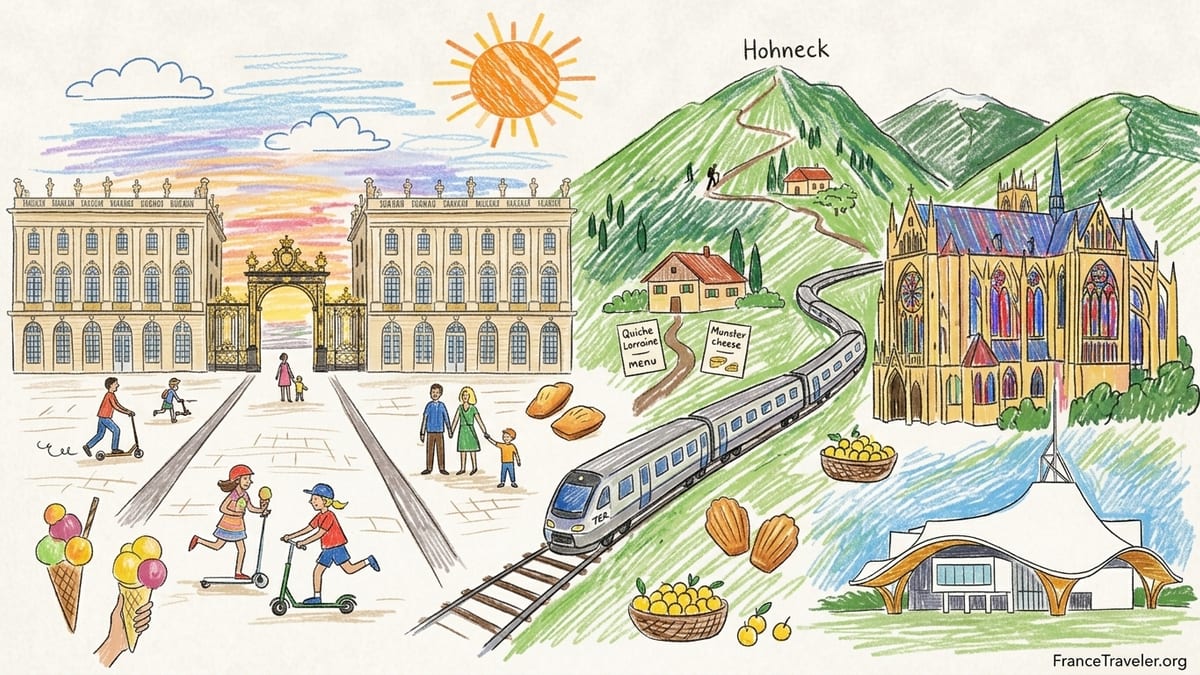
There are corners of Lorraine that deliver immediate, undeniable impact. Place Stanislas in Nancy is one of them. The square has been a UNESCO World Heritage site since 1983, an 18th century ensemble of creamy stone facades, gilded gates and radiating streets that feels like someone dropped a royal theater set into the middle of a modern city. I arrived just before sunset, when café terraces were filling and the paving stones were still warm from the day. The space has the kind of instant wow factor you expect from a European capital, but on a smaller, more human scale.
What surprised me was that Place Stanislas did not feel like a museum piece. Children rode scooters across the square, locals cut diagonally across on their commute, and students clustered on the steps with paper cones of mirabelle plum ice cream. In summer, a large-scale sound-and-light display animates the facades at night, and in early autumn the square hosts a temporary garden installation that changes theme each year. Standing in the middle, I caught myself thinking, slightly guiltily: if you plucked this square up and dropped it into Paris, it would be talked about constantly.
Metz offered a different kind of punch. Saint Étienne Cathedral dominates the old town, famous for roughly 6,500 square meters of stained glass that bathe the interior in shifting color. The glass panels span centuries, from medieval craftsmen to 20th century works by artists such as Marc Chagall and Jacques Villon. Walking in late afternoon, with low sun hitting the upper windows, I felt tiny under a forest of stone and color. Admission is free, and the cathedral generally keeps daily opening hours from morning to early evening, so it is easy to duck in more than once and watch the light change over the course of a day.
The Vosges Mountains, which mark Lorraine’s eastern frontier, delivered yet another kind of spectacle. Driving the Route des Crêtes along the ridge line between Lorraine and Alsace, I stopped near the Hohneck, the third-highest peak in the Vosges at about 1,363 meters. From the parking area it was only a short walk to broad views over glacial cirques, forested slopes and, on a very clear day, toward the Black Forest and distant Alps. The plateau summit is crisscrossed with marked hiking trails, and local tourism boards suggest routes ranging from short one-hour loops to full-day walks linking farm inns where you can sit down to plates of smoked pork, potatoes and Munster cheese.
Quiet Streets and Slow Burn Charms
For every Place Stanislas or Metz Cathedral, Lorraine also has towns that do not bowl you over at first glance. I took a mid-morning train along the Moselle valley, hopping off in smaller river towns where tourism offices were closed for lunch and the main street felt like it was waiting for something to happen. The stone was duller, the stucco plainer, the shop signs more workaday than charming. If you arrived expecting Provence-style prettiness on every corner, you might feel let down.
Yet in some of these places the experience deepened once I slowed down and looked closer. In Pont à Mousson, the arcades around the central square looked almost drab under overcast skies, but a short walk away the former Premonstratensian abbey hid a peaceful cloister and garden by the Moselle. In Bar le Duc, my first impression was of a practical town with traffic-clogged lower streets. Climb up to the “Ville Haute,” though, and you find a hilltop quarter of Renaissance facades and quiet lanes looking out over the valley. The transformation required effort and context. Lorraine often asks you to work for your reward.
This is where the question of whether Lorraine is underrated or simply less immediately exciting becomes tricky. Many of its smaller towns and villages have charm, but not the instant picture-perfect look you get in Alsace’s wine villages or in Burgundy’s stone hamlets. Streets can feel a little worn, shutters in need of paint, squares more oriented toward daily life than visitor appeal. If you equate travel value with visual drama at every turn, you may wonder what the fuss is about.
On the other hand, those quieter, slightly rough edges are part of what gives Lorraine its sense of normal life. In Epinal I watched high school students stream out of class and fill a riverside park, crossing a footbridge toward an old fortress hill that most guidebooks barely mention. No souvenir market, no choreographed sunset aperitif, just people using their city. Whether that feels authentic or disappointingly sleepy depends a lot on what you want from a trip.
Art Nouveau, Modern Art and Museums That Do the Heavy Lifting
One of Lorraine’s strongest cards is its museums and its ability to use interpretation to bring otherwise modest streetscapes to life. Nancy in particular rewards anyone with an interest in Art Nouveau, the fin de siècle movement that flourished here around 1900. The Musée de l’École de Nancy, housed in the former villa of a local patron, pulls you directly into that world with curved glass, floral marquetry and stained glass windows created by artists like Émile Gallé and the Daum brothers. As of 2026, a standard adult ticket is around 7.5 euros, with discounts and a combined ticket available that also covers the nearby Villa Majorelle, another Art Nouveau landmark.
Inside, the furniture and decorative objects do what the surrounding residential streets cannot. They make you feel the city’s turn of the century prosperity and creative ambition. Without the museum, the neighborhood would simply be a pleasant but unremarkable area of early 20th century houses. With it, you start to see carved balconies and glasswork details in a new light as you walk back toward the center.
Metz plays a similar trick with modern and contemporary art. The Centre Pompidou Metz, an offshoot of the Paris museum, anchors a redeveloped district near the train station. The building itself, with its swooping white roof, is a statement piece. Exhibition programs change regularly, drawing on the vast collections of the parent institution and hosting ambitious temporary shows. Recent official documents list a full-price adult ticket in the mid-teens in euros, comparable to major museums in larger cities, with reductions for younger visitors and various pass holders.
On a rainy afternoon I spent several hours wandering a show that juxtaposed postwar abstraction with installations by younger European artists. When I stepped back outside, the square in front of the museum was nearly empty, the drizzle keeping even locals away. In that moment, Metz felt more like an art pilgrimage stop than a lively city break. Whether that is a plus or a minus depends again on your travel style. For me, the museum easily justified the stop, but it was the content inside, not the streets outside, that gave Metz its energy.
War Memory, Industrial Scars and the Question of Atmosphere
No honest account of Lorraine can skip its role in European history, particularly the First World War. The Meuse department around Verdun is dotted with forts, cemeteries and ossuaries that draw visitors interested in memory tourism rather than casual weekenders. Standing in the Douaumont Ossuary, looking through windows over slopes filled with thousands of white crosses, is a sobering experience that leaves little room for lighthearted sightseeing.
Verdun’s town center, with its riverside promenade and rebuilt facades, is pleasant enough, but it does not offer the romantic atmosphere of riverside towns in other parts of France. Here the stories you absorb in museums and at battlefield sites shape your emotional impression more than any café terrace or pretty lane can. This is a region where history is heavy, and that weight is part of its identity.
Elsewhere, Lorraine’s industrial past still shows in old steelworks and factories, some converted into cultural venues, others standing as unused shells on the edge of town. Compared with Alsace, which has spent decades burnishing its image with half-timbered villages and flower competitions, Lorraine often feels less stage-managed. That can read as authenticity or neglect, depending on your perspective. A walk through a residential quarter outside central Metz or Nancy will bring you face to face with postwar apartment blocks and practical shopping centers as often as with historic charm.
In this context, the quieter atmosphere that many travelers praise starts to look more complex. Lorraine is not just calm because there are fewer tourists. It is also calm because everyday life has not been radically reshaped around visitors. Restaurants close on certain days without worrying about foreign expectations. Lunchtime can still mean shuttered doors even in places near major sights. If you thrive on constant buzz, you might interpret that as sleepy or unwelcoming. If you are curious about how a region lives when it is not performing for outsiders, it can be refreshing.
Eating and Drinking: Comfort, Mirabelles and Realistic Expectations
Food was one area where Lorraine often exceeded my expectations, provided I adjusted what I was looking for. This is the birthplace of quiche Lorraine, after all, and I found both classic versions with smoked bacon in Nancy brasseries and lighter interpretations in Metz bistros that used local goat cheese and seasonal vegetables. Portions tended to be generous, and set lunch menus in mid-range places often hovered around 18 to 25 euros for two or three courses, a solid value compared with Paris or the Riviera.
Desserts and snacks were where the region’s personality really showed. Mirabelle plums are a local emblem, and they appear everywhere in season, from tartes on bakery counters to sorbets and liqueurs. In Commercy and Liverdun, bakeries proudly advertise madeleines, small shell-shaped sponge cakes that local lore links to royal and aristocratic tables. None of these products are unique to Lorraine anymore, but tasting them in the region that made them famous adds a layer of pleasure.
What Lorraine does not offer, at least not on the same scale, is the kind of continuous wine route spectacle you find in neighboring Alsace. There are vineyards along the Moselle producing whites and sparkling wines, and you can certainly organize tastings with local producers around Metz and Toul. However, do not expect an unbroken procession of storybook villages with tasting rooms on every corner. Wine here is more of a supporting character than the whole show.
In smaller towns, dining required a bit of planning. On a weekday night in Verdun, several promising restaurants were either closed or fully booked, leaving more basic options in the center. In Vosges valley towns outside peak season, some hotel restaurants were the only places serving dinner after eight o’clock. None of this was dramatic, but it reinforced the sense that Lorraine still thinks first of its residents, not of squeezing every possible visitor euro out of the day.
Would I Cross France Just for Lorraine?
After a week on the ground, the hardest and most useful question I could ask myself was this: if I were planning another trip to France from scratch, would I cross the country specifically for Lorraine? The honest answer is that it depends very much on who is asking.
If you are visiting France for the first time, with maybe ten days to play with, I would still steer you toward a more classic mix of Paris, one wine region and perhaps the Mediterranean or the Loire. Lorraine has outstanding sights, but it does not yet have the density of showstoppers that make sense for a once-in-a-lifetime itinerary. You can see a royal square, a great Gothic cathedral and rolling countryside in other regions that also package them with more obviously charming towns.
However, if you have already done the greatest hits and you are looking for a second or third trip with a more focused theme, Lorraine suddenly becomes much more compelling. Art lovers who want to dive into Art Nouveau in Nancy and modern art in Metz could easily justify three or four days split between the two cities, using museums as anchors and filling the gaps with side trips to smaller towns along the Moselle. History enthusiasts interested in the World War I Western Front might find that Verdun and the surrounding Meuse give them a deeper, more concentrated understanding than the more frequently visited Somme.
Nature-oriented travelers who have already hiked the Alps or Pyrenees but want a gentler mountain experience will appreciate the Vosges ridges along the Lorraine border. Heights like Hohneck can be reached by car and then explored on foot, which makes serious views accessible even to those with only moderate hiking experience or limited time. Staying two or three nights in a valley town and using local buses or a rental car to access trailheads can create a mountain break that feels wild in parts but never logistically intimidating.
Lorraine on Its Own or as Part of a Grand Est Circuit?
The next pragmatic question is whether Lorraine works best as a stand-alone destination or as a chapter in a broader Grand Est itinerary that might also include Alsace and Champagne. For many travelers, the second option will make more sense. High-speed trains link Paris with Nancy and Metz in roughly 1 hour 30 to 1 hour 50, while regional lines connect onward to Strasbourg, Colmar and Reims. It is entirely feasible to build a loop that samples each region’s strengths over ten to fourteen days.
In that context, certain places in Lorraine shine as part of a mosaic. Nancy pairs beautifully with Strasbourg, offering a different architectural story and a less touristy feel. Metz combines naturally with Reims for a cathedral and champagne-themed arc. The Vosges ridges work as a bridge between Lorraine and Alsace, allowing you to sleep on one side and hike on the frontier the next day. Using Lorraine as connective tissue rather than the sole focus reduces the pressure for every town to be a marvel.
There are, however, a few spots that could justify a dedicated Lorraine trip for the right traveler. A long weekend centered on Nancy, with time for the UNESCO-listed eighteenth century squares, the Musée de l’École de Nancy and side excursions to nearby towns like Toul or Lunéville, would satisfy anyone interested in architecture and design. Another long weekend based in Metz could focus on the cathedral, the Centre Pompidou Metz and cycling along the Moselle, perhaps using local bike rental shops and signed river routes.
For those particularly drawn to war history, a focused journey through the Meuse, with Verdun as a base and visits to forts, memorials and battlefield landscapes, warrants its own careful pacing. This is not a region to rush through between wine tastings. Spreading the emotional weight of those visits over several days, with quiet evenings in small-town hotels or gîtes, respects both the past and your own ability to absorb it.
The Takeaway
So, is Lorraine underrated or just less exciting? After visiting, I would say it is neither a secret wonderland unfairly ignored nor a dull stretch of France to be skipped. It is a region of strong highlights that do not automatically knit together into a seamless spectacle, a place where museums, stories and landscapes often matter more than streets full of pretty facades.
Lorraine’s reputation for austerity has some truth to it if what you are seeking is constant charm and easy beauty. Many of its towns will not make your social media followers gasp at first glance. Yet within that restraint lies a different kind of appeal. If you are drawn to Art Nouveau interiors more than pastel exteriors, to modern art hangars more than medieval lanes, to war memorials and uncrowded hiking ridges more than to vineyard selfies, Lorraine can feel quietly rich.
For me, the verdict is this: I would not tell a first-time visitor to France to organize their whole trip around Lorraine. But I would, without hesitation, encourage a repeat traveler to carve out several days here, or to shape an entire journey around themes that Lorraine serves exceptionally well. Come for Place Stanislas at dusk, for the stained glass glow of Metz Cathedral, for the curve of an Art Nouveau staircase and the chill of a trench memorial, for the taste of mirabelle tart after a day on the Vosges ridges.
Lorraine may not deliver constant spectacle, and that is precisely why some travelers will cherish it. There is space here to think, to look closely and to let places unfold at their own pace. In an era when much of France’s tourism engine runs on polished images and orchestrated experiences, that might be the region’s most underrated quality of all.
FAQ
Q1. Is Lorraine worth visiting if I have never been to France before?
If it is your very first trip and you have limited time, Lorraine is better as an add-on to Paris or another classic region. If you have ten days or more and enjoy art, history and quieter cities, including Nancy or Metz for a few days can still be very rewarding.
Q2. How many days should I plan for Lorraine?
A focused visit to Nancy and Metz can work in three or four days, giving you time for main sights and a short side trip. A broader loop including Verdun and the Vosges tends to feel comfortable at seven to eight days, especially if you want hiking or in-depth war history visits.
Q3. Is Lorraine cheaper than Paris or the Riviera?
In general, yes. Museum tickets are often under 20 euros, with places like the Musée de l’École de Nancy under 10 euros, and set lunch menus in mid-range restaurants commonly run around 18 to 25 euros. Accommodation prices outside peak events are usually lower than in major coastal or capital cities.
Q4. Do I need a car to explore Lorraine?
You can visit Nancy, Metz and Verdun by train and local buses, but a car makes it much easier to reach rural sites, small villages and trailheads in the Vosges. For an itinerary focused on cities and major war memorials, public transport is workable. For extensive hiking or countryside wandering, renting a car for at least part of the trip is helpful.
Q5. What is the best time of year to visit Lorraine?
Late spring and early autumn offer a balance of pleasant temperatures, open hiking routes in the Vosges and fewer crowds. Summer brings more events and long evenings but can be warmer in the cities. Winter can be atmospheric in Nancy and Metz, especially around Christmas markets, though some rural activities and smaller attractions may be limited.
Q6. How does Lorraine compare to Alsace for scenery?
Alsace is more immediately picturesque, with its famous half-timbered wine villages. Lorraine’s scenic strength lies in the Vosges ridges, rolling countryside and less manicured river valleys. It feels wilder and less stage-managed but also less continuously striking from village to village.
Q7. Is Lorraine a good destination for hiking?
Yes, especially along the Vosges frontier, where routes around peaks like Hohneck offer panoramic views and well-marked trails. Elevations are lower than in the Alps, so hiking can feel more accessible, though weather and terrain still demand good footwear, layers and attention to safety information from local tourism offices.
Q8. Are museums in Lorraine suitable for children?
Many are. Saint Étienne Cathedral’s stained glass and the large modern art spaces at Centre Pompidou Metz can engage older children, while some war sites around Verdun may be more appropriate for teenagers due to their emotional weight. Always check museum websites for family guides, activity booklets or special programming when planning.
Q9. What local foods should I try in Lorraine?
Look for quiche Lorraine, mirabelle plum desserts, madeleines from towns like Commercy or Liverdun, Munster cheese dishes in the Vosges and regional charcuterie. In cities, many bakeries and brasseries showcase these specialties, especially during mirabelle season from late summer into early autumn.
Q10. Can I combine Lorraine with other regions on one trip?
Very easily. High-speed and regional trains link Nancy and Metz with Paris, Strasbourg, Colmar and Reims, making it simple to build a Grand Est circuit. Many travelers enjoy pairing Lorraine with Alsace for contrast or adding Champagne or Burgundy to create a wider loop of northeastern France.