


Northern France is far more than a rainy weekend cliché. From grand merchant cities and medieval cathedrals to white chalk cliffs, tidal islands and Belle Époque seaside resorts, this region combines short travel times from Paris and London with a huge variety of landscapes and travel styles. Whether you are planning a coastal escape, a culture-filled city break, a family holiday by the sea or a week-long road trip, the band of territory stretching from Lille and the Belgian border to Saint-Malo in Brittany offers some of France’s richest experiences.
How to Choose Your Northern France Base
For many visitors, the first decision is not what to see but where to sleep. Distances in Northern France are shorter than many expect. Lille is less than 1 hour by high-speed train from Paris and around 80 minutes from Brussels, while Bayeux and Caen are 2 to 2.5 hours by road from Paris. That means you can comfortably combine one inland city such as Lille or Rouen with one or two coastal bases like Honfleur, Étretat, Le Touquet or Saint-Malo over the course of a week.
Think about your priorities before you book. For art, nightlife and easy public transport, Lille and Rouen work well: both have compact historic centers, major museums and regular rail links. For romantic harbor views and boutique hotels with character, Honfleur and Bayeux are strong options. For classic sandy beaches, kids’ clubs and activities without needing a car every day, Le Touquet and Saint-Malo are particularly practical. If you want a once-in-a-lifetime landmark, Mont-Saint-Michel and its surrounding bay sit naturally at the heart of a coastal road trip.
Budget also plays a role. As a rule of thumb, a mid-range double room in Lille or Rouen often starts slightly below what you would pay in ultra-popular spots like Honfleur or Saint-Malo in high season. On the coast, expect prices to rise on summer weekends, public holidays and around big local events such as the Enduropale beach motorbike race in Le Touquet or major sailing events near Saint-Malo. Booking a few months ahead and visiting in shoulder seasons like May, June, September or early October can mean better availability and noticeably lower nightly rates.
Transport is another factor. If you will not be driving, cities with direct train connections like Lille, Rouen, Bayeux and Saint-Malo are easier to base in, with day tours and local buses filling the gaps. If you have a car, you gain access to smaller villages and coastal viewpoints, from the Somme Bay wildlife reserves to the winding country lanes above Étretat’s cliffs or the lesser-known beaches west of Mont-Saint-Michel.
Lille, Rouen and Amiens: City Breaks with Deep History
Lille, the largest city in Northern France, is an excellent gateway for travelers arriving by train from London, Brussels or Paris. Its restored Old Town mixes Flemish brick houses and gabled facades with a lively bar and restaurant scene. A practical example: you might spend a morning exploring the Palais des Beaux-Arts, one of France’s largest fine-arts museums, then have a simple lunch of carbonnade flamande (beef stewed in beer) at a traditional estaminet before browsing design shops in the afternoon. Lille’s City Pass offers free entry to many museums and public transport, which can be convenient if you are staying 48 or 72 hours and plan to visit several attractions.
Rouen, capital of Normandy, is ideal if medieval streets and Gothic architecture matter more to you than nightlife. The cathedral’s delicately carved facade famously inspired a whole series of Monet’s paintings, and the historical center is dense with half-timbered houses. Travelers often use Rouen as either a day trip from Paris or a one- or two-night base on a broader Normandy itinerary. You could, for example, arrive by morning train from Paris, visit the cathedral and the Joan of Arc museum, then rent a car the next day to continue west toward Étretat or Bayeux.
Amiens, slightly less known internationally, appeals to those who prefer quieter cities. Its UNESCO-listed cathedral is one of the largest in France, and the Hortillonnages, a maze of floating market gardens, offer boat trips through tranquil canals during the warmer months. Amiens can work as a base if you want to combine city comforts with day trips to the World War I remembrance sites on the Somme, or to the bird-rich Somme Bay coastline, around 1 to 1.5 hours away by car.
If your time is short and you are choosing between these three, Lille generally suits first-time visitors who want variety and nightlife, Rouen is the best single stop for medieval history and Norman identity, and Amiens is a thoughtful choice for travelers interested in cathedrals and the First World War, especially if you prefer a slower pace and less crowded streets.
Honfleur and Étretat: Romantic Normandy Coast for Couples
For many couples, Honfleur is the quintessential Norman harbor town: a tight rectangle of quayside lined with tall, narrow houses in slate and timber, with café terraces overlooking the fishing boats. It is a place to stroll rather than tick off sights. A typical weekend might include a coffee on the Vieux Bassin in the morning, browsing small art galleries and antique shops, and a leisurely seafood dinner in the evening, where a mid-range three-course menu might cost roughly what you would expect in a major French city bistro. Staying in a historic inn or a converted merchant’s house slightly back from the harbor can give you quieter nights and better value than rooms directly on the quay.
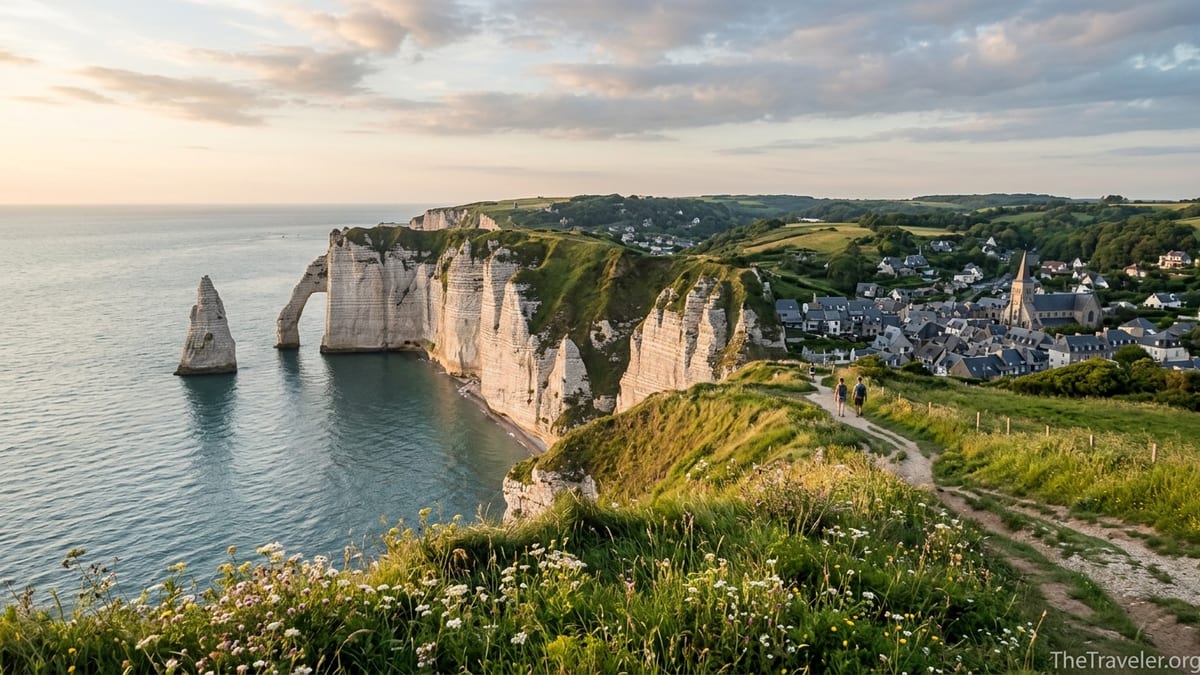
Étretat, about an hour’s drive from Honfleur, is one of the most photographed coastal spots in France. Its white chalk cliffs, natural arches and needle-shaped rock formations inspired painters like Monet and continue to attract visitors worldwide. The village itself is small and can feel crowded on sunny weekends, so many travelers choose to arrive early in the morning or late in the afternoon, walk one or both of the main cliff paths for panoramic views, and then move on. If you stay overnight, you gain peaceful early-morning access to the trails and the chance to watch sunset over the English Channel from above the arches.
Comparing Honfleur and Étretat for couples, Honfleur has more hotel and restaurant choice, plus an undeniably romantic harbor atmosphere in the evenings. Étretat offers drama and natural spectacle more than dining variety. If you are on a short Normandy trip and can only pick one, Honfleur makes a better base, with an easy day trip by car or local bus to Étretat, Deauville or Trouville. If you love hiking and photography, prioritizing at least half a day in Étretat is worth it, remembering to bring layers and comfortable shoes because coastal weather can change quickly.
Public transport is workable but slower on this stretch of coast, particularly if you want to see both towns in one day. Without a car, using Rouen or Le Havre as rail hubs and then connecting by bus or guided day trip can help, but if your priority is freedom to chase the best light on the cliffs or enjoy long dinners in small bistros, renting a car for a couple of days often feels more efficient and flexible.
Bayeux, Mont-Saint-Michel and Saint-Malo: History, Icons and Tides
Further west, Bayeux is one of the best bases for travelers interested in both medieval and modern history. The famous Bayeux Tapestry, an embroidered narrative of the Norman conquest of England, is housed in a dedicated museum that usually requires timed entry in busy months. The town itself survived the Second World War largely intact, leaving a harmonious center of stone houses and a magnificent cathedral. Many D-Day landing beach tours depart from Bayeux, offering full- or half-day excursions by minibus to sites such as Omaha Beach, the American Cemetery, and key bunkers and batteries. Joining a small-group tour typically costs more than using local buses, but gives you historical context and the ability to cover several sites in one day without navigating unfamiliar rural roads.
Mont-Saint-Michel, a tidal island crowned by a Gothic abbey, is on many travelers’ lifetime lists. Access has been heavily managed in recent years to protect the site, so you now park or arrive by shuttle on the mainland, then either walk the causeway or take a free shuttle bus to the island foot. The abbey on top of the island has separate admission; tickets can usually be bought online ahead of time, which helps avoid queues on busy days. Because crowds are heaviest from late morning to mid-afternoon, staying nearby and visiting first thing in the morning or in the evening often transforms the experience, allowing you to enjoy the steep lanes and views across the bay with more space.
Saint-Malo, across the bay in Brittany but often paired with Mont-Saint-Michel in itineraries, is a walled corsair city with broad sandy beaches and strong tides. Inside the ramparts, streets are dense with crêperies, seafood restaurants and independent shops. Families appreciate the easy combination of history and sandcastle time, while couples enjoy the sunset walks along the ramparts looking back toward the town’s granite skyline. Many travelers rent a car to connect Bayeux, Mont-Saint-Michel and Saint-Malo over three or four days, stopping at small villages and viewpoints along the way.
When choosing between basing in Bayeux or Saint-Malo for this stretch, think about emphasis. If your focus is D-Day history and the tapestry, Bayeux is clearly the better base. If you are more interested in beaches, tides and Breton atmosphere, Saint-Malo delivers. Mont-Saint-Michel sits roughly in the middle and works best as a dedicated day or overnight stop, rather than as your long-stay base, because accommodations on the island and immediate surroundings tend to be more limited and often priced higher for the setting.
Le Touquet, Arras and the Opal Coast: Families and Easy Beaches
On the northern side of the region, the Opal Coast combines broad sandy beaches, dunes and pine forests with easy road and rail access from Calais, Lille and Paris. Le Touquet-Paris-Plage, often shortened to Le Touquet, is one of its most famous resorts. Developed in the early 20th century for French and British holidaymakers, it offers long beaches, Belle Époque and Art Deco villas, and a compact town center of shops and brasseries. Families appreciate the kid-friendly beach clubs, cycle paths and riding stables; for example, many visitors book pony rides on the sand or rent bikes for an afternoon loop through the forest and along the seafront promenade.
Beyond the beach, Le Touquet has a reputation for outdoor sports. Golf courses, tennis courts and sailing schools cater to active travelers, while spa hotels attract couples looking for a relaxed, car-free long weekend. Prices rise on sunny summer weekends and during events such as the Enduropale motorbike race or music festivals, when it is wise to book accommodation many weeks in advance. Visiting in June or early September can mean pleasant sea temperatures and a full program of activities, but without the busiest crowds of late July and August.
Arras, a short train ride south of Lille, is a different proposition: an inland town with two stunning Flemish-style squares lined by arcades, and a role as a key World War I site. Travelers with older children or history enthusiasts often combine a morning in the town, including a climb up the belfry for roofscape views, with an afternoon tour of nearby battlefields, memorials and preserved tunnels. Compared with Lille, Arras feels smaller and more intimate, and accommodation prices are often modest, making it a practical overnight stop on a longer driving route between the Belgian border and Normandy.
Families choosing between Le Touquet and towns like Saint-Malo or Honfleur should weigh the style of beach and infrastructure. Le Touquet’s long, straight sands, organized children’s clubs and sports facilities suit active, multi-generation holidays where everyone can find something to do without long drives. Saint-Malo offers more tidal drama and fortified-city atmosphere but can be rockier in places and busier in midsummer. Honfleur is deeply charming but has no significant beach in the town itself, so it is better for couples or families who plan to drive out to other seaside spots during the day.
Designing a Northern France Road Trip
For travelers with 7 to 10 days and a rental car, Northern France is perfect road-trip territory. One classic loop starts in Lille, where you spend two nights exploring the old town, museums and nearby Roubaix, then heads west to Arras for a day of squares and remembrance sites. From there you can join the coast near Boulogne-sur-Mer or Le Touquet, following the Opal Coast south to the Somme Bay for birdwatching and wide open sands. Continuing into Normandy, you might then spend two nights in Honfleur or Deauville, with a day trip to Étretat for cliff walks and sea views.
From Honfleur, it is around three hours of relaxed driving to Bayeux, where two or three nights allow enough time for the tapestry, the cathedral and a structured D-Day tour. After Bayeux, the route naturally extends to Mont-Saint-Michel for one night, giving you the chance to see the island illuminated after dark or early in the morning before day visitors arrive. From Mont-Saint-Michel, you can finish with two nights in Saint-Malo, returning the car in a nearby larger city with rail connections back to Paris or to your onward destination.
Those with less time can compress this pattern. For a 4 or 5-night trip, many visitors choose one inland city and one coastal base, such as Lille plus Le Touquet, or Rouen plus Honfleur. Public transport also supports a form of “soft road trip” where you combine trains and occasional guided excursions. For instance, you could travel by train from Paris to Rouen, then to Bayeux, and finally to Saint-Malo, adding small-group tours to Étretat, the D-Day beaches and Mont-Saint-Michel along the way, without ever needing to drive.
When planning, pay attention to driving times and parking rules around major sights. Mont-Saint-Michel, for example, requires parking in designated mainland lots followed by a shuttle or walk, which adds time compared with simply pulling up outside a town hotel. Old centers like Honfleur and Saint-Malo have narrow streets where cars are restricted or discouraged, so choosing accommodation with on-site or nearby parking is worth the extra research. Booking cancellable rates and leaving some flexibility in your itinerary can help you adjust if coastal weather becomes stormy or if you decide to linger longer in a town that particularly suits you.
The Takeaway
Northern France rewards travelers who look beyond the idea of a single destination and instead think in terms of themes: art and architecture, medieval and modern history, family-friendly beaches, or dramatic coastal landscapes. Lille, Rouen and Amiens anchor the region with culture-rich city breaks, while Honfleur and Étretat offer postcard-perfect harbors and cliffs for couples. Bayeux, Mont-Saint-Michel and Saint-Malo form a historical and geographical arc filled with stories, from the Norman Conquest to the Second World War. Along the Opal Coast, Le Touquet and its neighbors combine classic seaside holidays with easy access from Paris and the Channel ports.
Choosing the “best” place depends less on rankings and more on your style. If you dream of gallery afternoons and late-night wine bars, Lille or Rouen should be your starting point. If you imagine hand-in-hand walks along harbor quays and clifftop paths, build your route around Honfleur and Étretat. For families who want safe beaches and structured activities, Le Touquet and Saint-Malo are reliable bases with plenty to do in almost any weather. For travelers whose priority is understanding European history on the ground, Bayeux and the D-Day coast, combined with a visit to Mont-Saint-Michel, are hard to beat.
In practice, the region is compact enough that you do not have to choose just one. With even a week, you might have breakfast in a Flemish townhouse café in Lille, walk the chalk cliffs of Étretat by late afternoon, and watch the tide race around Mont-Saint-Michel two days later. With a little planning, Northern France reveals itself as one of Europe’s most varied and accessible short-haul destinations, especially appealing to travelers who value a mix of culture, coastline, and the simple pleasures of French food and everyday life.
FAQ
Q1. If I only have three days, which single base in Northern France should I choose?
For a first visit without a car, Lille is the most convenient single base thanks to high-speed trains, a dense historic center, major museums and good day-trip options. If you prefer the coast and can handle slightly slower connections, Honfleur or Saint-Malo are attractive alternatives, but they work better with at least four or five days.
Q2. Is it realistic to visit Mont-Saint-Michel as a day trip from Paris?
It is physically possible via an early train to a nearby town and a connecting bus or organized coach tour, but you will spend many hours in transit and likely visit at peak crowd times. Staying one night closer to the site, for example in a nearby village or in Saint-Malo or Bayeux as part of a longer trip, usually makes for a more relaxed experience.
Q3. How should couples split their time between Honfleur and Étretat?
Many couples spend two nights in Honfleur, using one full day there and another for a half- or full-day trip to Étretat. Honfleur offers more hotels and restaurants and a romantic harbor atmosphere in the evenings, while Étretat is perfect for a focused visit of a few hours centered on cliff walks and sea views rather than a long stay.
Q4. Which towns are best for families with younger children?
Le Touquet and Saint-Malo stand out for families, thanks to broad beaches, promenades, playgrounds and organized children’s activities in summer. Bayeux can also work well with school-age children interested in history, especially if you combine museum visits with a structured D-Day tour and leave time for relaxed evenings in the old town.
Q5. Do I need a car to enjoy Northern France properly?
You can experience a lot by train and bus, especially between major cities like Lille, Rouen, Caen, Bayeux and Saint-Malo, and by joining guided day tours to places such as the D-Day beaches or Mont-Saint-Michel. However, a car gives you more freedom to explore smaller villages, viewpoints and quieter coastal stretches, and can make multi-stop itineraries simpler, especially for families.
Q6. How many days should I plan for the D-Day beaches around Bayeux?
If you are mainly interested in an overview, one full day on a small-group or private tour from Bayeux can cover key sites such as Omaha Beach and major cemeteries. Travelers with a deeper interest in Second World War history often stay two or three nights, allowing time for additional museums, lesser-known beaches and moments of quiet reflection between visits.
Q7. When is the best time of year to visit Northern France for good weather and fewer crowds?
Late spring and early autumn, roughly May to June and September to early October, usually offer milder weather, long daylight hours and fewer peak-season crowds. July and August can be lively and pleasant but are busier and often more expensive on the coast, while winter brings quieter streets and a moodier, more atmospheric coastline that appeals to some travelers.
Q8. How should I choose between staying in Bayeux or Saint-Malo?
Pick Bayeux if your main goals are seeing the Bayeux Tapestry and dedicating serious time to the D-Day beaches and Second World War history. Choose Saint-Malo if you want a walled port city with sandy beaches, strong tides and an easy pairing with Mont-Saint-Michel. Many travelers stay in both if they have at least five or six days in the region.
Q9. Is Le Touquet worth including if I am already visiting Normandy and Brittany?
Le Touquet is worthwhile if you enjoy classic seaside resort architecture, long sandy beaches and active holidays with cycling, riding or golf. It is especially convenient for travelers arriving by car from the Channel ports or Belgium. If your time is limited and you already have several coastal stops planned in Normandy and Brittany, you might reasonably skip it in favor of fewer, longer stays elsewhere.
Q10. Can I combine Lille, the coast and Mont-Saint-Michel in a one-week trip?
Yes, a week is generally enough to spend two nights in Lille, two or three nights at a coastal base like Honfleur or Saint-Malo, and one night near Mont-Saint-Michel. You will need to plan your route carefully, decide whether to rent a car or rely on trains plus tours, and accept that you will be sampling each place rather than exploring every detail.