


Normandy and Brittany sit side by side along France’s northern Atlantic edge, sharing a wild coastline, excellent seafood and an easy escape from Paris. Yet on the ground they feel very different. One is forever linked with D-Day beaches, half-timbered ports and rich dairy. The other leans Celtic, with pink granite headlands, walled corsair towns and buckwheat galettes washed down with cider. If you only have a limited number of days, deciding where to spend more time can shape the whole mood of your trip.
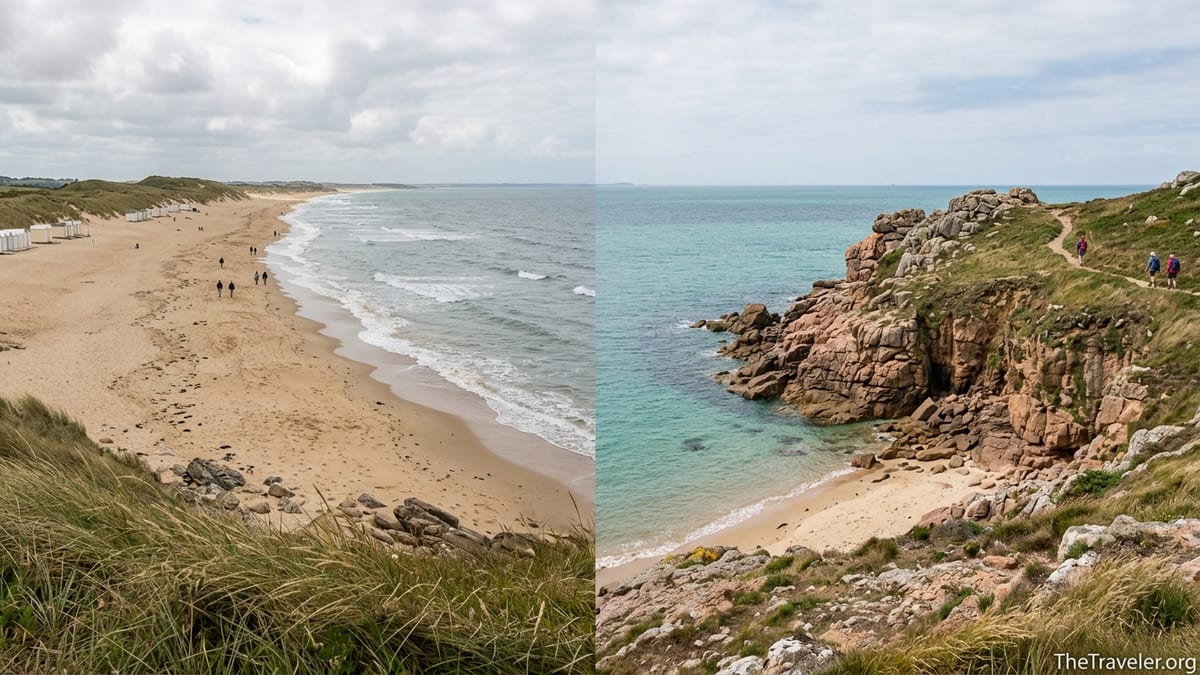
Setting the Scene: Two Coasts, Two Moods
Normandy stretches west from the mouth of the Seine, past the chalk cliffs of Étretat and the stylish resorts of Deauville and Trouville, then curves toward the D-Day landing beaches and the bay of Mont-Saint-Michel. It feels close to Paris in both distance and spirit, with easy rail links to Rouen, Caen and Bayeux and coastal towns that have long served as playgrounds for Parisians. The architecture mixes timbered medieval streets, grand 19th century villas and cities rebuilt after the Second World War.
Brittany, by contrast, feels more remote and self-contained. Its north coast runs from the Emerald Coast around Saint-Malo and Dinard west to the wild headlands of the Côte de Granit Rose, while the south coast softens into long sandy strands around Quiberon and the Gulf of Morbihan. The Breton language still appears on road signs, Celtic festivals fill summer calendars, and granite farmhouses cluster behind wind-bent hedges. It attracts French families and British visitors who return year after year for the slower pace.
In practical terms, Normandy often suits shorter breaks and first-time visitors, especially those arriving by train from Paris. Brittany rewards a little more time and a car, with distances between its signature sights slightly greater and its charms lying as much in small detours as headline names. Both regions have excellent tourist infrastructure, from modern roadside supermarkets to well-marked coastal trails, so your choice is less about logistics and more about the kind of coastal atmosphere you want.
Coastline and Beaches: Cliffs vs Coves
Normandy’s coastline is defined by variety: high white cliffs between Le Havre and Étretat, pebble beaches backed by elegant seafront promenades in Dieppe and Fécamp, then the broad, windswept sands of the landing beaches near Arromanches and Omaha. Official regional tourism information describes more than 600 kilometers of shore, including long arcs of sand lined with 19th century villas and beach cabins, many still busy with families in July and August. Swimming is possible in season, but the water remains cool, and windy days are common on the Channel coast.
Brittany’s north coast is more jagged and intimate, with headlands like Cap Fréhel and the Pink Granite Coast near Perros-Guirec broken up by sheltered coves. The Emerald Coast around Saint-Malo and Dinard offers sandy family beaches, lined with Belle Époque villas and coastal promenades that are popular for evening strolls. Local tourism boards highlight long stretches where the coastal path runs just above the sea, dropping to small coves like those on the Crozon peninsula or near Ploumanac’h, often with clear water and tide pools for children to explore.
For pure long, flat, easily accessible sand, Normandy’s D-Day beaches and resorts such as Cabourg or Houlgate are hard to beat, with large car parks right behind the dunes and beach clubs in high season. If you want wilder scenery and coastal hikes, Brittany has the edge. The GR34 customs path traces almost the entire Breton coast, and hikers can walk for hours above crashing waves with only the odd fishing hamlet for company. Many visitors base themselves in Saint-Malo or Dinard, combining city comforts with day trips to wilder stretches 30 to 60 minutes away by car.
Historic Towns and Cultural Atmosphere
Normandy offers some of northern France’s most evocative historic towns. Rouen, largely spared from wartime destruction in its medieval core, has one of the country’s highest concentrations of protected historic buildings, including a towering Gothic cathedral and streets of leaning half-timbered houses. Bayeux, a common base for D-Day excursions, feels smaller and gentler, with a cathedral, old stone mansions and the famous tapestry that narrates the Norman conquest of England. Honfleur, with its tight harbor lined by tall, narrow houses, has long been a favorite for artists and weekenders.
Brittany’s historic centers feel more distinctly Breton and maritime. Saint-Malo, heavily damaged in the war but meticulously rebuilt, sits entirely within ramparts, its granite streets filled with crêperies, seafood restaurants and small hotels. Dinan, a short drive inland, is enclosed by several kilometers of ramparts and offers half-timbered houses, a riverside port and cobbled lanes steep enough to feel like a workout. Vannes and Quimper, further west, serve up compact old towns with timber-framed facades, market squares and easy access to surrounding countryside.
Culturally, Normandy leans toward Franco-Norman traditions and Second World War memory. Museums at Caen and along the landing beaches focus on D-Day, and small country churches often hold plaques to local resistance members. Brittany adds a Celtic overlay: bilingual French-Breton signs, traditional music festivals, and a slightly different rhythm to village life. Travelers often notice the contrast simply by wandering an evening market: in Normandy you are more likely to see stalls piled with cream, Camembert and cider, while in Brittany buckwheat flour, salted butter biscuits and local cider producers share space with stands selling Celtic jewelry.
Food and Drink: Cream, Cider and the Sea
Normandy is one of France’s powerhouses for dairy and shellfish. Regional producers supply famous cheeses like Camembert, Pont-l’Évêque and Livarot, and menus routinely feature rich sauces built on butter and cream. Coastal towns from Ouistreham to Granville serve plates of oysters, mussels and scallops; Normandy is a leading French region for oyster cultivation and scallop exports. In a harbor town such as Courseulles-sur-Mer, you can buy a dozen local oysters at a market stall and eat them at a nearby table with a wedge of lemon for a modest price compared to Paris, then follow with a crêpe topped with local salted caramel.
Brittany shares a love of seafood but adds its own specialties. The port of Cancale, near Saint-Malo, is known nationally for oyster beds, and visitors line up at simple stalls along the waterfront to eat fresh oysters overlooking the bay, often paying just a few euros for a plate. Buckwheat galettes, filled with ham, cheese and egg, are a staple in Breton crêperies, while sweet crêpes arrive with salted butter caramel or local jams. Traditional pastries such as kouign-amann, rich with layered dough and butter, and Breton butter biscuits are widely sold in bakeries and specialty shops.
On the drinks side, both regions are strongholds for cider and apple-based spirits. In Normandy, signposted cider routes near Cambremer lead past farms where you can taste different styles of cider and Calvados, the local apple brandy, often buying a bottle directly from the producer. Brittany, particularly around the Rance valley and Cornouaille, offers its own ciders, typically served in ceramic bowls in crêperies. Craft beer is increasingly visible in both regions, and wine lists tend to focus on other parts of France, reflecting the cooler, wetter climate that suits apples better than vines.
Hotels and Where to Stay: Bases for Couples and Families
Normandy’s accommodation scene runs from simple seaside apartments to polished historic hotels. Around Deauville and Trouville you will find grand 19th century seafront properties with striped awnings and spa facilities, often with summer weekend rates that reflect their popularity with Parisians. Bayeux and the surrounding countryside offer smaller stone-built hotels and guesthouses that cater to visitors touring D-Day sites, many with family rooms and private parking. Independent guides published in 2026 highlight options in Honfleur, Rouen and smaller villages, with everything from renovated farm stays to contemporary design hotels near marinas.
Brittany’s coastal towns also provide a broad mix, often at slightly gentler prices outside peak summer. In Saint-Malo and Dinard, converted villas and mid-sized hotels line the seafront, many with sea-view rooms and easy beach access. Further along the coast, boutique hotels occupy old manor houses near Perros-Guirec or Vannes, while the south coast around Carnac and Quiberon hosts large family-friendly resorts and campsites. Hotel specialists currently feature dozens of properties branded as “by the sea” in Brittany, from simple two-star beach hotels to upscale spa resorts overlooking long bays.
For couples, Normandy’s Honfleur, with its harborfront restaurants and intimate guesthouses, and Brittany’s Dinard, with its Belle Époque villas and sunset walks, both make strong bases. Families may appreciate the practicalities of resort towns with parking, playgrounds and sandy beaches: Cabourg, Houlgate and Saint-Aubin-sur-Mer in Normandy, or Saint-Malo, Carnac and the Baie de Morlaix area in Brittany. Many coastal campsites in Brittany, for example near the Pink Granite Coast or on the Crozon peninsula, offer pitches and mobile homes with access to pools and kids’ clubs, making them popular with multi-generational trips.
Road Trips and Mont-Saint-Michel Access
Normandy and Brittany link naturally into road trip itineraries, particularly for travelers picking up a rental car in Paris or arriving by ferry from the United Kingdom. In Normandy, a classic three to five day loop might start in Rouen, continue to the Côte Fleurie resorts of Honfleur and Deauville, then swing west to Bayeux, the D-Day beaches and finally Mont-Saint-Michel. Distances are modest, with many drives between key sights under two hours, and major highways connect inland cities like Caen to the coast. Drivers from abroad report that signage is clear and traffic generally light outside peak summer weekends.
Brittany lends itself to a slightly longer circuit. One popular route begins in Saint-Malo, crosses the Rance to Dinard and Dinan, then continues west to the Pink Granite Coast and perhaps the Crozon peninsula before looping south toward Quimper and the Gulf of Morbihan. Coastal roads are slower but scenic, and you may average less distance per day than in Normandy as you stop for short walks, photo viewpoints and small fishing ports. Many visitors choose two or three bases, spending three nights in the Saint-Malo area and three in the west to avoid constant packing and unpacking.
Mont-Saint-Michel itself sits in Normandy, close to the border with Brittany, and is accessible from both regions. The tidal island is reached via a causeway from large car parks on the mainland; official visitor information advises allowing about an hour from parking to the abbey entrance, including the shuttle bus and the climb through village streets. From Bayeux, the drive is commonly around two hours; from Saint-Malo or Dinard, it is usually closer to one hour by car. Many travelers choose to visit in the evening, when day-trip crowds from Paris thin and sunset over the bay can be spectacular.
Couples vs Families: Which Region Fits Your Style?
For couples, the choice often comes down to ambiance. Normandy’s Côte Fleurie offers a blend of Belle Époque glamour and modern seaside comfort, with casino nights in Deauville and candlelit dinners in Honfleur’s harborfront bistros. Inland, villages near Bayeux and along the cider routes provide quiet stone farmhouses, garden terraces and easy day trips to historic sites. The combination of art, history and seaside promenades suits travelers who enjoy long meals, museum visits and gentle walks more than strenuous hiking.
Brittany has a slightly wilder, more road-trip feel that many couples appreciate, especially those who enjoy coastal hiking and exploring small ports. A day might start with coffee in a market square in Dinan, continue with a cliff-top walk at Cap Fréhel or along the Pink Granite Coast, and end with a simple seafood dinner in a harbor like Paimpol. Towns such as Saint-Malo and Vannes provide enough restaurants and bars for relaxed evenings without feeling overly resort-driven. The strong sense of regional identity, from music to food, adds a romantic sense of place.
Families with school-age children often find both regions easy and low-stress. Normandy’s flat beaches are ideal for sandcastle building and kite flying, and D-Day sites can be powerful educational experiences for older children and teenagers. Visitor centers at beaches such as Omaha provide exhibits that explain the landings in accessible formats, and many tours are designed with mixed-age groups in mind. Short drives and plentiful supermarkets make self-catering apartments around towns like Courseulles-sur-Mer or Granville practical for a week-long stay.
In Brittany, families gravitate toward seaside bases like Saint-Malo, Dinard, Carnac or the Crozon peninsula, where they can alternate between beach days, boat trips and short hikes. Large aquariums, such as those near Brest and Saint-Malo, offer rainy-day options, while enclosed historic centers provide safe spaces for children to wander. Coastal campsites with pools and play areas are especially popular with families who want a social atmosphere for children and simple on-site dining. Overall, Brittany’s more rugged coast and network of walking paths encourage an active, outdoorsy style of family holiday.
So Which Region Deserves More Time?
If your trip to northern France is short, particularly three to four days paired with Paris, Normandy generally deserves more time. The combination of straightforward train links from Paris to cities like Rouen, Caen and Bayeux, compact driving distances between sights, and the concentration of high-profile landmarks such as the D-Day beaches and Mont-Saint-Michel make it easy to build a satisfying itinerary without rushing. You can base in Bayeux or Caen, visit multiple landing beaches and cemeteries, fit in a day trip to Mont-Saint-Michel and still have an evening in Honfleur or Deauville.
For travelers with a week or more dedicated to the coast, especially those who prioritize scenery and walking over formal sightseeing, Brittany is the stronger candidate for extended time. Its coastline is longer, more indented and arguably more varied, from the Emerald Coast to the Pink Granite formations and the islands off the south shore. Giving Brittany five to seven days allows you to combine two different bases, for example three nights in the Saint-Malo and Dinan area and four nights farther west near Perros-Guirec or in the Gulf of Morbihan, with enough time to settle into the slower pace.
Many visitors who have sampled both regions on the same trip report that Normandy delivered the “must-see” experiences they expected, while Brittany provided the moments that felt more like discovery: a tiny cove at the end of a footpath, a village festival, or a sunset over standing stones near Carnac. If you value iconic sites and historical depth, allocate more nights to Normandy. If you are searching for remote-feeling coasts, Celtic-inflected culture and hikes with sea views, tilt your schedule toward Brittany. Because the two borders meet near Mont-Saint-Michel, combining them is very feasible on longer trips.
The Takeaway
Normandy and Brittany share a rugged Atlantic setting and excellent food, but they tell different stories. Normandy is coastal cliffs and D-Day history, creamy sauces and cider routes, grand seaside resorts and timbered ports within easy reach of Paris. Brittany is Celtic villages and fortified corsair towns, pink granite headlands and long coastal paths, galettes and kouign-amann, wilder road trips and ferry-linked islands. Both are rewarding in their own right, which is why many travelers end up planning a return visit to see what they missed the first time.
If you have limited time and want headline sights, Normandy deserves the larger share of your days, with its concentration of world-famous beaches and simple logistics. If you can linger, or if your ideal holiday leans toward hiking, exploring small ports and feeling a distinct regional culture, Brittany merits at least as much time, and often more. For those fortunate enough to have a full week or longer, the most satisfying solution is often to split your stay, using Mont-Saint-Michel as the hinge between two very different but complementary coasts.
FAQ
Q1. Is Normandy or Brittany better for a first trip from Paris?
Normandy is usually better for a first short trip because it has faster train connections from Paris, shorter driving distances, and a dense cluster of well-known sights such as the D-Day beaches and Mont-Saint-Michel.
Q2. Which region has better beaches for swimming?
Brittany generally offers more sheltered coves and family-friendly sandy bays that feel comfortable for swimming in summer, while Normandy excels in wide, open beaches that are great for walks, wind sports and history-focused visits.
Q3. Where should I base myself in Normandy without a car?
Many travelers choose Bayeux or Caen because both are reachable by train from Paris and have organized tours to the D-Day beaches and Mont-Saint-Michel, along with enough restaurants and services for a multi-night stay.
Q4. Where should I stay in Brittany if I only have a few days?
Saint-Malo is a practical base for short stays, with a walled old town, good beaches, frequent trains from Paris via Rennes and easy day trips to Dinan, Dinard and Cancale by bus, car or organized excursion.
Q5. Is it realistic to see both Normandy and Brittany in one week?
Yes, many visitors spend three to four nights in Normandy and three to four in Brittany, often splitting the week between the Bayeux or Caen area and the Saint-Malo or Dinan area, with Mont-Saint-Michel as a shared highlight.
Q6. How busy do the regions get in July and August?
Both coasts become significantly busier in late July and August, when French school holidays fill seaside towns, accommodations book up early, and traffic on coastal roads increases, especially around major resorts.
Q7. Which region is better for hiking and coastal walks?
Brittany is stronger for dedicated hiking, thanks to the GR34 coastal path that rings most of the peninsula and offers varied stages along cliffs, dunes and rocky headlands, often with small ports or villages at regular intervals.
Q8. Where will I eat better seafood, Normandy or Brittany?
Both regions have excellent seafood. Normandy is famous for oysters, mussels and scallops, while Brittany adds celebrated oyster beds at Cancale, plentiful crêperies serving seafood galettes and many small harbors with simple fish restaurants.
Q9. Is driving difficult for foreign visitors in these regions?
Most foreign visitors find driving manageable, with clear signage and relatively light traffic away from major cities, though narrow village streets, roundabouts and parking in popular coastal towns require a bit of extra attention in peak season.
Q10. If I love history more than beaches, which region should I prioritize?
Normandy is the better choice if history is your main interest, thanks to the D-Day landing sites, major war museums, medieval towns like Rouen and Bayeux and strong connections to both medieval and 20th century European history.