


Northern France brings together Parisian café culture, Normandy’s quiet beaches, the dramatic tidal island of Mont-Saint-Michel, the walled corsair city of Saint-Malo and the windswept cliffs of the Channel coast. With fast rail links from Paris and Lille and a dense web of motorways and regional roads, it is one of the easiest regions in France for a first road trip or rail-based adventure. This guide sets out practical 5, 7, 10 and 14 day itineraries with realistic travel times and suggested overnight bases, so you can connect the highlights without spending your whole holiday on the move.
How to Use This Northern France Itinerary Guide
These routes are built for travelers arriving via Paris or Lille, which are the main international gateways to northern France. From Lille, high speed trains reach Paris in about 1 hour 15 minutes on TGV and similar services, with multiple departures daily, making it easy to start in one city and end in the other. From Paris, direct trains radiate to Normandy hubs such as Rouen, Caen and Bayeux, and seasonal connections or buses continue on toward Mont-Saint-Michel and Brittany.
Travel times quoted here are approximate and assume typical conditions. For example, driving from Paris to Bayeux usually takes around 3 hours, while Paris to Mont-Saint-Michel by car is closer to 4 to 4.5 hours, depending on traffic. Public transport to Mont-Saint-Michel generally involves a train from Paris-Montparnasse to Pontorson or Rennes, then a connecting bus for the final 30 to 45 minutes. The idea is to give you a realistic sense of what fits comfortably into a day rather than a tight checklist of sights.
The overnight suggestions assume you prefer changing hotels every 1 to 3 nights rather than every day. Cities like Bayeux, Caen, Saint-Malo and Rouen make efficient bases because they sit at the crossroads of several key sights and have a good range of midrange and budget accommodation. Travelers on a tighter budget can often find simple hotels around 80 to 120 euros per night for a double room in these towns outside the very peak of July and August.
All four itineraries can be adapted to self-drive, train and bus, or a mix of both. For context, a small rental car in France often starts around 40 to 60 euros per day before fuel and tolls if booked in advance, which can be good value for couples or small groups who want to explore rural areas like the Normandy bocage or the smaller fishing villages of Brittany that are only lightly served by buses.
Route Overview: Key Hubs in Normandy, Brittany and the Channel Coast
For Normandy, Bayeux and Caen are the classic bases. Bayeux is a compact medieval town near the D-Day beaches, with easy access by regional train from Paris Saint-Lazare via Caen in under 3 hours total. Caen, a larger city with more nightlife and shopping, sits on major road and rail junctions and is about 2 hours by train from Paris. Honfleur, on the Seine estuary, is a pretty harbor town better suited to drivers because it lacks a direct mainline railway station.
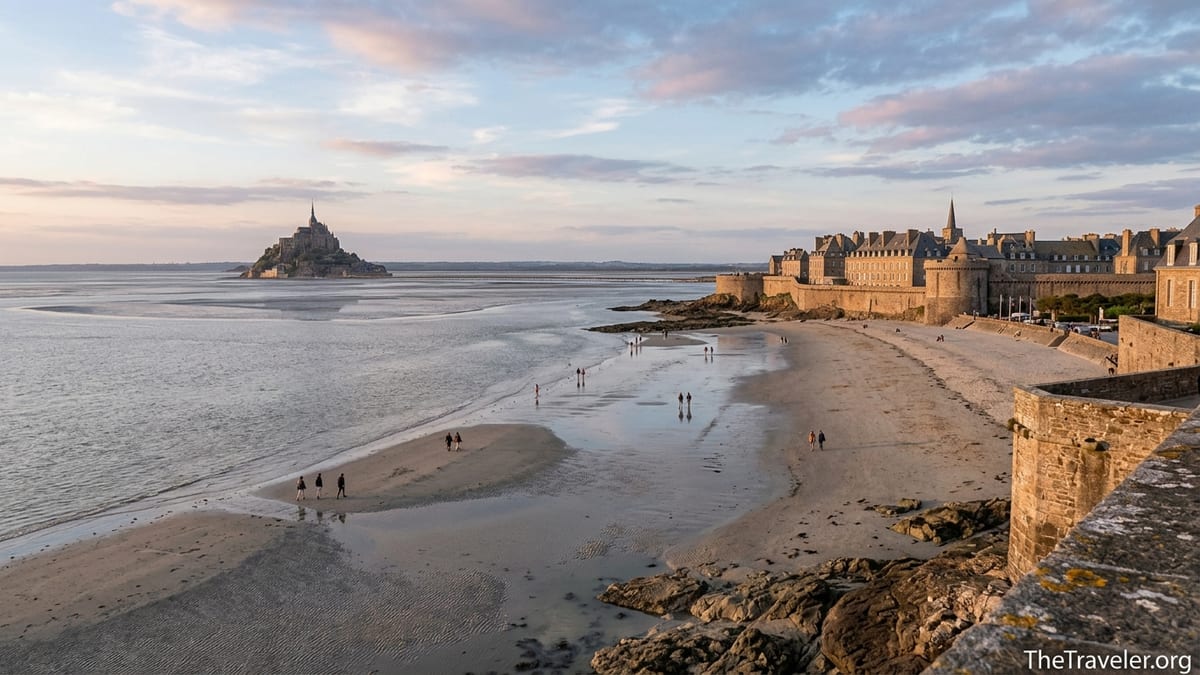
Mont-Saint-Michel is technically in Normandy, on the edge of the bay that separates Normandy from Brittany. Most independent travelers reach it either by car or by combinations of train and bus. Many visitors stay in nearby Pontorson, Avranches or Dol-de-Bretagne, or travel on to Saint-Malo in Brittany after a visit. Overnighting either in the village at the base of the mount or in one of the hotels along the causeway-side approach allows you to see the abbey before the bulk of the day trip crowds arrive.
In Brittany, Saint-Malo and nearby Dinan are the headline stops for shorter trips, and both combine well with Mont-Saint-Michel. Saint-Malo is a walled corsair city with tidal beaches and a lively restaurant scene, around 1 hour’s drive from Mont-Saint-Michel or roughly 1.5 hours by regional bus depending on the schedule. Dinan lies inland on the Rance river and offers cobbled streets, half-timbered houses and a calmer atmosphere. Farther west, but generally beyond the scope of a 7 day trip, lie the Pink Granite Coast, Quimper and the wild Crozon peninsula, which fit better into the 10 and 14 day routes.
Along the Channel coast of Normandy, Étretat is famous for its white cliffs and natural rock arches, reachable by car in a little over 2.5 hours from Paris via Le Havre or in about 1.5 hours from Rouen. Honfleur, with its narrow quays, slate-fronted houses and cobblestoned old basin, is a natural overnight stop when linking the Seine valley with the coast. These places are best visited with a car because public transport typically requires several changes and can be slow, especially outside of summer.
5 Day Northern France Taster: Paris, Normandy and Mont-Saint-Michel
A 5 day trip works best if you accept that you will only see a slice of the region. The most efficient version starts and ends in Paris and focuses on Normandy and Mont-Saint-Michel, using Bayeux as a base. On Day 1, travel from Paris to Bayeux in the morning by train via Caen, settle into your hotel and spend the afternoon exploring Bayeux’s cathedral and tapestry museum. Overnight in Bayeux for 2 or 3 nights to avoid packing and unpacking daily.
On Day 2, dedicate a full day to the D-Day landing beaches, the American Cemetery at Colleville-sur-Mer and sights such as Pointe du Hoc or Arromanches. Without a car, joining a small-group minivan tour from Bayeux is often the most time-efficient option, with typical tours lasting 8 to 10 hours and costing around 120 to 150 euros per person, depending on inclusions. With a car, you can design your own circuit, but you should still expect to spend the better part of the day along the coast.
Day 3 is your Mont-Saint-Michel day. From Bayeux, driving to the Mont takes about 2.5 hours each way. Many travelers choose to leave Bayeux early, arrive at the Mont mid-morning, spend several hours exploring the abbey and ramparts, then continue east to overnight in Saint-Malo or return to Bayeux. If you are returning to Paris on Day 5, it is usually more efficient to stay one night near Mont-Saint-Michel or in Saint-Malo, then take a train from nearby Dol-de-Bretagne or Rennes back to Paris the next day.
Day 4 can be either a leisurely morning at Mont-Saint-Michel followed by a transfer toward Paris, or a half-day in Saint-Malo walking the ramparts and beaches before catching an afternoon train via Rennes. Use Day 5 to return to Paris if you finished in Saint-Malo or Rennes, or to enjoy one last morning in Bayeux or Caen before heading back. With just 5 days, it is sensible to skip Étretat and the eastern Channel coast unless you drop Mont-Saint-Michel from the plan.
7 Day Gateway Itinerary: Paris or Lille with Normandy and Brittany
A week in northern France allows you to connect more dots and comfortably include both Normandy’s D-Day sector and the Brittany coast. If flying into Paris, a common pattern is 2 nights Paris, 3 nights Bayeux or Caen, and 2 nights Saint-Malo. Arriving in Lille, you could spend 1 night in Lille’s old town, then take a TGV to Paris in around 1 hour 15 minutes and follow the same route. Lille itself offers Flemish-style squares, a renowned fine arts museum and easy day trips into Belgian Flanders, which can give your itinerary a cross-border flavor.
On Days 1 and 2, enjoy your gateway city. For Paris, that might mean classic first-time sights or quieter neighborhoods depending on how many times you have visited before. On Day 3, travel to Bayeux or Caen. The train from Paris Saint-Lazare to Caen takes roughly 2 hours, and the connection to Bayeux adds about 20 minutes of travel time plus connection. Check into your hotel and spend the remainder of the day on local sights like the Bayeux Tapestry or Caen’s castle and abbey complex.
Days 4 and 5 can then be divided between D-Day sites and a coastal excursion to places like Honfleur or the resort town of Deauville if you have a car. Without a car, it is still feasible to visit the D-Day sector via tour or carefully planned buses, but Honfleur is trickier by public transport and may be best left for a future trip. On the evening of Day 5 or the morning of Day 6, travel onward to Mont-Saint-Michel and Saint-Malo by car or by a combination of train to Rennes and connecting bus to the Mont or Saint-Malo.
Use your final 2 nights in Saint-Malo to slow the pace. Walk the ramparts at low and high tide, sample local seafood such as mussels and oysters, or take a short side trip to the riverside town of Dinan. On your last day, take a regional train to Rennes and connect to a high-speed service back to Paris in about 1.5 hours, or if you are returning home from elsewhere, continue toward another French region. From Saint-Malo, it is usually more practical to end back in Paris or Rennes rather than attempting to loop all the way to Lille within a week.
10 Day Coastal Discovery: Looping Paris, Normandy, Mont-Saint-Michel and Brittany
With 10 days, you can create a satisfying loop that starts and ends in Paris, or starts in Lille and finishes in Paris, while including both the eastern Channel cliffs and the western bays. A typical driving itinerary might look like this: Paris to Rouen, overnight 1; Rouen to Étretat and Honfleur, overnight 2 in Honfleur; Honfleur to Bayeux, 3 nights for D-Day and the Norman countryside; then 2 nights near Mont-Saint-Michel and 2 nights in Saint-Malo or Dinan before returning to Paris from Rennes.
In this structure, days 1 and 2 focus on the Seine valley and Channel cliffs. Rouen’s Gothic cathedral, medieval streets and art museum make it more than a quick rest stop, and it sits about 1.5 hours from Paris by car or train. From Rouen, the drive to Étretat is about 1.5 hours, allowing time to walk the cliff paths and beaches before heading to Honfleur for dinner at the harbor and an overnight stay. Since public transport between these coastal points is fragmented, this segment is best driven.
Days 3 to 5 based in Bayeux or Caen allow not only a D-Day beach day and a day in Bayeux itself, but also a more leisurely excursion into the Pays d’Auge countryside of cider orchards and half-timbered villages. With a car, you can spend half a day exploring pretty places like Beuvron-en-Auge, then return to Bayeux for dinner. If visiting in July or August, book D-Day tours and accommodation several months ahead, as demand is high around the anniversary of the landings in early June and throughout the summer.
On Day 6, drive from Bayeux or Caen to Mont-Saint-Michel in around 2.5 to 3 hours, factoring in time to park in the designated lots on the mainland and take the free shuttle or walk across the causeway. Overnight nearby and return in the evening to see the abbey lit up after many day trippers have left. Day 7 can then be a short drive to Saint-Malo for two nights, with an optional side trip to Dinard or Cancale on Day 8. Days 9 and 10 see you back to Paris, typically via a train from Rennes that takes about 1.5 hours, leaving time for a final evening in the capital.
14 Day Grand Circuit: Lille, Paris, Normandy, Brittany and the Channel Coast
Two full weeks give you freedom to combine both gateways and travel at a measured pace. One practical version begins in Lille, continues by train to Paris, then by car into Normandy and Brittany before looping back. For instance, Days 1 and 2 might be spent in Lille exploring the Grand Place, the old town and the LaM museum in nearby Villeneuve-d’Ascq. On Day 3, take a TGV to Paris in about 1 hour 15 minutes and spend Days 3 to 5 in the capital, perhaps including a day trip to Versailles or Giverny if you are keen on gardens.
On Day 6, pick up a rental car and drive to Rouen and the Channel coast. Overnight in Rouen, then spend Day 7 on the cliffs of Étretat and the harbor of Honfleur before overnighting there. Days 8 to 10 can be devoted to Bayeux or Caen and the D-Day coast, with one full beach day, one day at inland sights or villages, and one day left flexible for weather-dependent activities or museum visits such as the Caen Memorial Museum.
For Days 11 and 12, shift your base to Mont-Saint-Michel and Saint-Malo. Arrive at the Mont either late afternoon to catch an evening mood or early the next morning before the tours arrive. Staying overnight within the walls is more expensive but allows you to experience the mount in quieter hours. Saint-Malo and Dinan then provide a contrast with seaside promenades and river views, plus a chance to taste Breton crêpes and cider in local creperies.
On Days 13 and 14, you can either explore a bit farther into Brittany, for example toward the Pink Granite Coast around Perros-Guirec, or begin your return toward Paris via Rennes. If your return flight leaves from Paris, it is generally wise to be back in the capital the night before departure rather than attempting a same-day transfer from Brittany, given occasional rail delays or traffic around the ring road.
Practical Tips: Travel Times, Seasons and Booking Strategies
Travel times in this region are manageable, but it pays to cluster sights. As a rule of thumb, most of the key legs such as Paris to Caen, Caen to Bayeux, Bayeux to Mont-Saint-Michel and Mont-Saint-Michel to Saint-Malo fall between 1.5 and 4.5 hours by car, depending on the route. Regional trains between major hubs such as Paris, Caen, Rennes and Saint-Malo are frequent in season, but the last local bus of the day from Pontorson to Mont-Saint-Michel or from the Mont back toward Saint-Malo may be mid-afternoon outside peak periods, so always check current timetables close to your travel dates.
Weather in northern France is maritime and changeable. Spring and early autumn often bring mild temperatures and fewer crowds compared with July and August, when French school holidays push up prices and fill coastal resorts. In peak summer, hotel rates in places like Honfleur and Saint-Malo can be noticeably higher than inland towns such as Caen or Rennes. If you plan to visit around major events like the anniversary of D-Day in early June or school vacation periods, secure your rooms and key tours several months in advance.
Driving is straightforward for most visitors but tolls on the major motorways add up. Typical tolls between Paris and Caen, then toward Mont-Saint-Michel, might cost the equivalent of several tens of euros each way, on top of fuel. Parking at Mont-Saint-Michel is in large designated lots on the mainland with a daily fee. Once parked, visitors either walk or use free shuttle buses along the causeway. If you prefer not to drive, consider basing yourself in Bayeux and Saint-Malo and using organized day tours for D-Day and Mont-Saint-Michel, accepting a slightly higher per-person cost in exchange for convenience.
For accommodation, mixing city hotels and countryside guesthouses can keep costs balanced. In Bayeux and Caen, midrange hotels with breakfast included are common, while in the countryside you may find family-run bed and breakfasts with half-board options that include dinner. In Saint-Malo and Honfleur, harbor-view rooms and properties within historic walls typically command a premium, so booking early or staying one or two streets back from the waterfront can make your budget go further.
The Takeaway
Northern France rewards both quick escapes and slow, exploratory journeys. In as little as 5 days you can travel from Paris to Normandy and Mont-Saint-Michel, while 7 and 10 day itineraries allow time to add the Brittany coast and the dramatic cliffs and harbors of the Channel shore. With a full 14 days you can comfortably include both Paris and Lille as gateways, building a satisfying grand circuit that touches many of the region’s most distinctive landscapes and historic towns.
Whichever itinerary length you choose, the key is to group overnight stays in a handful of efficient bases such as Bayeux, Caen, Saint-Malo, Rouen or Honfleur, and to keep individual travel legs realistic. By combining high speed trains, regional lines, occasional buses and, where practical, a rental car, you can move between abbeys and apple orchards, medieval ramparts and modern cities without exhausting transfers. With some advance planning around transport and seasons, northern France is a region where the journey between places can be as memorable as the destinations themselves.
FAQ
Q1. Is it better to start a northern France trip in Paris or Lille?
Both work well. Paris has more direct train and tour options into Normandy and Brittany, while Lille is convenient if you arrive by train from London or Brussels and want time in a smaller, walkable city before heading south.
Q2. Do I need a car to follow these itineraries?
A car gives you the most flexibility, especially for Étretat, Honfleur and rural villages. However, you can still manage a good 5 or 7 day trip by combining trains and organized day tours from Bayeux or Caen for D-Day sights and from Rennes or Paris for Mont-Saint-Michel.
Q3. How many nights should I spend at Mont-Saint-Michel itself?
Many travelers visit as a long day trip, but staying one night either on the mount or in nearby hotels on the mainland lets you enjoy the abbey at quieter times and breaks up driving or train days between Normandy and Brittany.
Q4. Can I see both the D-Day beaches and Brittany on a 5 day trip?
It is possible but rushed. In 5 days you can fit Paris, a D-Day day trip from Bayeux and a quick visit to Mont-Saint-Michel with an overnight nearby. Adding Saint-Malo means more time in transit and less time on the ground, so many visitors prefer to choose either Brittany or more depth in Normandy.
Q5. When is the best season to visit northern France?
Late April to June and September to early October often offer a good balance of mild weather and manageable crowds. July and August bring long days and lively seaside towns but also higher prices and heavier traffic, particularly around Mont-Saint-Michel and the main beaches.
Q6. How far in advance should I book D-Day and Mont-Saint-Michel tours?
For peak periods or dates close to the D-Day anniversary in early June, booking several months ahead is sensible. For shoulder seasons, a few weeks’ notice usually works, but last minute spaces can be limited for small-group or English-language tours.
Q7. Are the Channel cliffs at Étretat suitable for children and less mobile travelers?
The main seafront promenade and beach at Étretat are accessible, but the cliff-top paths include steeper sections and uneven ground. Families with young children or anyone unsteady on their feet should stick to marked viewpoints, allow extra time and check local conditions before tackling longer walks.
Q8. How expensive is accommodation in Saint-Malo and Honfleur?
Prices vary by season, but rooms with harbor or sea views in peak summer can cost significantly more than similar-quality rooms a few streets inland. Traveling in shoulder season, booking early and considering guesthouses or small hotels slightly away from the water are effective ways to keep costs down.
Q9. Can I combine this region with another part of France in 10 days?
Yes, but it means compromises. Many travelers pair 3 or 4 nights in Paris with 6 or 7 nights split between Normandy and Brittany. Adding another distant region like Provence in just 10 days requires flight or long train segments and leaves less time to enjoy each area.
Q10. Is it practical to rely only on public transport in Brittany?
For major hubs like Rennes and Saint-Malo, trains and buses work fine. However, smaller coastal villages and scenic stretches between them are harder to reach without a car. If you prefer trains and buses, focus on a few well-connected bases and consider guided excursions for harder-to-reach spots.