


Picking your route through Normandy and Brittany can feel overwhelming. Distances look small on the map, but coastal roads, tidal schedules and countless worthwhile stops quickly eat into your days. This guide lays out realistic 5, 7 and 10 day itineraries that knit together Rouen, Honfleur, Bayeux, the D-Day beaches, Mont-Saint-Michel, Saint-Malo and the Brittany coast, with clear advice on where to base yourself, when to rent a car and when to rely on trains.
How Much Time Do You Really Need in Normandy and Brittany
Normandy and Brittany together cover a large corner of northern France. Driving from Rouen on the Seine to Saint-Malo on the Brittany coast is roughly 3.5 to 4 hours without stops, and a full Rouen to Brittany coastal loop that includes Honfleur, Bayeux, the D-Day beaches and Mont-Saint-Michel easily adds up to 450 to 600 kilometres depending on detours. That is why most recent guided tours and self-drive examples cluster the region into logical segments such as "Rouen, Honfleur and the Côte Fleurie" or "Bayeux, D-Day beaches and Mont-Saint-Michel" rather than trying to see everything from one base.
In practical terms, five days is enough for a focused Normandy loop that includes Rouen, Honfleur, Bayeux, the D-Day beaches and a fast visit to Mont-Saint-Michel, provided you are comfortable driving and changing bases every one or two nights. Seven days gives you breathing room, with two-night stays and a full day for Mont-Saint-Michel. Ten days lets you extend into Brittany properly, adding Saint-Malo and a slice of the Pink Granite Coast or Cap Fréhel, and travelling at the same pace you see on well regarded small group itineraries.
Budget also plays a role. As of mid 2026, a compact rental car in Normandy typically averages around 50 to 60 US dollars per day from major brands like Europcar, Avis or Enterprise, with cheaper deals if you book several months ahead. Fuel, tolls and parking around popular sites such as Mont-Saint-Michel and within walled towns like Saint-Malo add noticeably to daily costs. Trains between Paris, Rouen and Bayeux are frequent and good value, but public transport between coastal highlights is limited, so a car often becomes the more efficient choice once you leave the main rail corridors.
Season matters as well. In July and August, D-Day beaches like Omaha and Gold, and the streets of Mont-Saint-Michel and Saint-Malo, can be very crowded in the middle of the day. In shoulder months such as late April, May, June and September, you are more likely to find moderate weather, easier parking and more flexible accommodation choices across Normandy and eastern Brittany.
Car Versus Train: How To Move Around Smartly
The simplest hybrid strategy is to use the train from Paris as far as your first base, then pick up a rental car there for the coastal section. Fast Intercités trains link Paris Saint-Lazare to Rouen in about 1 hour 20 minutes, and to Bayeux via Caen in roughly 2 hours 15 to 2 hours 30, which mirrors what many seasoned travellers and small group tours do. This allows you to avoid Paris traffic and higher one day rental prices in the capital.
Once in Normandy, a car becomes the tool that unlocks the region. From Bayeux, for example, you can reach most of the major D-Day sites in under an hour. The Normandy American Cemetery and Omaha Beach near Colleville-sur-Mer are around 45 to 50 minutes, the British sector at Arromanches and the remains of the Mulberry harbour sit less than 30 minutes away, and Sainte-Mère-Église and Utah Beach are typically about an hour to the west. These are workable half or full day outings if you are driving yourself, while equivalent bus excursions tend to be more rigid in timing.
Driving also makes a big difference between Mont-Saint-Michel and Brittany. The causeway parking area for Mont-Saint-Michel is roughly 1 hour 30 minutes from Bayeux by car in light traffic, and around 55 minutes from Saint-Malo. Ferries and trains do not join these dots directly, so day trips by public transport can easily consume an entire daylight window. By contrast, a driver can visit the abbey at morning opening time, enjoy lunch looking back across the bay and still arrive in Saint-Malo for an evening walk on the ramparts.
If you are uncomfortable driving, you can still build a workable itinerary by pairing trains with organised day tours. Paris to Bayeux by train, then a one day small group D-Day tour and a separate Mont-Saint-Michel excursion from Bayeux, is a common pattern. However, you will sacrifice the flexibility to stop in photogenic cider villages such as Beuvron-en-Auge or at quiet stretches of coast between the big-name beaches, and you are less likely to reach smaller Brittany highlights such as Dinan or Cancale without changing bases more often.
Five Day Normandy and Brittany Sampler Route
A five day route is tight but feasible if you focus on the essential sights and accept a couple of longer drives. The cleanest version starts in Rouen, moves to Bayeux and ends near Mont-Saint-Michel or Saint-Malo, using three overnight bases and a rental car from day one.
On Day 1, arrive in Rouen by midmorning. Trains from Paris usually reach Rouen before lunchtime, leaving time to collect your car near the station. Spend the afternoon in Rouen’s old town: walk through the timber-framed streets around the cathedral, visit the Gros-Horloge clock and, if you have the energy, climb the cathedral tower or the hill of Sainte-Catherine for a wide view over the Seine valley. Overnight in Rouen puts you on the right side of the city to leave quickly next morning.
Day 2 takes you from Rouen to Honfleur and then on to Bayeux. The drive over the elegant Pont de Normandie bridge yields big estuary views and takes roughly 1 hour 15 minutes, longer if you detour to the chalk cliffs of Étretat. Honfleur’s old harbour is compact enough to explore in two or three hours: stroll the quay, visit the wooden church of Sainte-Catherine and perhaps sample local seafood on the terrace of one of the bistros that ring the water. Continue to Bayeux in about 1 hour 15 minutes, often via Caen, and sleep in Bayeux for two nights.
On Day 3, base yourself in Bayeux and devote the day to the D-Day beaches. A common self-drive loop starts at Arromanches for the British sector and the Musée du Débarquement, continues to the German gun battery at Longues-sur-Mer, then heads west to the American sector at Omaha Beach and the Normandy American Cemetery, before returning inland through quiet bocage countryside. Distances are modest but the emotional weight and time in museums add up; many travellers report that this day feels full even though you cover less than 150 kilometres.
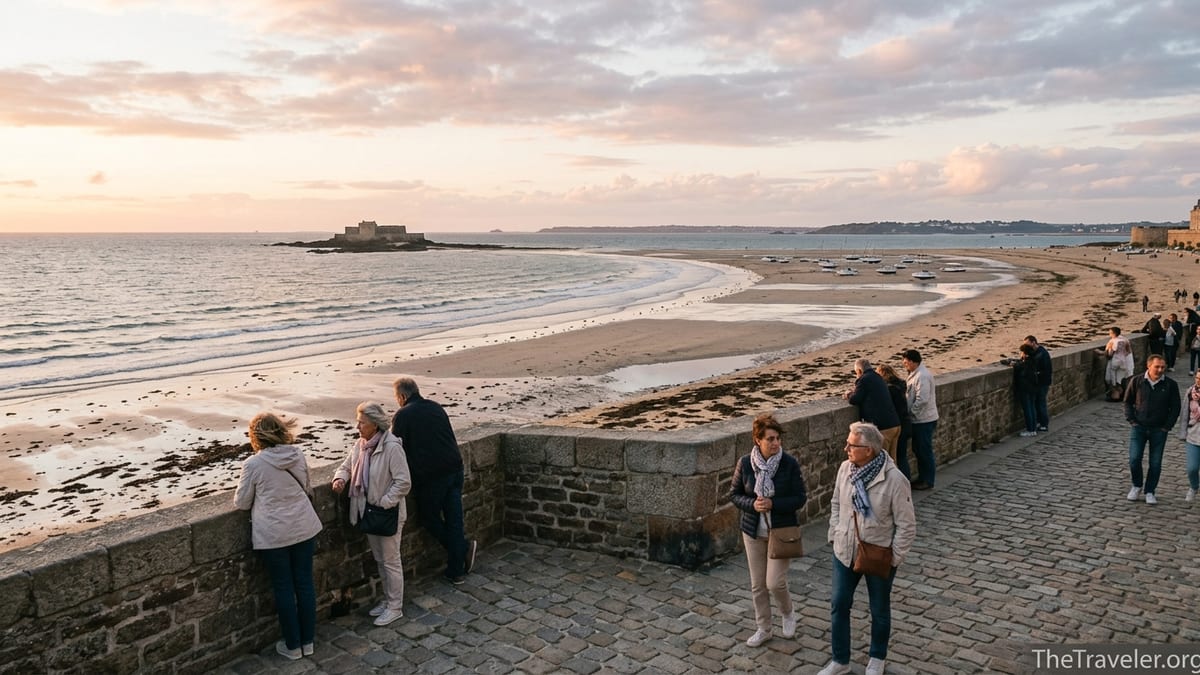
Day 4 is the long drive to Mont-Saint-Michel, roughly 1 hour 30 minutes from Bayeux, followed by a transfer to your Brittany base. To make the most of your time, aim to arrive at the Mont’s parking area by late morning. The shuttle buses and footbridge from the mainland take you across the tidal flats to the island in around 15 minutes. Visiting the abbey, wandering the ramparts and pausing for views across the bay will easily fill three to four hours. From there, it is about 55 minutes by car to Saint-Malo, where you can walk the granite ramparts at sunset and stay overnight.
On Day 5, use Saint-Malo as your base for a taste of Brittany. You might stroll the Intra-Muros walled town in the morning, then drive 20 minutes to Cancale for oysters on the harbour at lunchtime, or 1 hour to Cap Fréhel for cliff-top walks above turquoise water. In the afternoon, return to Saint-Malo or continue another 30 minutes inland to the medieval town of Dinan, which pairs well with an evening train or drive onward to Rennes or back toward Paris.
Seven Day Itinerary With Two-Night Bases
With seven days you can slow the pace, keep one or two two-night stays and feel less like you are merely ticking boxes. A typical pattern is two nights in Rouen or Honfleur, three nights in Bayeux and two nights split between Mont-Saint-Michel bay and Saint-Malo, with a rental car for days 2 through 7.
Day 1 still begins in Rouen, where an overnight stay lets you explore at leisure and perhaps include the Impressionist collections at the Musée des Beaux-Arts or an evening light show on the cathedral facade in summer. On Day 2, rather than rushing on, you might take a half day detour to Giverny for Monet’s gardens if you have your own car, or head out to Étretat’s cliffs on the Côte d’Albâtre before dropping south through Honfleur and on to Bayeux by early evening.
Days 3 and 4 are best spent with Bayeux as your base. One full day can focus on the D-Day beaches, following a similar loop to the five day itinerary but adding extra time at museums such as the Airborne Museum in Sainte-Mère-Église or the Mémorial de Caen if you are willing to drive slightly farther. The other day can combine the Bayeux Tapestry and cathedral with a relaxed rural drive along the Route du Cidre, stopping in half-timbered villages like Beuvron-en-Auge to sample local calvados and apple juice.
On Day 5, drive from Bayeux to Mont-Saint-Michel and plan to stay near the bay overnight rather than pressing all the way to Saint-Malo. Small hotels and chambres d’hôtes in villages like Beauvoir or Courtils offer quieter evenings and easier parking than the island itself, while still being only a short shuttle or drive from the abbey. This also lets you visit Mont-Saint-Michel outside the busiest midday hours, for example for a late afternoon and early evening walk when the day trippers have thinned out.
Days 6 and 7 belong to Saint-Malo and the Brittany coast. From your Mont-Saint-Michel base it is under an hour to Saint-Malo by car. Spend one night within or near the old walls so you can walk the ramparts at both high and low tide, watch the changing sea levels around the tidal swimming pool at Plage du Sillon and explore the cobbled streets once the cruise buses have gone. On your final day, choose between a coastal drive to Cancale, Cap Fréhel or the start of the Pink Granite Coast, or an inland visit to Dinan, before dropping your rental car in Saint-Malo or Rennes and taking a train back to Paris.
Ten Day Route Adding the Brittany Coast
In ten days you can stretch your route into Brittany without constant packing and unpacking. A well balanced pattern is two nights in Rouen or Honfleur, three nights in Bayeux, one night near Mont-Saint-Michel and three nights between Saint-Malo and the northern Brittany coast. You will still want a car for most of this route, picking it up in Rouen or Caen and dropping it at Saint-Malo or Rennes.
Days 1 and 2 can be split between Rouen and Honfleur, with enough time to include Étretat’s cliffs or Deauville’s Belle Époque seafront if you are interested. Many self-drive travellers like to stay directly overlooking Honfleur’s Vieux Bassin harbour on the second night, accepting a slightly higher room rate in exchange for evening and early morning light over the boats once most day trippers have gone.
Days 3, 4 and 5 focus on Bayeux and the surrounding coast. On a ten day schedule you can dedicate one full day to the American sector of the D-Day beaches, another to the British and Canadian sectors and a third to Bayeux itself and the inland countryside. That means time to walk stretches of Omaha or Juno Beach in silence at the end of the day rather than sprinting from one museum to the next. Bayeux’s compact centre also makes it easy to enjoy dinners in local bistros before a short stroll back to your hotel or rental apartment.
On Day 6, move from Bayeux to Mont-Saint-Michel. Consider arriving early enough to take a guided walk on the sands at low tide if conditions allow, or book an evening abbey visit on summer nights when special openings are scheduled. Staying either on the island itself or in a nearby village keeps the experience from feeling rushed, though prices on the island are higher than on the mainland and rooms in the historic buildings sell out far ahead for peak dates.
Days 7, 8 and 9 belong to Saint-Malo and the Brittany coast. Make Saint-Malo your base for at least two nights so that you are not constantly moving your luggage. Popular outings include a coastal drive to Cancale for seafood and views back toward Mont-Saint-Michel, a day exploring the fortified port and riverfront lanes of Dinan, and a longer excursion west to the Pink Granite Coast near Perros-Guirec, which is around 2 hours by car each way but rewards the effort with strange rose-coloured rock formations and wide Atlantic views. On Day 10, use Saint-Malo’s rail link to Paris or drive an hour to Rennes to return your car before catching a high speed train.
Choosing Overnight Bases and Booking Strategy
Most travellers find it easier to think in terms of bases rather than individual nights. In Normandy, Rouen or Honfleur works as an entry base, and Bayeux is widely considered the most practical hub for the D-Day beaches and the tapestry. Guided itineraries and rental cottage operators alike often recommend three or more nights around Bayeux so that you can spread site visits between days and avoid long consecutive drives.
For Mont-Saint-Michel, the main decision is whether to sleep on the island or near it. Rooms within the medieval walls deliver atmosphere after dark and the chance to see the abbey lit up once the last shuttle buses leave. However, they are compact, often involve hauling your luggage up steep stairs and carry a premium price tag. Mainland properties within 5 to 15 kilometres, including simple inns and higher end country hotels, usually offer better value and easy parking, and still allow you to reach the island in a short shuttle or car ride.
In Brittany, Saint-Malo makes the most versatile base for a first visit. It is large enough to have a good range of hotels and restaurants open year round, with direct trains to Paris and easy roads to Dinan, Cancale and Mont-Saint-Michel. If you have three or more nights, you might add a second base farther west on the coast such as Perros-Guirec or Paimpol to reduce backtracking when exploring the Pink Granite Coast or Pointe de Plouha.
For bookings, peak summer and major French holidays require more advance planning. D-Day anniversary dates around early June, for example, see Bayeux and nearby coastal villages book out months ahead, and Mont-Saint-Michel hotels and parking can be fully committed on long weekends. In shoulder seasons, you can usually book a flexible rate a few weeks in advance for the main bases and then fill in smaller Brittany stays closer to departure, giving you room to adjust for weather or evolving interests.
Practical Planning Tips, Costs and Driving Realities
A realistic daily budget for a couple on a mid-range trip through Normandy and Brittany might sit around 220 to 320 US dollars per day once car rental, fuel, tolls, parking, accommodation, meals and entrance fees are added together. A compact hotel room in Rouen, Bayeux or Saint-Malo typically runs from the equivalent of 110 to 180 US dollars per night in mid season, more for harbour or seaview locations. Abbey entry at Mont-Saint-Michel and major museums at the D-Day beaches are priced in line with other major French attractions, while smaller local museums and churches are either free or charge only a modest fee.
On the road itself, driving norms are similar to the rest of rural France. Motorways in Normandy mostly run as toll roads, with fees collected at gantries or booths where credit cards are widely accepted. Coastal routes and departmental roads are free but slower, often winding through villages with 30 or 50 kilometre per hour limits and frequent roundabouts. Parking in historic centres can be tight in the middle of the day, but larger car parks exist at the edge of towns like Honfleur, Bayeux and Saint-Malo, and are signposted clearly from the main approaches.
Weather is another factor that shapes the feel of your trip. Normandy’s maritime climate means changeable conditions even in summer: it is common to experience a misty grey morning on Omaha Beach, bright sun by lunchtime in Bayeux and showers over Mont-Saint-Michel in late afternoon. Pack waterproof layers, comfortable walking shoes that can cope with wet cobblestones, and an extra warm layer for lingering on breezy ramparts in Saint-Malo or at viewpoints on the Brittany headlands.
Finally, consider pacing your days around light and tide. On the D-Day beaches and at Mont-Saint-Michel, low angled morning or evening light often makes for the most atmospheric visits and photographs, while some viewpoints or tidal pools in Saint-Malo and Cancale are completely transformed between high and low tide. Checking local tide tables a day or two ahead and aligning your drives accordingly can make the difference between a crowded midday march and a quieter, more contemplative experience.
FAQ
Q1. Is a car essential for this Normandy and Brittany itinerary
While you can reach Rouen, Bayeux, Saint-Malo and Rennes by train, a car is strongly recommended for linking smaller coastal towns, the D-Day beaches and Mont-Saint-Michel efficiently within a 5, 7 or 10 day trip.
Q2. Where should I pick up and drop off a rental car
Many travellers take the train from Paris to Rouen or Caen, pick up a car there to avoid Paris traffic, and then drop it in Saint-Malo or Rennes before returning to Paris by train.
Q3. How many nights should I stay in Bayeux
For a combined visit to the D-Day beaches, Bayeux Tapestry and nearby countryside, plan at least two nights in Bayeux, and three if your total trip is seven days or more.
Q4. Is Mont-Saint-Michel better as a day trip or overnight stay
If time and budget allow, staying overnight on or near Mont-Saint-Michel lets you experience the abbey and village outside the busiest midday hours, which most visitors find more enjoyable.
Q5. Can I visit both D-Day beaches and Mont-Saint-Michel in a single day
It is technically possible to drive from Bayeux to the D-Day beaches and then on to Mont-Saint-Michel in one day, but it makes for a very long and rushed program, especially in peak season.
Q6. What is the best time of year to follow these routes
Late April, May, June and September usually offer milder weather and fewer crowds than July and August, particularly at the D-Day beaches, Mont-Saint-Michel and in Saint-Malo.
Q7. Are there tolls on the main driving routes
Yes, major highways between Paris, Rouen, Caen and the western part of Normandy use toll sections, while many coast roads and Brittany routes are toll free but slower.
Q8. Is it difficult to park at Mont-Saint-Michel and Saint-Malo
Both have large paid parking areas outside the historic cores, with shuttle buses or short walks into town, but spaces can fill up in the middle of busy holiday periods.
Q9. Can I do this itinerary without changing hotels too often
Yes. With seven or ten days you can base yourself for several nights in Bayeux and Saint-Malo, using them as hubs for day trips while adding only one or two one-night stops.
Q10. How far in advance should I book accommodation
For June, July, August and early September, book key bases like Bayeux, Mont-Saint-Michel and Saint-Malo several months ahead, especially if you want central locations or sea views.