


Northern France is where European history, coastal landscapes and small-town life collide. From the D-Day landing beaches in Normandy to the abbey of Mont-Saint-Michel and the World War I battlefields of the Somme, this part of France rewards both first-time visitors and repeat travelers. Whether you are deciding between a long day tour from Paris, a private driver, or a multi-day self-drive, this guide compares real tour options, typical prices and practical routes to help you choose the style of trip that fits your time, interests and budget.
How Northern France Fits Into a France Itinerary
Most travelers use Paris as their base for northern France. High-speed and regional trains reach Bayeux for Normandy, Pontorson and Rennes for Mont-Saint-Michel, and Amiens or Arras for the World War I battlefields in about 1.5 to 3 hours. That makes day trips possible, but the sheer amount of history means an overnight or two can be more rewarding.
In practical terms, you are choosing between three main hubs. Bayeux works well for D-Day beaches and the Norman countryside. Saint-Malo or Pontorson suit Mont-Saint-Michel and the Emerald Coast. Amiens, Arras or Albert make efficient jump-off points for the Somme and other First World War sites. Many multi-day tours stitch two or three of these together in a loop back to Paris.
The region is compact enough to connect by car in a few hours, but public transport can be patchy once you leave the main lines. That is why so many operators sell guided day tours and small-group minivan trips to specific sites, while private driver-guides focus on customized battlefield or heritage itineraries for families and small groups.
As you compare options, consider your priorities: seeing headline sights in a single day, slowing down in small towns, or tracing a specific family story or national history. Your answers to those questions will steer you toward anything from a large-coach day tour from Paris to a tailored, multi-day battlefield pilgrimage.
Normandy & D-Day Tours: Group Coach, Small Group or Private
Normandy is the most popular northern France excursion from Paris, and that is reflected in the range of tours. Large coach operators sell long day trips that depart central Paris around 7:00 a.m., reach the D-Day beaches by late morning and return late evening. These tours typically cost from about 150 to 190 euros per person for a 12 to 14-hour day, including coach transport, a guide, stops at sites such as Omaha Beach, Colleville-sur-Mer American Cemetery and Pointe du Hoc, plus a basic lunch or free time for meals.
Small-group minivan tours usually limit numbers to 7 or 8 passengers. A typical itinerary from a company like Blue Fox Travel or other Paris-based outfits includes hotel-adjacent pickup points, focused commentary, and more time at fewer sites. Expect pricing from around 220 to 260 euros per person for a full day from Paris. Some operators based in Bayeux, such as local D-Day specialists, offer half-day and full-day circuits of Utah Beach, Sainte-Mère-Église, Gold Beach or Juno sectors that start around 100 to 130 euros per person if you get yourself to Bayeux by train.
Private driver-guide services are the most flexible but also the most expensive. A full-day private D-Day tour for up to 6 people typically runs from about 650 to 900 euros per day, depending on guide credentials, vehicle type and language requirements. These tours are valuable if you have specific family sites to visit, are traveling with older relatives who need a slower pace, or want to include lesser-known locations such as La Cambe German Cemetery or inland battle sites around Carentan.
If you are considering independent travel, renting a car in Caen or Bayeux and following museum and tourist office materials will keep costs down. Car rental for a day in Normandy can start around 60 to 90 euros plus fuel, with parking at most sites either free or low-cost. The trade-off is that first-time visitors may spend more time on navigation and logistics. For travelers with a strong interest in military history but a limited budget, a smart compromise is taking an early train from Paris to Bayeux, joining a small-group tour focused on your preferred nationality’s sector, and returning by rail in the evening.
Mont-Saint-Michel Excursions: Day Trip vs Overnight
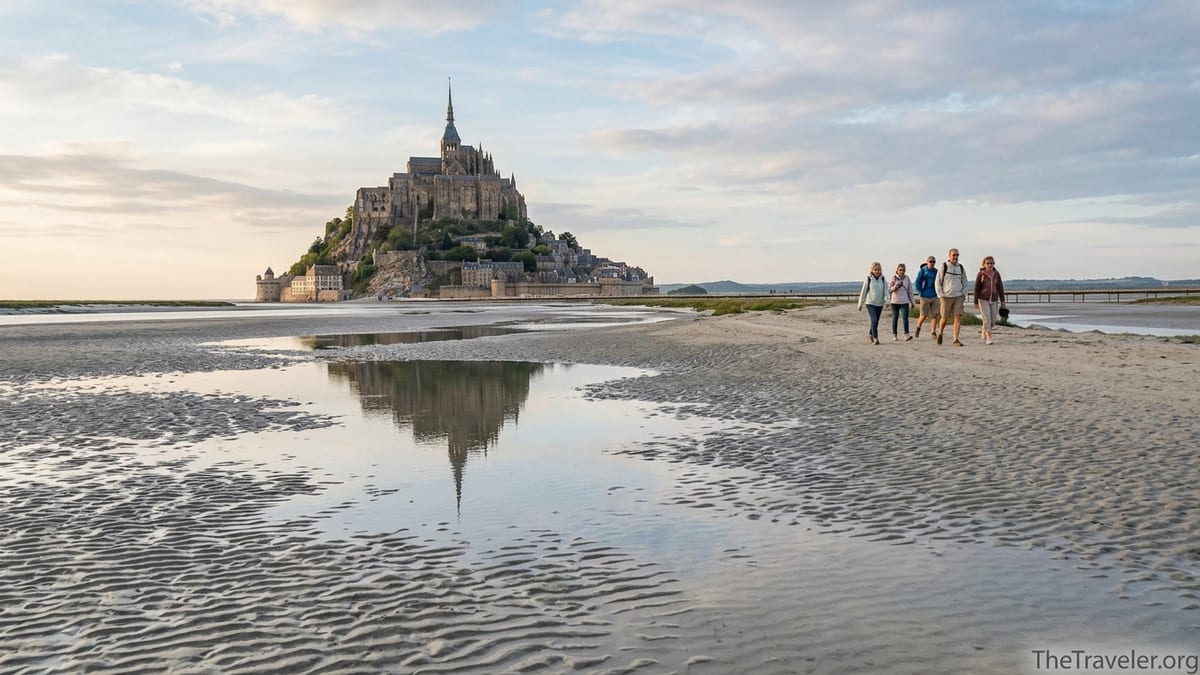
Mont-Saint-Michel is both wildly atmospheric and logistically demanding. From Paris, day tours by coach or minibus typically last 13 to 14 hours. Well-known Paris agencies price these trips from about 135 to 170 euros per person for basic packages that include round-trip coach transport and abbey admission, and up to around 250 euros per person for small-group, semi-private minivan departures with more commentary and smaller numbers.
Many visitors underestimate the time spent on the road. It is about four to five hours each way from Paris, with a rest stop. That leaves roughly four hours on the Mont itself. A typical pattern is a guided abbey visit, followed by one to two hours of free time to explore the medieval streets and walk the ramparts. Lunch is usually on your own in the village or in the modern service area on the mainland. If you want to see the island at dawn or after the day-trippers leave, you will need to plan an overnight stay.
Staying the night either on the Mont or in nearby Pontorson or the bay villages changes the experience. Many travelers catch a train from Paris to Rennes, then board the dedicated coach to Mont-Saint-Michel. This combination can cost roughly 60 to 100 euros per person each way in standard class, depending on booking horizon and ticket type. Basic hotel rooms in Pontorson or on the mainland often start around 90 to 120 euros per night in shoulder seasons, while character hotels on the Mont itself can cost considerably more.
Independent travelers who rent a car in Paris or Rennes gain flexibility to combine Mont-Saint-Michel with Saint-Malo, Cancale or the Normandy coast over several days. Fuel and tolls add up, but for a group or family the per-person cost can be similar to coach tours. The main downside is navigating narrow roads and parking areas, especially in high season. If you prefer to skip driving, a private driver from Rennes or Bayeux for a day at Mont-Saint-Michel for a small group often costs from about 450 to 700 euros, which becomes competitive when split among four or more travelers.
WWI Battlefield Trips: Somme, Ypres and Beyond
The World War I battlefields in the Somme and around Arras and Ypres attract a different kind of visitor, often with family connections or a deep interest in military history. From Paris, specialist small-group tours to the Somme typically run around 11 to 12 hours and cost from about 200 to 250 euros per person. These trips usually include stops at the Thiepval Memorial, Beaumont-Hamel Newfoundland Memorial Park, Lochnagar Crater and the Sir John Monash Centre linked to the Australian National Memorial at Villers-Bretonneux.
Private battlefield tours, especially those focused on the Australian, Canadian, British or American sectors, are common around Amiens and Arras. Companies such as ToursByLocals list full-day Somme itineraries with local driver-guides for around 700 to 1,200 US dollars for a private vehicle carrying two to six people, depending on duration and inclusions. Many of these guides are licensed battlefield specialists who can adapt the day to particular regiments, cemeteries or trench systems, which is difficult to replicate independently in the same time frame.
If you have more than a single day, 2-day and 3-day Western Front packages departing Paris combine the Somme with Ypres in Belgium or Verdun further east. These multi-day tours usually include hotel accommodation, breakfast, museum entries and transport by minibus or coach. Prices can start around 900 to 1,300 euros per person in a small group, depending on hotel category. While not inexpensive, they deliver a structured overview of the main Western Front sectors without requiring you to drive or research each site yourself.
Independent travelers with a rental car can base themselves in Amiens, Arras, Albert or even smaller villages like Péronne to explore at their own pace. Hotels in these areas are often less expensive than Paris, with midrange rooms commonly in the 80 to 130 euro range per night outside the busiest periods. Tourist offices provide maps of circuits such as the Circuit du Souvenir in the Somme, and museums like the Historial de la Grande Guerre in Péronne and the underground Somme 1916 Museum in Albert anchor days that mix driving with walking the preserved trenches and cemeteries.
Private Drivers, Multi-Day Tours vs Independent Travel
Choosing between a private driver-guide, a multi-day escorted tour and independent travel comes down to a mix of budget, confidence with driving, and how deeply you want to engage with the history. Private drivers and guides in Normandy, the Somme and around Mont-Saint-Michel generally charge day rates that start near 450 euros and can exceed 800 euros for highly specialized battlefield historians. These rates typically cover the vehicle, fuel, parking and guide’s time, but not meals or some museum entries.
Private arrangements make the most sense when you want to connect several regions without backtracking. For example, a couple or family might book a three-day private itinerary that leaves Paris for the D-Day beaches and Bayeux on day one, continues along the coast and inland to Mont-Saint-Michel on day two, then cuts across to the Somme for key World War I sites on day three before catching a train back to Paris from Amiens. The per-day cost is higher than a coach tour, but when divided among four or five people and compared with separate day trips, the numbers can converge.
Multi-day escorted tours from major operators cover similar ground on set dates. These trips often bundle accommodation, some meals, coach transport, entrance fees and a program of visits with a dedicated tour director and local guides. On a typical 7 to 10-day northern France itinerary that includes Paris, Normandy, Mont-Saint-Michel and parts of the Western Front, per-person prices can range broadly from about 2,500 to over 4,000 euros depending on hotel class and group size. The appeal is convenience: one booking, one suitcase to manage, and a clear structure each day.
Independent travel remains the most flexible and often the least expensive option for couples or small groups willing to rent a car. Renting a compact car in Paris for a week might cost roughly 350 to 550 euros plus fuel and tolls. Add moderately priced hotels and occasional guided day tours in key areas, and a week exploring northern France can be more cost-effective than a package tour while still providing access to expert commentary where it matters most, such as a dedicated D-Day or Somme battlefield guide for one or two days.
From Paris or On Your Own: Practical Planning & Costs
For many visitors on a short Paris stay, time dictates starting point and style. If you have three or four full days in Paris and want to see Normandy or Mont-Saint-Michel, a single long day tour from Paris is often the most straightforward choice. You trade an early start and late return for the simplicity of walking onto a coach at a central meeting point and letting the guide handle the rest. Budget roughly 150 to 250 euros per person per day for quality full-day excursions by coach or small group minivan.
If you have at least six or seven days in France overall, splitting time between Paris and a regional base can make sense. For example, you might spend three nights in Paris, two nights in Bayeux and two nights in Amiens. You could then book a focused half-day or full-day D-Day tour from Bayeux, walk the medieval streets in the evening, and explore the Somme with a specialist guide from Amiens or Arras. Rail fares on these legs are often modest when booked in advance, leaving budget for targeted guided experiences.
Travelers confident behind the wheel can start or end their car rental outside Paris to avoid city driving. One realistic loop might involve taking a morning train from Paris to Caen or Bayeux, renting a car there for several days to cover Normandy and Mont-Saint-Michel, then driving on to Amiens before returning the car and taking a train back to Paris. Daily driving distances on such a route usually stay under three hours, leaving plenty of time for museums, cemeteries and walks on the beaches or along the bay.
Whichever model you choose, remember to factor in seasonal differences. In July and August, D-Day beaches and Mont-Saint-Michel can feel crowded, and coastal accommodations book out early. Shoulder seasons in May, June, September and early October often combine milder weather, longer daylight and fewer tour groups, which can be especially meaningful for reflective visits to cemeteries and battlefields.
Which Northern France Tour Is Right for You?
To narrow down the options, start with your core interest. If your priority is to stand on Omaha Beach and at the American Cemetery, a structured D-Day tour, whether from Paris or Bayeux, should come first. Travelers intrigued by medieval architecture and unique landscapes may gravitate toward Mont-Saint-Michel and the fortified town of Saint-Malo. Those with family ties to World War I or a deep interest in early twentieth-century history might devote most of their time to the Somme, Arras and Ypres.
Budget is the next filter. Solo travelers and couples who prefer context to logistics may find best value in small-group tours for key experiences combined with independent city and village time. Families or small groups of friends can often justify private guides and drivers if the cost is shared across several people, particularly for customized battlefield itineraries where personalization adds real depth.
Accessibility and pacing also matter. Many D-Day and WWI sites involve uneven ground, slopes, and walking on grass or sand. Private or small-group tours tend to adapt more easily to mobility needs than large coaches. Mont-Saint-Michel’s steep alleys and stairs can be challenging; those with limited mobility may appreciate extra time on the lower streets and terraces rather than rushing up to the abbey and back on a tight group schedule.
In the end, there is no single “best” way to see northern France. A history-focused traveler might combine a full-day small-group D-Day tour with a two-day self-drive across the Somme, while a first-time visitor on a short break might opt for one carefully chosen day tour from Paris. The key is to match the intensity of the history with enough unstructured time to absorb what you see, whether that means a quiet walk among white headstones, a sunset over Mont-Saint-Michel’s bay, or a slow drive through the Norman bocage.
The Takeaway
Northern France rewards both quick forays from Paris and deeper journeys that link the D-Day beaches, Mont-Saint-Michel and the Western Front into one narrative. Large-coach day trips provide a cost-effective, simple way to see headline sights in a single long day, especially if you are short on time or unsure about driving. Small-group and private tours raise the price but deliver denser commentary, more flexible pacing and, in the case of battlefield specialists, a level of interpretation that is difficult to replicate alone.
Independent travel with a rental car, combined with targeted guided days in key areas, offers a strong middle ground for many visitors. It allows you to sleep in Bayeux or Amiens, stroll the streets after the day-trippers leave, and shape your own encounters with some of the most consequential sites in modern history. However you structure your visit, planning early, being realistic about distances, and allowing room for reflection will help you make the most of northern France’s powerful landscapes and stories.
FAQ
Q1. Can I visit the Normandy D-Day beaches on a day trip from Paris?
Yes, you can. Full-day coach and small-group tours typically last 12 to 14 hours, leaving Paris early and returning in the evening. You will see a selection of key sites, but it will be a long day with limited time at each stop.
Q2. Is Mont-Saint-Michel worth visiting on a day tour, or should I stay overnight?
A day tour offers a good first impression, but much of your time is spent traveling. Staying overnight on the Mont or nearby lets you experience the abbey and village in early morning or evening light, when the crowds thin and the atmosphere is most striking.
Q3. How much do small-group Normandy or D-Day tours usually cost?
Small-group minivan tours to the D-Day beaches from Paris commonly start around 220 to 260 euros per person for a full day. Tours starting in Bayeux are often less, roughly from 100 to 150 euros per person, since they do not include the long transfer from Paris.
Q4. What is the best base for visiting the WWI Somme battlefields?
Amiens, Arras and Albert are all practical bases. They have rail connections to Paris, a range of hotels and easy access by car or with local guides to major sites such as Thiepval, Beaumont-Hamel, Villers-Bretonneux and Péronne.
Q5. Do I need a guide to visit the WWI battlefields, or can I go independently?
You can visit independently by car using maps and local signage, but a specialist guide can add significant value by explaining specific actions, units and terrain. Many travelers combine self-drive days with one or two guided days focused on their main areas of interest.
Q6. Are private driver-guides in northern France affordable?
Private driver-guides are a premium option. Full-day rates often start around 450 euros and can exceed 800 euros for specialized battlefield historians. Costs become more accessible when shared among four to six travelers, especially if the itinerary replaces multiple separate day tours.
Q7. Is renting a car in northern France difficult for foreign visitors?
Renting a car is straightforward for most visitors with a valid license and credit card. The main adjustment is to French road signage, toll motorways and roundabouts. Many visitors avoid city driving by collecting and returning the car in regional centers such as Caen, Bayeux or Amiens rather than central Paris.
Q8. How far in advance should I book tours to Normandy or the battlefields?
For high season dates around late spring, summer and key anniversaries, booking several months ahead is wise, especially for small-group and private tours. Outside peak periods, you may find availability closer to your travel dates, but last-minute spots on the most popular tours are not guaranteed.
Q9. Can I combine Normandy, Mont-Saint-Michel and WWI sites in one trip?
Yes. With a week or more, you can link them by car or in some cases with a mix of trains and guided tours. A common pattern is to visit Normandy and Bayeux first, continue to Mont-Saint-Michel and the bay, then head inland to Amiens or Arras for the Western Front before returning to Paris.
Q10. Are these northern France sites suitable for children and families?
Families often find coastal areas like Normandy and Mont-Saint-Michel appealing, though the war sites can be emotionally heavy. Many parents choose a mix of educational visits to selected cemeteries and museums with lighter time on beaches and in small towns, adjusting the amount of battlefield detail to the age and temperament of their children.