


Turning Paris into a base for exploring northern France is one of the smartest ways to structure a first or second trip to the country. Within two to three hours you can be standing on the D-Day beaches, wandering half-timbered streets in Rouen, breathing in Monet’s gardens at Giverny, or watching the tide race around Mont-Saint-Michel. This guide focuses on concrete, current options for doing it as a day trip or an overnight extension, whether you prefer the train, a rental car, or an organized tour that handles everything for you.
How to Choose: Day Trip or Overnight From Paris
From Paris, northern France breaks down into two practical categories: easy day trips under about 90 minutes each way, and deeper excursions that become far more rewarding with at least one night away. Places like Rouen, Giverny, Amiens and Lille sit comfortably in day-trip range by direct train, with journey times of around one hour from central Paris in most cases. You can leave after breakfast, still be back in time for a late bistro dinner, and never touch a rental car.
Destinations on the Normandy coast and beyond, such as the D-Day beaches and Mont-Saint-Michel, technically work as very long day trips, but the travel time pushes you toward either an organized coach tour or a one or two night stay. Expect around three hours by road each way for the main D-Day sites and roughly four to four and a half hours each way when combining train and bus to Mont-Saint-Michel. That is a very big day if you plan it independently, especially in winter when daylight is short.
Your travel style and budget also shape the decision. For example, a same-day return rail ticket from Paris Saint-Lazare to Rouen often starts around 25 to 35 euros if booked in advance in second class, while guided small-group Normandy D-Day tours from Paris typically start near 150 to 190 euros per person including transport and guiding. If you are two or three people who are comfortable driving, renting a compact car for 70 to 120 euros per day including basic insurance can make sense for Normandy or Mont-Saint-Michel, particularly if you plan an overnight in Bayeux, Caen or Saint-Malo.
Time of year matters as well. In high season from May through September, trains and organized tours to these classic excursions often sell out, especially on weekends and dates close to D-Day commemorations in early June. In cooler months you gain breathing room and lower prices, but need to watch for shorter opening hours, reduced shuttle timetables and earlier sunsets, especially along the coast.
Rouen and Giverny: Impressionist Normandy in a Day
Rouen and Giverny give you an accessible taste of Normandy’s history and art without committing to an overnight. Fast regional trains from Paris Saint-Lazare reach Rouen in roughly 1 hour 15 minutes, running frequently throughout the day. Second class advance fares often fall in the 20 to 30 euro range one way, with walk up prices somewhat higher. From Rouen’s station it is a 15 to 20 minute walk down into the medieval core, where the half timbered houses, the soaring cathedral painted by Monet, and the square where Joan of Arc was executed feel a world away from Parisian boulevards.
Travelers often combine Rouen with Giverny on a long spring or summer day. The usual pattern is Paris to Vernon by train in about 45 minutes, followed by a quick shuttle bus or shared taxi to Giverny, a ride of around 15 minutes. Round trip shuttle prices commonly sit around the 10 to 15 euro mark per person, and entrance to Monet’s House and Gardens costs roughly the same again. From late March to early November, when the gardens are in bloom, plan to arrive early in the morning to enjoy the famous water lilies and Japanese bridge before tour groups swell by late morning.
If you prefer not to worry about connections, several operators in 2025 and 2026 run full day tours from Paris that pair Giverny and Rouen. These typically depart central Paris by coach around 8 a.m., stop first in Giverny for a timed entrance to Monet’s estate, then continue to Rouen for a walking tour and independent time before returning to Paris early evening. Prices generally fall in the range of 130 to 200 euros per adult depending on group size and whether lunch and entrance fees are included. While more expensive than the do it yourself option, they remove the stress of coordinating train and bus schedules, especially on Sundays and public holidays.
Independent travelers can also split the two into separate day trips, which is kinder on the pace. For example, you might dedicate one full day to Rouen, including a visit to its excellent fine arts museum with its Impressionist collection, and use another half day for Giverny from late March through October. That approach works well if you have a week or more in Paris and want to keep days relaxed without sacrificing depth.
Amiens and Lille: Cathedral Cities and Northern Flair
North from Paris, Amiens and Lille offer very different flavors of northern France, both perfectly suited to day trips by rail. Trains from Paris Gare du Nord reach Amiens in roughly 1 hour 15 minutes on regional services, with one way fares often falling between 15 and 30 euros depending on departure and advance purchase. Once in Amiens it is about a 15 minute walk along the pedestrian streets to the vast Gothic cathedral, among the largest in France, which dominates the city center.
A practical itinerary is to catch a mid morning train from Paris, arrive in Amiens by late morning, visit the cathedral with time to climb its towers if available, then stroll through the Saint Leu district along the canals and stop for lunch at one of the bistros overlooking the water. In the afternoon you can add a guided boat tour of the Hortillonnages, the floating gardens just outside the center, which run more frequently from spring through early autumn and usually cost a modest fee per person. You can comfortably be back in Paris by early evening on a late afternoon train.
Lille, near the Belgian border, has a more cosmopolitan energy and a strong Flemish influence in its architecture and food. High speed TGV and frequent regional trains link Paris Gare du Nord and Lille in roughly 1 hour flat on the fastest services. Advance one way tickets on non peak departures can be found from around 20 to 35 euros, though last minute peak hour fares can be higher. From the station it is a 10 to 15 minute walk to the Grand Place and the Old Stock Exchange, where ornate gables and colorful facades give the city a different feel from Paris.
Given how easy the rail link is, many travelers treat Lille as a flexible escape from Paris. You might, for example, leave around 9 a.m., spend the morning exploring the old town and the afternoon at the Palais des Beaux Arts, often cited as one of France’s most important museums outside Paris, then linger over early dinner with local beer and carbonnade flamande before catching a late train back. If you are traveling on to Belgium later, Lille also works well as an overnight stepping stone, with direct trains onward to Brussels and beyond.
D-Day Beaches from Paris: Day Tours vs Overnight Base
Visiting the D-Day landing beaches is a priority for many visitors to France, and Paris makes a practical starting point. The core American sector sites such as Omaha Beach, Utah Beach, Pointe du Hoc and the Normandy American Cemetery sit roughly 260 to 300 kilometers west of Paris. By car, that translates to about three hours each way in light traffic. By public transport you are typically looking at a train of about two hours to Bayeux or Caen, followed by a local tour or bus out to the coast.
The most straightforward way to visit as a day trip is an organized tour from Paris that bundles coach transport and guiding. Several established companies currently offer full day D-Day itineraries leaving central Paris around 7 a.m. and returning around 8 to 9 p.m. Many follow a similar pattern: a mid morning stop at the Caen Memorial or another museum, time at Omaha Beach, a visit to the American Cemetery with its sea of white crosses, and sometimes a stop at Arromanches to see remnants of the Mulberry harbor. Prices for these day tours typically start around 150 to 190 euros per adult, sometimes more for small group minivan versions that limit group size to eight people.
For travelers who want more context or a slower pace, building in at least one overnight in Normandy can make a dramatic difference. A popular pattern is to take a morning train from Paris Saint-Lazare to Bayeux in about two hours, check into a local hotel or guesthouse, and join a half day or full day small group tour of the American or mixed Allied sectors the following day. Operators based in Bayeux and Caen run a wide range of tours focused on different national perspectives, including Canadian and British sites, often in groups of eight persons or fewer in minivans. Prices typically range from around 90 to 140 euros per person for a small group day tour, with private tours costing more.
If you are comfortable driving, renting a car in Paris and heading west lets you link the beaches with other Normandy highlights such as Honfleur or the Pays d’Auge cider country. However, be realistic about distances and concentration. A common mistake is planning to leave Paris late morning, stop for lunch en route and still visit several major D-Day sites the same afternoon. In practice, you will want a full day on the ground in Normandy, ideally with an expert guide for at least part of the time, rather than rushing between beaches just long enough for a photo.
Seasonal considerations are important for this region. Around June 6 every year, commemorations bring ceremonies, occasional road closures and higher demand for accommodation. In February 2026, work is also scheduled to restrict access in parts of Pointe du Hoc, which may affect how tours route their visits. Booking well ahead for both transport and guided tours is essential in late spring and early summer, while in winter you may find fewer tours operating each day, especially on Sundays.
Mont-Saint-Michel: Ambitious Day Trip or Magical Overnight
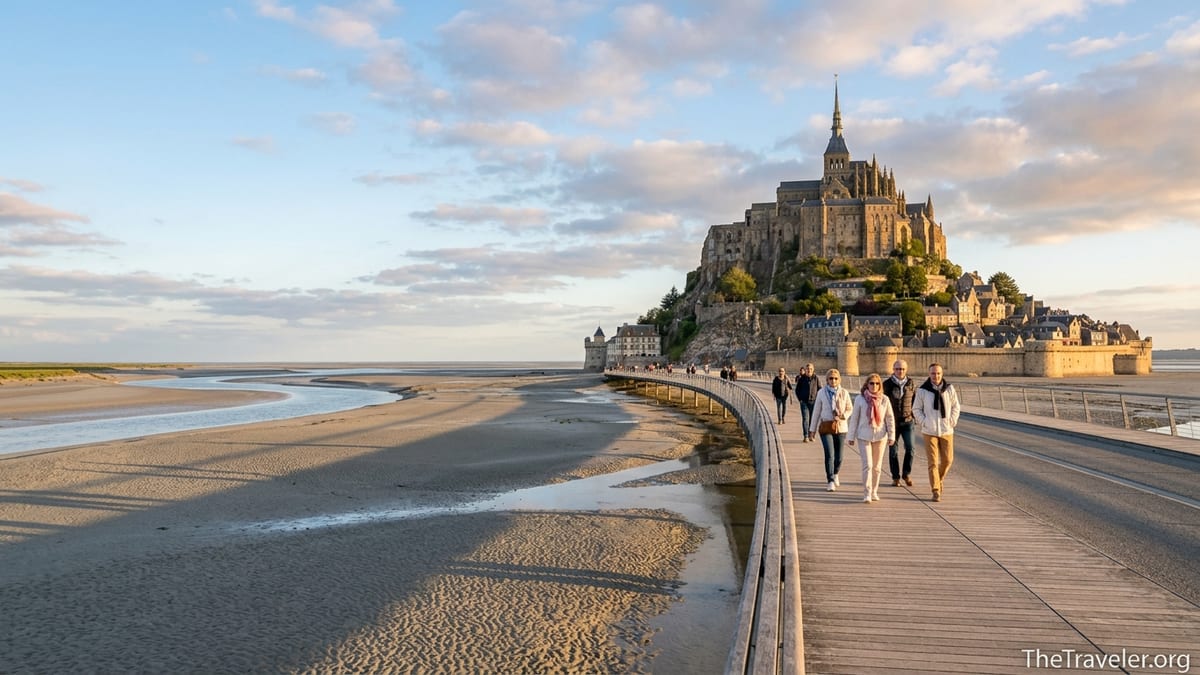
Mont-Saint-Michel, the tidal island crowned by a medieval abbey on the border between Normandy and Brittany, is one of France’s most iconic sights. Reaching it from Paris in a single day is absolutely possible but requires careful planning. The most efficient independent route combines a high speed or regional train from Paris Montparnasse to either Rennes or Pontorson and then a dedicated bus or shuttle onward. Typical travel time is around four to four and a half hours each way when connections line up smoothly.
On certain days of the week, a direct train branded for Mont-Saint-Michel runs from Paris Montparnasse toward Pontorson or nearby, with a timed shuttle connecting to the island. This can allow roughly four to five hours of actual visiting time at the site before you need to head back for the return train, making an intense but doable day trip if you leave Paris early. Expect to depart around 7 a.m. and return to Paris about 9 or 10 p.m. in many sample itineraries, with total transport costs often in the range of 80 to 130 euros per adult depending on how early you book your train tickets.
Organized day tours by coach also depart Paris for Mont-Saint-Michel, usually around 7 a.m., with a drive of approximately four and a half to five hours each way including a rest stop. These tours typically include Abbey entrance and a guided visit, plus some free time in the village. Prices usually start around 150 to 200 euros per person. While they save you from managing train and bus timetables, you should be comfortable with a long day sitting on a coach and visiting during the middle of the day when the island is most crowded.
If your schedule allows, staying overnight near Mont-Saint-Michel or in nearby towns such as Pontorson or Saint-Malo transforms the experience. With a night nearby you can see the abbey illuminated after dark, wander the ramparts when day trippers have gone, and experience the dramatic tidal changes at a more relaxed pace. A practical approach is to travel from Paris to Rennes by late morning train, transfer to an afternoon bus to Mont-Saint-Michel, stay overnight, then continue on to Saint-Malo or back to Paris the following day. Expect mid range hotels on or near the causeway to run from around 120 to 220 euros per night in high season, with more economical options in Pontorson or inland.
Whichever approach you choose, keep an eye on the shuttle system between the mainland parking area and the island. The free shuttles normally run frequently from early morning until late at night, but during peak summer weekends they can be crowded with standing room only. Comfortable walking shoes are essential, as the streets on the island are steep and cobbled, and the abbey visit involves several staircases.
Normandy Beyond the Icons: Honfleur, Deauville and Countryside
Beyond the high profile D-Day beaches and Mont-Saint-Michel, Normandy’s coast and countryside offer quieter places that pair well with an overnight escape from Paris. Honfleur, with its old harbor ringed by tall narrow houses, lies about two and a half hours by car from Paris, often reached via the impressive Pont de Normandie bridge. There is no simple direct rail route, which is why many visitors include Honfleur as a stop on a driving loop that also touches Deauville, Trouville and the inland cider route.
A classic short break looks like this in practice: rent a car in Paris after the morning rush, drive roughly two and a half hours to Honfleur for lunch and an afternoon stroll, then continue 30 to 40 minutes along the coast to overnight in Deauville or Trouville. The next day you might explore half timbered villages in the Pays d’Auge, stopping at a cider producer for a tasting and perhaps picking up a bottle of Calvados before returning to Paris in the late afternoon. This kind of itinerary works best outside the peak August holiday period, when coastal roads and parking can become congested and beach towns book up far in advance.
Travelers who prefer not to drive can still sample this side of Normandy via combinations of train and local bus. For example, you can take a train from Paris Saint-Lazare to Deauville or Trouville in around two and a half hours and then use buses or taxis to reach nearby villages. However, frequencies can be limited, particularly on Sundays and in shoulder seasons, so it is realistic to plan just one or two base towns rather than trying to replicate a complex driving loop by public transport.
Several tour operators based in Paris and Normandy have begun to offer themed small group trips focused on food and landscape rather than military history. These often combine stops at traditional markets, cheese farms and coastal villages, typically in groups of eight people or fewer. Prices are generally comparable to D-Day small group tours, often between 130 and 200 euros per person for a full day including transport and tastings. For travelers who already visited the beaches on a prior trip or who are traveling with children more interested in animals than history, these itineraries can be a worthwhile alternative.
Weather is another factor in choosing where to go. Normandy’s climate is maritime and changeable, with frequent showers and cooler temperatures than Paris even in summer. Having a flexible plan that lets you swap a coastal walk for a market visit or museum on a rainy day is sensible, particularly if you are basing yourself in one town for several nights and taking short drives each day.
Trains, Cars and Organized Tours: Choosing Your Transport
For most of these northern France excursions, you effectively choose between three modes: independent train travel, renting a car, or booking an organized day tour or short package. In practice, many travelers mix and match. For example, you might rely on trains for Rouen, Giverny, Amiens and Lille, then rent a car or join a tour for the D-Day beaches and Mont-Saint-Michel, where public transport is slower and less direct.
Train travel out of Paris is straightforward on the main lines serving these destinations. Rouen, Giverny, Honfleur’s gateway towns and much of coastal Normandy use trains from Paris Saint-Lazare, while Mont-Saint-Michel routes via Paris Montparnasse, and Amiens and Lille use Paris Gare du Nord. Seats are usually unreserved on regional TER services but reserved on high speed TGV and some Intercités trains. Buying tickets in advance through official French rail channels can yield better fares on longer trips such as Paris to Lille or Paris to Rennes, while shorter regional hops like Paris to Rouen are more flexible but may cost slightly more if purchased at the last minute.
Renting a car gives you the most freedom once you are beyond the capital, but it is rarely worth driving within Paris itself. A common strategy is to pick up a rental on the edge of the city or at a station such as Saint-Lazare or Montparnasse, then head directly onto the autoroutes. Expect daily rates for a compact manual car to begin around 50 to 80 euros in low season and rise to 80 to 120 euros or more in peak months once you add basic insurance and occasional tolls. Fuel and tolls between Paris and Normandy’s coast can easily add another 40 to 70 euros to a round trip, depending on your exact route.
Organized tours make the most sense when destinations are remote, transit is infrequent, or context is crucial. The D-Day beaches are the clearest example, where a knowledgeable guide can bring events of 1944 to life in a way that is hard to replicate from a guidebook alone. Mont-Saint-Michel is another case where a structured day trip can simplify complicated connections, particularly in winter. When comparing tours, look for clear information on group size, what is included in the price, language of guiding and any seasonal notes such as limited access to specific sites during renovations.
Whatever mode you choose, consider travel times realistically. For a relaxed trip, many travelers set an informal rule: if a destination involves more than about three hours of total travel each way, they make it an overnight. That threshold would suggest keeping Rouen, Giverny, Amiens and Lille as day trips, while treating the D-Day beaches, Mont-Saint-Michel and the wider Normandy coast as opportunities for at least one night away from Paris.
The Takeaway
Using Paris as a springboard into northern France opens up a range of experiences, from Monet’s water lilies and Gothic cathedrals to windswept beaches rich with 20th century history. The key is matching each destination to the right format. Compact cities on fast rail lines such as Rouen, Amiens and Lille shine as easy day trips. More distant icons like the D-Day beaches and Mont-Saint-Michel reward the extra time and budget of an overnight, especially if you want quieter moments at key sites rather than quick photo stops.
For many travelers, a balanced itinerary might build two or three day trips into a week based in Paris, then add one short Normandy or Mont-Saint-Michel overnight. For example, you might spend one day in Giverny and Rouen, another in Lille, then later in your stay take a one or two night excursion to Bayeux for D-Day touring or to the Mont-Saint-Michel area. Mixing trains, limited car rental and perhaps one carefully chosen guided tour lets you see a surprisingly large slice of northern France without feeling rushed or overloaded by logistics.
Costs will vary depending on season, how far in advance you book and how much comfort you want in hotels and tours. However, with some planning and realistic expectations about travel times, it is entirely possible to experience medieval streets, world class art, moving war memorials and one of Europe’s most dramatic tidal islands, all without giving up Paris as your main base. The result is a trip that feels both rich and manageable, with each excursion adding a distinct chapter to your broader France journey.
FAQ
Q1. Can I realistically visit the D-Day beaches as a day trip from Paris?
Yes, but it is a long day. Organized coach or small group tours that depart Paris around 7 a.m. and return about 8 to 9 p.m. are the most practical for a same day visit. Independent travel by train and local tour is possible but often works better with at least one overnight in Bayeux or Caen.
Q2. Is Mont-Saint-Michel better as a day trip or an overnight from Paris?
You can visit as a long day trip using a train plus bus combination or an organized coach tour, but many travelers find an overnight stay more rewarding. Sleeping nearby lets you see the abbey in the evening or early morning when crowds thin and the tides are more dramatic.
Q3. Do I need to rent a car to explore Normandy from Paris?
No, you do not need a car for every destination, but it can be helpful for coastal and rural areas. Rouen, Giverny, Amiens and Lille are easy by train. For the D-Day beaches, Mont-Saint-Michel or smaller towns like Honfleur and Deauville, a car or organized tour often saves time and simplifies logistics.
Q4. How far in advance should I book train tickets for these trips?
For high speed routes such as Paris to Lille or Paris to Rennes, it is wise to book several weeks in advance for better fares, especially in May through September and on weekends. For shorter regional trips like Paris to Rouen, you have more flexibility, but booking a few days ahead can still secure better prices and preferred departure times.
Q5. Are these day trips suitable for children?
Yes, with some adjustments. Giverny, Mont-Saint-Michel and coastal towns are generally very appealing for children. The D-Day beaches can be moving and sometimes emotionally intense, so it is worth considering your child’s age and interests, and choosing a shorter or more general history focused tour if needed.
Q6. What is the best season to take these excursions from Paris?
Late spring and early autumn offer a good balance of milder weather, longer daylight and fewer peak season crowds. Summer brings vibrant gardens and beach weather but also higher prices and busier trains and tours. Winter is quiet and atmospheric, especially in cities like Rouen and Lille, but some coastal services run less frequently and days are shorter.
Q7. Can I combine Giverny and Rouen in a single day trip?
Yes, especially from late March to early November when Monet’s gardens are open. A common pattern is to visit Giverny in the morning using the train and shuttle via Vernon, then continue by train to Rouen for an afternoon and early evening in the city before returning to Paris.
Q8. How expensive are organized tours compared with doing it myself?
Organized full day tours from Paris to Normandy or Mont-Saint-Michel often start around 150 to 200 euros per adult, including transport and guiding and sometimes entrance fees or lunch. Doing the same trip independently by train or rental car can be cheaper, especially for couples or small groups, but you trade some savings for the added effort of arranging all logistics and, for historical sites, the lack of a dedicated guide.
Q9. Are there language barriers on trains and tours outside Paris?
On main train routes, ticket machines and signage generally offer English, and staff in larger stations are accustomed to international travelers. Many organized tours from Paris and major hubs such as Bayeux, Caen or Rennes run in English or bilingual formats. In smaller towns, a few basic French phrases and a translation app go a long way.
Q10. What should I pack for a winter or shoulder season day trip to Normandy?
Pack layers, a waterproof jacket and comfortable walking shoes, as Normandy’s weather can be windy and damp even when Paris is relatively calm. A compact umbrella, gloves and a warm hat are useful at coastal sites and exposed places like Mont-Saint-Michel or the D-Day beaches, where conditions can feel colder than in the city.