


Northern France rewards travelers who choose their base towns wisely. Distances look short on the map, yet trains are slower once you leave the Paris region, coastal roads twist along cliffs and tides shape how you experience headline sights such as Mont‑Saint‑Michel and Saint‑Malo. Picking the right place to stay can mean the difference between relaxed café evenings and hours spent staring through a windscreen. This guide compares the main hubs in Normandy, Brittany and Lille, with practical suggestions for first‑time visitors, couples, families, road‑trippers and travelers arriving from the UK.
Lille: Best Northern City Hub and UK Arrival Base
Lille is the main big‑city gateway to northern France and an excellent first or last stop if you are arriving by Eurostar from London or by train from Brussels. Trains from London Saint Pancras to Lille Europe often take around 1 hour 20 minutes, so many visitors step off the train mid‑afternoon and want a hotel they can reach on foot. For first‑timers, the most atmospheric base is Vieux‑Lille, the old town north of the Grand Place, a district of Flemish gabled houses, cobbled streets and boutiques. Typical mid‑range hotels in this area might charge in the region of 130 to 200 euros per night for a double room in high season, with breakfast usually an extra 12 to 18 euros per person.
Travelers who prioritize convenience over charm often choose the streets between Lille Flandres and Lille Europe stations, where large chain properties offer air‑conditioned rooms, reliable Wi‑Fi and underground parking. This can work well for a one‑night stop at the beginning or end of a road trip, especially if you plan to pick up a rental car near the station the next morning. Expect station‑area prices to be similar to the old town, with occasional weekend deals outside major events such as the huge September braderie flea market, when rates rise sharply and early booking becomes essential.
For couples, Vieux‑Lille’s renovated mansions and design‑led guesthouses provide a more intimate feel than the business hotels near the station. Many properties occupy 17th and 18th century townhouses, with details like exposed beams, brick vaults and small internal courtyards. Families, on the other hand, often prefer modern chain hotels around the station or the Euralille shopping complex, where you are more likely to find quadruple rooms, sofa beds and interconnecting options. From Lille, it is realistic to do a day trip by train to places like Arras or Dunkirk, but for Normandy and Brittany you will almost always want to move your base closer.
Rouen: Historic Capital and Handy Base for Eastern Normandy
Rouen, Normandy’s historic capital on the Seine, works best for travelers interested in Gothic architecture, museums and charming streets rather than beach time. The compact centre on the right bank is renowned for its half‑timbered facades, the vast cathedral famously painted by Monet, the Gros‑Horloge clock and the modern church dedicated to Joan of Arc. Most visitors choose to stay in or just around this pedestrian core so they can walk everywhere and avoid driving narrow lanes that can be confusing after dark. In practice this means looking for accommodation within a 10 to 15 minute walk of the cathedral or the train station called Rouen‑Rive Droite.
Prices in the historic centre are moderate by French city standards. Simple two‑star and three‑star hotels and guesthouses might start from around 90 to 130 euros per night in shoulder seasons, rising in summer or during festivals. Historic properties near the cathedral or Place du Vieux‑Marché can cost more, but they place you amid Rouen’s best restaurants and terraces. This area suits first‑time visitors who plan to explore the city itself for at least a day or two, perhaps combining the cathedral, Joan of Arc sites and the excellent fine arts museum with café stops on timber‑framed squares.
Rouen is a strong base for travelers who want to combine city life with Impressionist and river scenery. By car it is roughly 1 hour to the chalk cliffs of Étretat and around 1 hour 30 minutes to Honfleur in normal traffic, making Rouen suitable for day trips if you do not mind some driving. Public transport options also exist but tend to be slower and require connections. Couples may appreciate a boutique hotel in a restored mansion with views of the cathedral spire, while families sometimes choose chain hotels on the edges of the centre because these properties more often provide secure onsite parking and family rooms.
Honfleur: Romantic Harbour Town for Short Breaks
For many travelers, the postcard image of Normandy is Honfleur’s Vieux Bassin, the old harbour lined with slate‑faced tall houses reflected in the water. Staying here is about atmosphere rather than logistics. The town is compact and walkable, with most hotels and guesthouses clustered around the harbour and in the lanes behind Sainte‑Catherine church. Prices are typically higher than in inland towns because space is limited and demand from weekenders is constant. A comfortable, mid‑range room for two near the harbour in high season can easily start around 180 to 230 euros per night, with harbour‑view rooms often costing more.
Honfleur is ideal for couples on a two to three night romantic break, especially if arriving by car. From town you can drive across the Pont de Normandie bridge to Le Havre or along the Côte Fleurie to Deauville and Trouville in under an hour in reasonable traffic. Many travelers pair Honfleur with one more inland base, such as Bayeux, to see the D‑Day beaches and Mont‑Saint‑Michel without excessive backtracking. The streets immediately around the harbour can be noisy, particularly on summer evenings, so light sleepers sometimes choose guesthouses a five to ten minute walk uphill, where parking is also easier.
Families can enjoy Honfleur’s small beaches and playgrounds, but the town’s narrow streets and limited parking make it less relaxing in peak school holiday weeks. Accommodation suitable for families, such as apartments with kitchenettes or hotels offering larger rooms, tends to book out quickly for July and August. If your priority is space and value, you may prefer a nearby village or a hotel further out along the coast, using Honfleur for daytime visits rather than as your overnight base.
Bayeux and the D‑Day Beaches: Best Base for History Lovers
Bayeux is widely regarded as the most practical base for exploring the D‑Day landing beaches, thanks to its central location, walkable medieval core and rail link to Caen and Paris. The town is known for the Bayeux Tapestry and its cathedral, but for many visitors the main draw is easy access to sites like Omaha Beach, the US cemetery at Colleville‑sur‑Mer and the artificial harbour remains at Arromanches. By car, most of these key points are within 20 to 40 minutes, and numerous local tour operators run half‑day and full‑day excursions that depart directly from Bayeux’s centre and train station.
Accommodation in Bayeux ranges from small family‑run hotels in 18th century mansions to simple modern chains near the ring road. A central three‑star hotel might cost from roughly 120 to 170 euros per night in spring and autumn, with higher prices in June around D‑Day commemorations. Many properties include parking, which is helpful for road trips linking Bayeux to Mont‑Saint‑Michel or the Cotentin Peninsula. This makes Bayeux a smart choice for visitors from the UK who arrive at Caen‑Ouistreham or Cherbourg by ferry and want an easy first stop that combines history and practicality.
For families, Bayeux offers a calmer environment than beach resort towns, with playgrounds, casual crêperies and manageable walking distances. Couples who value character may look for bed‑and‑breakfasts in old stone houses along quiet side streets. Travelers relying on public transport can still base themselves here by using guided tours to reach more remote D‑Day sites that are not well served by buses. Bayeux also pairs logically with a second base such as Saint‑Malo or Mont‑Saint‑Michel for a broader Normandy and Brittany itinerary over a week.
Mont‑Saint‑Michel Area: Overnight or Day Trip Base
Mont‑Saint‑Michel is one of France’s most iconic sights, yet choosing where to sleep requires thought. The island itself has a handful of small hotels and inns lining the steep main street. Staying here allows you to experience the abbey early in the morning or late in the evening, when day‑tripper crowds have thinned and the bay feels atmospheric. However, rooms on the island are typically small, often in historic buildings with many stairs, and prices are high for the level of comfort. Dinner options are limited and usually must be reserved in advance, especially in summer.
Many travelers instead choose lodging on the mainland within the official shuttle zone, near the causeway. Here, modern hotels and motels offer larger rooms, easier access with luggage and more predictable amenities such as onsite parking and air‑conditioning. Rates are usually lower than on the island itself, with mid‑range rooms sometimes found around 130 to 190 euros per night depending on season. From these hotels, shuttle buses and a pedestrian path bring you to the island throughout the day, allowing you to time your visit with the tides and avoid the peak midday crowds.
Mont‑Saint‑Michel works well as a one‑night stop on a longer road trip between Normandy and Brittany. For example, a common UK‑to‑France route is to arrive by ferry in Caen or Saint‑Malo, spend two nights in Bayeux for the D‑Day beaches, then continue to Mont‑Saint‑Michel for one night, followed by two or three nights in Saint‑Malo or along the Emerald Coast. Families often prefer the mainland hotels with family rooms and easier parking, while couples seeking a once‑in‑a‑lifetime atmosphere may gladly accept the island’s quirks and higher prices for a night within the walls.
Saint‑Malo and the Emerald Coast: Seaside Base for Brittany
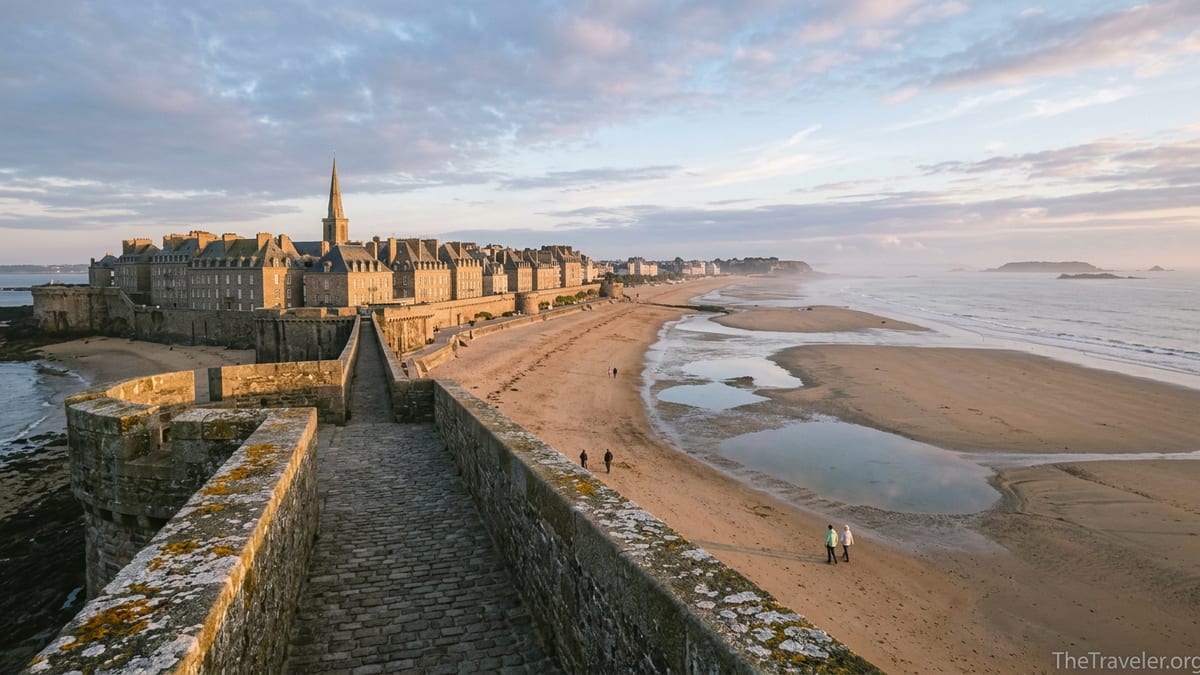
Saint‑Malo, with its granite ramparts and tidal beaches, is a major entry point to Brittany for travelers from the UK. Ferries from Portsmouth and other English ports arrive at the modern harbor, from which it is a short drive or taxi ride to the walled old town known as Intra‑Muros. This is the most atmospheric area to stay, with stone streets, restaurants and bars protected by fortifications. Many hotels here occupy historic buildings and are compact, but the trade‑off is the ability to walk along the ramparts at sunset or step out early for a quiet stroll before cruise passengers and excursion groups arrive.
Room prices in Intra‑Muros vary widely. Simple two‑star properties and small family‑run hotels may start around 110 to 150 euros per night in shoulder seasons, while sea‑view and spa hotels on or near the walls can be significantly higher, particularly in July and August. Some hotels provide underground or nearby reserved parking for an extra nightly fee, a consideration if you are mid‑road trip and do not want to circle repeatedly for a space. For travelers who prefer calmer evenings, the beachside districts beyond the walls, such as those along Plage du Sillon, provide more space, modern rooms and easier access by car.
Saint‑Malo works well for a mixed city‑and‑coast holiday. By car you can reach Dinard across the estuary in about 20 minutes, Cancale and its oyster farms in roughly 25 minutes and the countryside of inland Brittany in under an hour. Couples often choose boutique hotels inside the walls for access to restaurants and bars, while families might favor apartments or aparthotels near the beach where children can play between sightseeing. From a logistics perspective, Saint‑Malo is also a practical final base before returning a rental car at the port or driving back to ferry terminals, avoiding the need to thread through large cities at the end of your trip.
Choosing Between Coastal Bases: Who Should Stay Where
When comparing coastal bases, it helps to think in terms of travel style. First‑time visitors keen to see both Normandy and Brittany often choose a two‑base strategy: one inland or near the D‑Day beaches, such as Bayeux, and one on the coast, such as Saint‑Malo. This approach keeps daily driving times manageable. For example, spending three nights in Bayeux gives you time for the tapestry, a full D‑Day tour and perhaps an afternoon in Arromanches, then two or three nights in Saint‑Malo allow for a day trip to Mont‑Saint‑Michel, another to Dinard or Cancale and at least one unscheduled day for beach walks.
Couples focused on atmosphere and food might lean toward Honfleur plus Saint‑Malo or Dinard. A long weekend could look like one or two nights in Honfleur for harbour‑side dinners and gallery browsing, followed by two nights in Saint‑Malo inside the walls, with a side visit to Cancale for oysters. On the other hand, families who prefer space may gravitate toward self‑catering cottages just outside Bayeux or along the countryside near Saint‑Malo, allowing children to play in gardens while parents cook simple meals from local markets. In such cases, towns like the fishing port of Cancale or villages along the Côte d’Émeraude become day‑trip destinations rather than bases.
Road‑trippers arriving by car from Calais or Dunkirk might structure their itinerary around one‑night stops, using Lille or Rouen as the first city break, then continuing to Bayeux and Mont‑Saint‑Michel before finishing in Saint‑Malo. Travelers arriving from the UK by ferry directly to Caen or Saint‑Malo can often skip Lille entirely and focus on regional bases. Think carefully about parking: historic centres such as Honfleur’s harbour area and Saint‑Malo Intra‑Muros are charming but can be challenging for drivers unfamiliar with French signposting, especially in peak season or in the evening when on‑street spaces are scarce.
The Takeaway
Northern France rewards those who accept that one all‑purpose base rarely works. Lille is your efficient urban gateway, Rouen the Gothic and cultural hub of eastern Normandy, Honfleur the classic harbour escape, Bayeux the practical anchor for the D‑Day beaches, Mont‑Saint‑Michel a dramatic but specialized overnight and Saint‑Malo the ideal seaside finale. Thinking in terms of two or three bases, rather than trying to do everything from a single hotel, reduces transit time and gives each stop a clear purpose.
When choosing where to stay, match your base to your priorities: history and museums, romantic harbour evenings, family‑friendly beaches or smooth ferry and train logistics. Check approximate driving times rather than relying on straight‑line distances, and factor in the reality of parking outside historic centres. With a realistic plan that balances movement and rest, your trip through Lille, Normandy and Brittany can feel like a sequence of distinct, memorable chapters instead of a blur of packed suitcases and motorway exits.
FAQ
Q1. Is Lille a good base for exploring Normandy and Brittany?
Lille is excellent as an arrival or departure city, especially by Eurostar, but it is too far from the Normandy and Brittany coasts for efficient day trips. Most travelers use Lille for one or two nights, then move closer to the areas they want to explore.
Q2. If I only have three nights, where should I base myself for the D‑Day beaches?
For a short visit focused on the D‑Day sites, Bayeux is usually the most practical base. It offers easy access to Omaha and Gold beaches, organized tours, a walkable centre and a range of hotels that suit both couples and families.
Q3. Is it worth staying overnight on Mont‑Saint‑Michel?
Staying overnight on the island is worthwhile if you value atmosphere and are comfortable with small rooms, stairs and higher prices. If you prefer more space, parking and modern facilities, choose a hotel on the nearby mainland and visit the abbey in the early morning or evening.
Q4. Which is better for couples, Honfleur or Saint‑Malo?
Honfleur feels more intimate and is ideal for a short romantic break centered on the harbour and nearby Côte Fleurie resorts. Saint‑Malo offers grander ramparts, bigger beaches and easier onward connections in Brittany, making it better for longer trips that mix romance with exploring.
Q5. What is the best base if I am arriving by ferry from the UK?
If you arrive in Saint‑Malo, staying Intra‑Muros or along Plage du Sillon is very convenient. From Caen‑Ouistreham, many travelers drive on to Bayeux for at least two nights to see the tapestry and D‑Day beaches, while Cherbourg arrivals sometimes choose Bayeux or the Cotentin Peninsula as a first base.
Q6. Do I need a car to enjoy Northern France properly?
A car gives you much more flexibility, especially for rural sites and small coastal towns. However, it is still possible to combine trains and organized tours by basing yourself in places like Rouen, Bayeux and Saint‑Malo, which all have reasonable public transport links and excursion options.
Q7. Where should families stay for a mix of history and beach time?
Families often do well splitting time between Bayeux and the Saint‑Malo area. Bayeux provides manageable access to the D‑Day sites and museums, while Saint‑Malo and nearby beaches like Dinard offer space for children to play and relax between excursions.
Q8. Are hotels in old town centres noisy at night?
Historic centres such as Vieux‑Lille, Honfleur’s harbour and Saint‑Malo Intra‑Muros can be lively in the evenings, especially in summer. Light sleepers may prefer side‑street rooms, upper floors or properties set a short walk away from the busiest squares.
Q9. How far in advance should I book accommodation in Normandy and Brittany?
For June to September, it is sensible to book popular bases like Bayeux, Honfleur, Mont‑Saint‑Michel and Saint‑Malo at least two to three months in advance, especially if you need family rooms, parking or specific dates around school holidays or the D‑Day anniversary.
Q10. Can I visit both Normandy and Brittany in one week?
Yes, many travelers comfortably combine both in seven to eight days by choosing two or three well‑placed bases, such as Bayeux plus Saint‑Malo with an optional overnight stop near Mont‑Saint‑Michel. The key is to avoid overpacking your schedule with long day trips.