


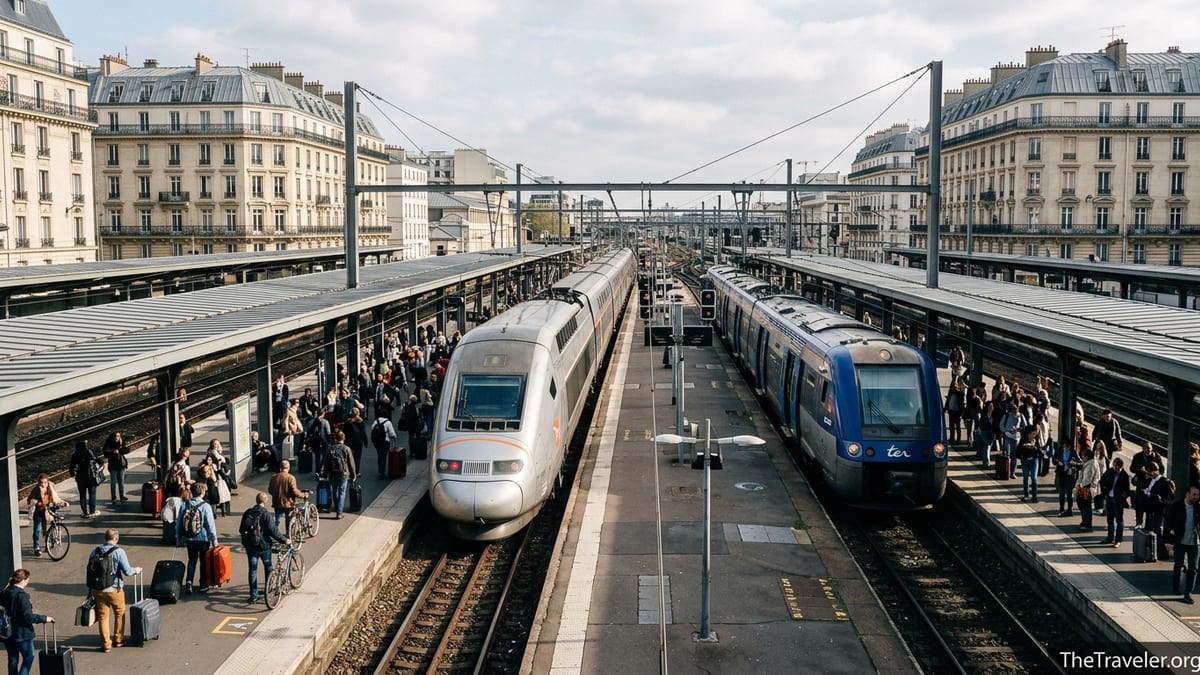
Northern France is made for rail travel. Fast links radiate from Paris to Lille, Amiens, Rouen, Caen and Rennes, putting grand cathedrals, medieval ports and Atlantic beaches within a few hours of the French capital. With some planning, you can combine high speed trains, regional lines and a short rental car to unlock windswept cliffs, D-Day beaches and quiet inland villages without wasting time or money.
Understanding Northern France by Rail from Paris
Most journeys in northern France start or connect in Paris, and knowing which station serves which region makes planning much easier. Lille and the northeast are served from Paris Gare du Nord, Normandy from Paris Saint Lazare, Brittany and the Atlantic coast from Paris Montparnasse, and some secondary routes from Paris Gare de l’Est. These stations sit in different neighborhoods, so allow at least 45 to 60 minutes to cross town if you need to change between them using the Metro, RER or a taxi.
From Paris to Lille, TGV inOui services run from Gare du Nord, usually taking about 1 hour on the fastest departures. On a typical weekday there are multiple trains each hour at peak times, giving you flexibility to leave Paris after breakfast and be having coffee in Lille’s Grand Place by late morning. Slower and usually cheaper OUIGO or regional trains also run on some dates, at the cost of a longer journey and fewer onboard services.
Normandy lines fan out from Paris Saint Lazare, a bustling commuter and long distance hub in the 8th arrondissement. Frequent TER Normandie and Intercités-style services reach Rouen in about 1 hour 15 minutes and Le Havre in roughly 2 hours, with Caen in just over 2 hours and Cherbourg in around 3. These trains are not high speed but are comfortable, with a mix of reserved and open seating depending on the service and fare you choose.
Brittany and western routes depart Paris Montparnasse on high speed TGVs. Paris to Rennes usually takes around 1 hour 30 minutes on the fastest trains, making it realistic to leave Paris in the late morning and arrive in time for lunch in the old town. From Rennes you can connect to slower regional trains towards Saint Malo, Quimper and other coastal towns, or pick up a rental car to reach beaches, countryside inns and small Breton ports that are not served directly by rail.
Key City Bases and Typical Train Journeys
Lille makes an excellent base for the northern plains and cross-border trips to Belgium. Two central stations, Lille Flandres and Lille Europe, sit a short walk apart. TGVs from Paris usually arrive at Lille Europe, while some regional TER services and occasional TGVs use Lille Flandres. From Lille, you can reach Arras in about 20 to 40 minutes by regional train, Amiens in around 1 hour 20 minutes with a change, and even Brussels in roughly 35 minutes on high speed services, making day trips across the border straightforward.
Amiens, reachable in roughly 1 hour 15 to 1 hour 30 minutes from Paris Gare du Nord on TER Hauts de France trains, is a good gateway to the Somme battlefields and the Baie de Somme coast. Trains typically run at least once an hour during the day. Many visitors overnight in Amiens, visit the cathedral and hortillonnages (floating gardens), then rent a car for 24 to 48 hours to explore rural memorials, cemeteries and coastal villages like Saint Valery sur Somme that can be awkward to string together by bus.
Rouen, about 1 hour 15 minutes from Paris Saint Lazare on frequent TER Normandie services, works well for exploring the Seine valley and the Alabaster Coast. With 1 or 2 trains most hours during the day, you can comfortably day-trip from Paris. However, if you want to visit Etretat’s chalk cliffs, the fishing port of Fécamp or smaller seaside resorts, you will quickly hit the limits of rail and bus schedules. Many travelers spend at least one night in Rouen, then pick up a car near the station for a loop along the coast and back.
Further west, Caen and Rennes provide bases for larger itineraries. Caen, roughly 2 hours from Paris Saint Lazare, gives access to the D-Day landing beaches, Bayeux and the Cotentin Peninsula. Rennes, about 1 hour 30 minutes from Paris Montparnasse by TGV, opens routes to Saint Malo, Dinan and the rugged north coast of Brittany. In both cities you can combine a rail arrival with a short car rental to cover rural or coastal highlights before returning the car and continuing by train.
Tickets, Reservations and Where to Book
For most routes in northern France, buying tickets through the main French rail app or a major international distributor is the simplest option. You can usually purchase tickets up to about three months ahead on domestic services, sometimes a little more for TGVs. Advance purchase almost always yields lower prices on Paris to Lille and Paris to Rennes TGVs, where standard one way fares can be relatively high if bought last minute.
As an example, a midweek Paris to Lille TGV booked several weeks in advance might cost in the region of 25 to 40 euros in second class, while a last minute fare at a similar time of day can easily be significantly higher. Paris to Rennes TGVs show similar patterns, with attractive advance deals and steeper walk up prices. On regional TER services such as Paris to Amiens or Paris to Rouen, pricing is usually more stable and sometimes starts at under 20 euros, though there can still be small discounts for early purchase or off peak travel.
Seats on TGVs and most Intercités services are reservation based, so buying a ticket automatically includes a specific seat or at least a reserved place on a specific departure. On TER regional trains, tickets are often more flexible, and you may simply validate your ticket if it is paper, or show a QR code for a given day of travel without a compulsory seat reservation. When in doubt, check whether your ticket is tied to a specific departure time or valid all day, especially on routes where both TGV and TER options exist.
International visitors may be tempted by rail passes, but for a focused trip in northern France, point to point tickets often work out cheaper and easier. Passes can be good value if you plan to travel on high speed trains almost every day, for example combining Paris, Lille, Brussels and Amsterdam in a single week. For a shorter itinerary that spends several nights in each base and uses a rental car for local exploration, individual tickets usually give more flexibility and lower overall cost.
Navigating Stations, Luggage and Connections
Major Paris stations and regional hubs like Lille, Rouen, Caen and Rennes are generally straightforward, but they can feel hectic at peak hours. In Paris, platforms for long distance trains are usually posted about 15 to 20 minutes before departure. Regulars line up in front of the departure boards, and once your train’s platform is announced you may need to walk several hundred meters along the concourse. If you are carrying large suitcases, arrive at the station at least 30 minutes before departure to find your platform calmly.
On most French trains you keep your luggage with you. TGVs and Intercités typically have luggage racks at the carriage ends and above seats. Regional TER trains have more open layouts, sometimes with dedicated spaces for suitcases and bikes. There are rarely strict weight checks, but traveling with one medium suitcase and a smaller day pack per person makes boarding and storing bags far easier, especially when you need to change trains or navigate stairs between platforms.
Station services vary by city. Paris Gare du Nord, Saint Lazare and Montparnasse all have staffed ticket counters, ticket machines that accept major cards, and a range of cafes and food outlets. Lille Flandres and Lille Europe include luggage lockers, though availability can change, and security rules apply. Rouen, Caen and Rennes have more modest but still functional facilities, usually including a small waiting area, basic food options and at least one kiosk or supermarket nearby for picking up snacks and water before your train.
When planning connections, be conservative. In Paris, aim for at least 1 hour between trains if you must change stations, for example arriving at Gare du Nord from London or Lille and continuing from Saint Lazare to Rouen. Within the same station, a 20 to 30 minute connection is usually enough if trains are on time, but allowing more time helps if you are unfamiliar with the layout. In regional hubs like Rennes or Caen, a 15 to 20 minute change between platforms is generally comfortable, though leaving a buffer protects you from occasional delays.
When a Rental Car Becomes Useful
Trains handle long distances across northern France very efficiently, but a rental car can transform access to coastal and rural areas. A common strategy is to ride the train from Paris to a regional base, then collect a car near the station for a short, focused segment. For example, you might take a morning train from Paris Saint Lazare to Caen, pick up a car just outside the station, and spend two or three days exploring Omaha Beach, Pointe du Hoc, Arromanches and the cider roads of the Pays d’Auge before returning the car in Caen or Bayeux.
Normandy’s Alabaster Coast is another area where a car pays off. From Paris you can reach Rouen easily by train and continue to Le Havre by rail, but smaller places like Etretat, Yport and Veules les Roses are connected mainly by regional buses that run less frequently outside summer. Renting a compact car in Rouen or Le Havre opens up this coastline at your own pace, letting you stop at viewpoints, small harbors and inland villages that trains and buses pass by.
In Brittany, trains comfortably cover the main line from Paris to Rennes and on to Saint Malo and Quimper, yet a car is helpful to reach wilder stretches of coast. From Rennes or Saint Malo, many travelers rent a car to explore Cap Fréhel, Cancale’s oyster beds or the Emerald Coast’s smaller coves. Similarly, if you are staying inland in a gîte or country hotel in the Breton countryside, having a car makes it much easier to reach trailheads, markets and remote chapels that rarely see public transport.
Conversely, in large cities like Lille or central Rennes, a car can be a burden rather than a benefit. Street parking can be limited and expensive, and you will not need a vehicle to explore the compact historic centers. In these cases, plan your trip so that you only collect a car on the day you leave the city for the countryside, and drop it before returning to a major urban base or back to Paris. This keeps costs down and avoids navigating unfamiliar traffic and environmental zones.
Suggested Rail-Based Itineraries with Targeted Car Use
One classic five to seven day loop combines Normandy and Brittany with minimal driving. You might start with a TGV from Paris Montparnasse to Rennes, spend two nights exploring the city’s half timbered old quarter and markets, then take a regional train or short car rental to Saint Malo for a night inside the walled town. From there, a train or bus back to Rennes and a TGV to Paris followed by a transfer to Saint Lazare sets you up for a second leg in Normandy.
From Paris Saint Lazare, continue by train to Caen and stay two or three nights. Here, renting a car becomes valuable. You could spend one day driving the D-Day sector between Sword and Juno beaches, and another heading to Bayeux’s tapestry and on to the American cemetery above Omaha Beach. Return the car in Caen or Bayeux, then rejoin the rail network to Rouen for a final night, before taking a direct train back to Paris Saint Lazare on your departure day.
Another option focuses on the north and northeast. Start from Paris with an early TGV to Lille, base yourself for two nights and day trip by regional train to nearby towns such as Arras, with its reconstructed Flemish squares, or Lens for the Louvre Lens museum. There is no need for a car here, as frequent regional trains and local trams cover the main sights. On day three, continue by TER to Amiens for a night, exploring the cathedral and riverfront, then rent a car the next morning for a Somme loop through Villers Bretonneux, Thiepval and the countryside memorials.
Couples and families who prefer fewer hotel changes might choose just one or two hubs. For example, you could spend four nights in Rouen, arriving from Paris by train, taking one day trip to Le Havre by rail, and renting a car for a separate two day loop along the coast to Etretat and Fécamp with an overnight in a seaside guesthouse. Returning the car in Rouen keeps your final day simple: a direct train back to Paris Saint Lazare without worrying about city driving or parking fines.
Practical Tips for Comfort, Timing and Costs
Travel times in northern France are short enough that most journeys fit comfortably between breakfast and lunch, or lunch and dinner. When possible, aim for mid morning or mid afternoon trains to avoid commuter peaks around Paris, Lille and Rouen where carriages can feel busy. On high speed TGVs, booking a specific seat allows you to choose between solo seats, window pairs or family facing bays where available, which is worth the small extra effort on journeys of more than an hour.
Food on French trains is improving but still limited compared with what you can buy in city bakeries and supermarkets. Before boarding, pick up a baguette sandwich, pastries and bottled water near the station. Gare du Nord, Montparnasse and Saint Lazare all have multiple bakeries and takeaway counters; in smaller towns like Caen or Amiens, look for bakeries on the streets leading to the station. Onboard TGVs usually carry a café bar with snacks, hot drinks and simple meals, but regional TER trains rarely do.
To control costs, be flexible with days and times where you can. Shifting a Paris to Lille or Paris to Rennes departure by an hour earlier or later can sometimes cut the fare noticeably, especially on busy Fridays and Sundays. Traveling midweek, avoiding major French holiday weekends and buying tickets several weeks ahead are simple ways to keep the budget in check. If you hold a discount card or are under 28, senior or traveling with children, check for reduced fares on the booking site before you confirm.
Finally, do not underestimate how pleasant it is simply to watch the landscape change from the train window. Between Paris and Rouen you pass gentle Seine valley farmland, on the way to Lille you cross the flat fields and wind turbines of the north, and the Paris to Rennes high speed line alternates between forests and rolling countryside. Even if you plan to rent a car later, giving yourself time to enjoy at least one high speed segment in daylight adds another layer of experience to your northern France journey.
FAQ
Q1. Do I need to reserve seats on trains from Paris to Lille, Rouen, Caen or Rennes?
Seat reservations are compulsory on TGV services to Lille and Rennes and on most long distance trains, but not usually on regional TER trains to Rouen, Caen or Amiens, where tickets are more flexible and seating is generally first come, first served.
Q2. How far in advance should I book my train tickets in northern France?
For high speed TGV routes such as Paris to Lille or Paris to Rennes, booking a few weeks to a couple of months ahead often secures lower fares, while regional TER tickets on routes like Paris to Rouen or Amiens can be bought closer to departure without as much price difference.
Q3. Which Paris station do I use for trains to Lille, Amiens, Rouen, Caen and Rennes?
Trains to Lille and Amiens leave from Paris Gare du Nord, services to Rouen and Caen depart from Paris Saint Lazare, and TGVs to Rennes and Brittany use Paris Montparnasse.
Q4. Is it easy to travel with luggage on French trains?
Yes, most French trains have overhead racks and larger luggage spaces at carriage ends, but there is no dedicated checked baggage service, so traveling with one main suitcase and a smaller bag per person makes boarding and storage much easier.
Q5. When is renting a car essential for northern France?
A car is most useful for reaching the D-Day beaches near Caen, the Alabaster Coast around Etretat and Fécamp, the Somme battlefields near Amiens, and rural or coastal areas in Normandy and Brittany that are poorly served by trains and buses.
Q6. Can I do day trips from Paris to Lille, Rouen or Amiens by train?
Yes, fast connections make day trips realistic: Paris to Lille is about 1 hour by TGV, Paris to Rouen around 1 hour 15 minutes, and Paris to Amiens roughly 1 hour 15 to 1 hour 30 minutes on regional trains.
Q7. Are there discounts for children, students or seniors on these routes?
French rail offers various discount cards and reduced fares for children, young adults, seniors and families; when booking, check the relevant age categories and card options to see if you qualify for lower prices.
Q8. Do I need a car inside cities like Lille, Rouen, Caen or Rennes?
No, central areas in these cities are compact and walkable, often with local trams or buses, so it is usually better to explore on foot and only rent a car when you leave the city for coastal or rural excursions.
Q9. How much time should I allow to change between Paris stations?
If you must transfer between stations, such as Gare du Nord and Saint Lazare or Montparnasse, allow at least 45 to 60 minutes using the Metro, RER or a taxi, especially if carrying luggage or traveling at busy times.
Q10. Is driving in northern France difficult for visitors?
Outside Paris, roads in northern France are generally well maintained and relatively calm, but you should familiarize yourself with French road rules, speed limits and parking regulations, and avoid driving into central Paris where traffic and restrictions are more challenging.