


Central France is one of the easiest parts of the country to explore without a car. Fast and frequent trains fan out from Paris to Loire Valley châteaux, Burgundy vineyards and volcanic landscapes in Auvergne. With a bit of planning, you can ride the rails to strategic bases like Tours, Orléans, Dijon and Clermont-Ferrand, then decide where a short-term rental car adds flexibility for villages and vineyards beyond the tracks.
Understanding Central France by Rail: The Big Picture
When people talk about “central France,” they are usually referring to a broad swath of territory stretching from the Loire Valley south through Auvergne, and east toward Burgundy. The good news for travelers is that many of the region’s key cities are on direct rail lines from Paris, often with journey times of two hours or less. This makes it realistic to land in Paris, spend a couple of days in the capital, then move on by train for a week in the countryside without ever touching a steering wheel.
From a rail-planning perspective, Paris is not one station but several. Trains to the Loire Valley hubs of Orléans and Tours normally leave from Gare d’Austerlitz or Montparnasse, while Dijon and the Burgundy area are served from Gare de Lyon on high-speed TGV services. Clermont-Ferrand, gateway to Auvergne’s volcano country, is linked to Paris Bercy by classic Intercités trains rather than TGVs. Knowing which station you need helps you judge transfer time across Paris if you are arriving on Eurostar at Gare du Nord or flying into Charles de Gaulle Airport.
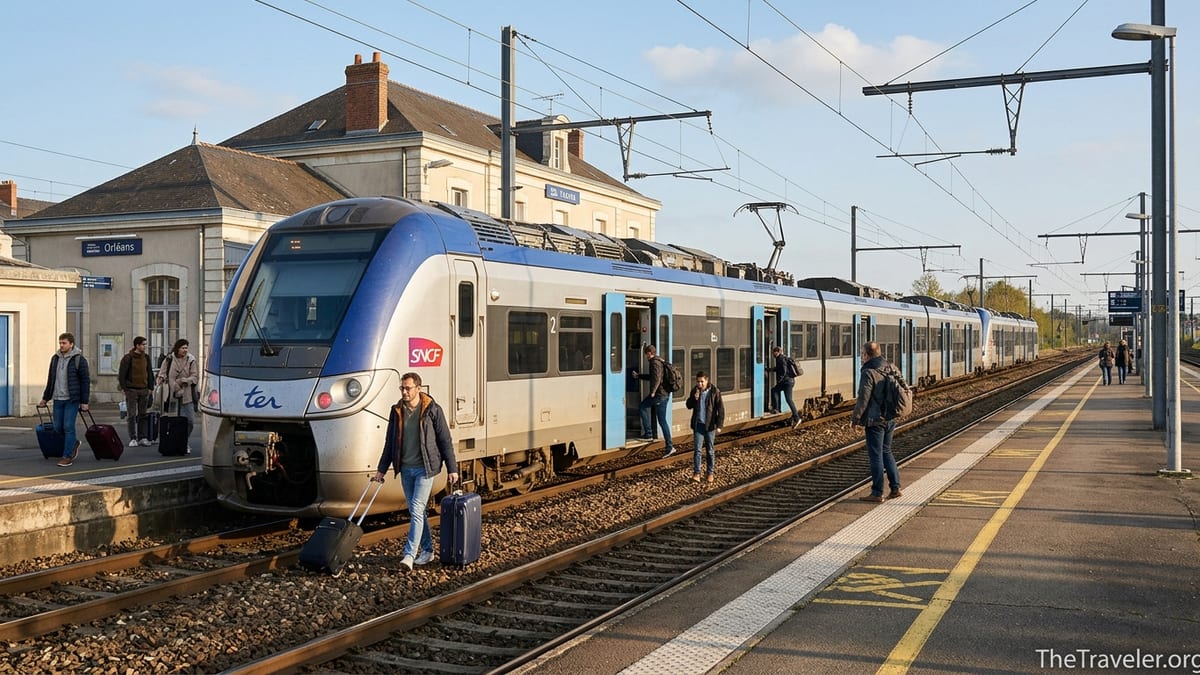
The core operators you will see when you search schedules are TGV INOUI and sometimes OUIGO for high-speed services, Intercités for classic long-distance trains, and TER regional trains that stop more frequently but are often cheaper and require no seat reservation. For many central France journeys, you will be choosing between a fast, reserved TGV from Paris plus a local TER connection, or a slower but often more scenic direct Intercités or TER train.
Because SNCF uses dynamic pricing on TGV and Intercités services, booking these a few weeks ahead often yields advance fares around 25 to 40 euros for journeys like Paris to Dijon or Clermont-Ferrand in second class, instead of 60 euros or more if you buy at the last minute. Regional TER services on routes such as Paris to Orléans often have fixed or only mildly variable pricing, so they are less time-sensitive to book and can be bought on the day without a major penalty.
Paris to Orléans and Tours: Loire Valley Gateways
Orléans is one of the closest significant cities to Paris and a natural jumping-off point for the eastern Loire Valley. Direct TER or Intercités trains from Paris Austerlitz reach Orléans or Les Aubrais (the main intercity stop just north of town) in roughly one to one and a half hours, with several departures throughout the day. Typical one-way fares on regional TER services can start around 15 to 25 euros in second class if you buy online or at the station. Because these trains are regional, they do not usually sell out and do not require seat reservations, which makes Orléans a flexible first stop if you are worried about tight connections.
Orléans itself has a pleasant historic center and cathedral, but for many visitors it is mainly a base to pick up a rental car. Local trains and buses reach some Loire châteaux, but if you want to string together sights like Chambord, Cheverny and Chenonceau in one or two days, coordinating infrequent buses quickly becomes frustrating. A common pattern is to take a mid-morning train from Paris to Orléans, check into a city-center hotel, then collect a rental car from one of the offices near Les Aubrais or the central station for two or three days of château-hopping.
Tours and nearby Saint-Pierre-des-Corps further west are excellent rail-served bases for the central Loire. High-speed TGVs from Paris Montparnasse cover the route to Saint-Pierre-des-Corps in around 1 hour, while slower TER or Intercités services from Austerlitz may take closer to 2 hours. Advance TGV fares between Paris and Tours can often be found from roughly 25 to 40 euros in second class if you book several weeks out, particularly for off-peak departures midday or in the evening.
In Tours, you can combine trains and short car rentals strategically. The city’s tram and bus network links the main station with outlying districts, and many rental agencies cluster just outside the station concourse. A realistic itinerary might be three nights in Tours without a car, using local trains to visit Amboise or Chinon along the Loire, then hiring a car for a single day to reach more remote spots such as Château de Villandry’s gardens or the vineyards around Bourgueil. This approach keeps parking headaches and rental costs contained while still giving you access to quieter parts of the valley.
Paris to Dijon: Fast Tracks into Burgundy
Dijon is one of the easiest central and eastern French cities to reach from Paris, thanks to frequent high-speed TGV services from Gare de Lyon. On most days, there are around a dozen or more direct trains, with average journey times of roughly 1 hour 40 minutes to 2 hours. When you search on SNCF’s booking site or on international platforms, you will see a mix of TGV INOUI and TER services, with advance second-class TGV fares often starting around 30 euros on quieter days for the roughly 300-kilometer trip.
Burgundy is where the train-versus-car question becomes particularly relevant. Dijon itself is compact and walkable, with tram lines connecting the station to the historic center in a few minutes. You could easily spend two or three days here without a car, visiting the Ducal Palace, market halls and mustard shops on foot. For wine country, however, the famous Route des Grands Crus that links villages like Gevrey-Chambertin, Nuits-Saint-Georges and Beaune is only partially accessible by train. Local TER trains can take you from Dijon to Beaune in about 20 minutes, but most vineyards and smaller villages lie a few kilometers off the rail line.
A practical compromise is to base yourself in Dijon or Beaune by train, then rent a car for one or two days to explore the Côte de Nuits and Côte de Beaune at your own pace. Many visitors pick up a compact car at Dijon Ville station around 9 a.m., spend the day weaving through villages like Vosne-Romanée and Pommard, and return the car before closing time in the early evening to avoid overnight parking fees. Expect daily rental rates for a small manual car in low season to start around 50 to 70 euros before fuel and insurance, rising in summer and early autumn when harvest season draws more visitors.
If you prefer to avoid driving after wine tastings, consider combining TER trains with local taxi services or guided minivan tours instead of renting a car. For example, you might take the train from Dijon to Beaune in the morning, leave luggage in station lockers, join a half-day vineyard tour that handles the country roads and tasting-room logistics, then continue by TER to another town. In Burgundy, the rail spine between Dijon, Beaune and further south toward Chalon-sur-Saône is robust; it is the last-mile access into the vineyards where hired wheels or a rental car become more useful.
Paris to Clermont-Ferrand: Into the Auvergne Volcanoes
Clermont-Ferrand sits in the heart of the Auvergne region, framed by the Chaîne des Puys volcanic hills. From Paris, you reach it by Intercités trains rather than TGV. These leave from Paris Bercy Bourgogne – Pays d’Auvergne station, typically around eight or more times a day on weekdays. The distance of roughly 430 kilometers is covered in around 3 hours 30 minutes on the fastest services, with some trains taking closer to 4 hours depending on stops. Advance second-class fares can sometimes be found in the 25 to 40 euro range, while last-minute bookings may approach or exceed 70 euros on busy days.
The Intercités experience is different from a TGV but well-suited to this route. Seats are generally roomy, there are dedicated luggage racks at the ends of cars and overhead shelves above seats, and you can walk through several carriages for a quieter spot. On a daytime train, the journey becomes part of the trip: you watch the flat plains south of Paris gradually give way to rolling hills, with glimpses of towns like Nevers or Vichy depending on your service. Snack bars are not guaranteed on every Intercités run, so bringing a simple picnic from a Paris bakery is a good idea.
Once in Clermont-Ferrand, the question of renting a car becomes more pressing. The city itself is compact and served by trams and buses, so you can manage easily on foot for one or two days while exploring the cathedral, Michelin museum and old town squares. But many of the region’s strongest attractions, such as the Panoramique des Dômes rack railway up the Puy de Dôme, lakes like Aydat or Chambon, and hiking trails through the volcanoes regional park, are far easier to reach by car. Public buses do serve some of these sites, but frequencies drop sharply on weekends and outside July and August.
A pragmatic strategy for central France rail travelers is to take the Intercités from Paris to Clermont-Ferrand, stay one or two nights car-free, then pick up a rental car on the morning of a planned loop through the volcanoes. Several major rental brands maintain offices within walking distance of the station. A three-day rental allows you to circle through the Chaîne des Puys, spend a night near a lake or country inn, then return to Clermont-Ferrand to drop the car and rejoin the rail network. This way, you avoid the fatigue and toll costs of driving all the way from Paris while still accessing remote rural spots.
Tickets, Reservations and Luggage: How to Make Trains Work for You
Planning a central France rail trip effectively means understanding how SNCF tickets and reservations work. On TGV INOUI and most Intercités services, every seat is reserved, and prices are dynamic. Purchase a non-flexible advance fare and you may pay half what a flexible, refundable ticket costs. For example, a midweek morning TGV from Paris to Dijon booked a month ahead might cost around 30 euros in second class, while a fully flexible same-day ticket could be 60 euros or more. Regional TER trains, such as the frequent Paris to Orléans services, usually do not require reservations, and the price is mainly determined by distance, with occasional regional passes or weekend discounts.
If your trip involves a flight or Eurostar arrival, resist the temptation to book a tight connection to your first central France train. It is wiser to allow a buffer of at least two hours between a scheduled arrival at Gare du Nord and a TGV or Intercités departure from another Paris station. This gives you time to clear possible delays, ride the RER or metro across town, and still pick up a coffee and snack. On routes served by TER trains with fixed pricing, such as Paris to Orléans, you can wait until you are in Paris to buy onward tickets, preserving maximum flexibility in case of late arrivals.
Luggage on French trains is largely self-service. On TGV and Intercités services, you keep your bags with you; there are usually large luggage racks at car ends and smaller shelves between seat backs or overhead. There is no separate checked baggage service on most domestic routes. Practically, this means one medium suitcase and a carry-on per person is far more manageable than multiple large bags, especially on busy trains in summer. On TER services to Orléans or Tours, racks may be smaller, so it helps to arrive a few minutes early to board and position your luggage.
When booking, you will also encounter optional extras such as seat selection, first-class upgrades and flexible fare add-ons. First class on many central France routes buys slightly wider seats and quieter cars rather than radically different service. For a short 1 hour 40 minute hop to Dijon, second class is usually comfortable enough. The main upgrade worth considering is fare flexibility: if your plans are uncertain, paying a little more for a semi-flexible ticket that can be changed for a small fee is often cheaper than forfeiting a non-changeable fare entirely.
When a Rental Car Becomes More Useful
Trains are excellent for moving between major hubs in central France, but a rental car becomes more useful the moment your plans depend on rural villages, scattered vineyards or multiple châteaux in a day. The rail network excels at getting you to cities like Orléans, Tours, Dijon and Clermont-Ferrand; it is weaker at connecting hamlets, country inns and trailheads. In the Loire Valley, for example, you can visit Amboise and Blois by train quite easily, but stitching together Chambord, Cheverny and a wine tasting in Sancerre in one loop is impractical without a vehicle.
You do not need to rent a car for your entire French vacation to benefit from one. Many travelers increasingly use short-term rentals of two to four days tacked onto a mostly rail-based itinerary. A couple might spend three nights in Paris, take the train to Tours, travel by regional train to Chinon for a day, then pick up a car from a station-side agency for a two-night loop through remote châteaux and vineyards before dropping it back in Tours and continuing by TGV to Dijon or Lyon. This approach keeps fuel, tolls and parking costs in check and avoids driving in central Paris entirely.
Season matters too. In high summer or during grape harvest in Burgundy, local buses and taxis can be heavily booked or operate on reduced rural schedules. A rental car then becomes not just more convenient but sometimes the only practical way to reach trailheads in the Auvergne volcanoes or late-afternoon tastings in small wine villages that have no evening bus home. Conversely, in winter, some mountain roads near Clermont-Ferrand require extra caution or snow equipment, and in that season it can be wiser to base your countryside exploring on guided tours and trains.
Finally, think about how comfortable you are with French road rules, manual transmissions and narrow lanes. Many smaller rentals in central France are manual, and automatic vehicles usually cost more and sell out first in peak season. If you are not confident driving a manual car, reserve an automatic as early as possible and consider concentrating your driving days in less congested areas, such as the plains around Orléans or the rolling hills south of Dijon, rather than attempting complex urban driving in larger cities.
Practical Itineraries: Combining Trains and Cars
One of the easiest itineraries to visualize starts and ends in Paris with a loop through the Loire and Burgundy. On day one, you take a mid-morning TGV from Paris Montparnasse to Saint-Pierre-des-Corps, arriving in about an hour, and spend two nights in Tours without a car, using local trains to visit Amboise and its château. On day three, you collect a rental car by the station around 9 a.m., drive to Villandry’s gardens and Chinon’s medieval streets, stay overnight at a countryside guesthouse, and return the car to Tours the following afternoon before boarding a late-day TGV back to Paris or onward to Dijon.
A second example focuses on Burgundy and Auvergne. From Paris Gare de Lyon, you ride a morning TGV to Dijon, checking into a hotel within walking distance of the station. After a day and a half exploring Dijon on foot, you rent a car for two days to meander through the Côte de Nuits and Côte de Beaune villages, staying one night in Beaune. You return the car in Dijon, then take an Intercités or TER train via Nevers or another junction to Clermont-Ferrand, spend two nights car-free in the city, and finally rent a car one last time for a two-day loop through the Chaîne des Puys and nearby lakes before returning to Clermont-Ferrand and catching an Intercités back to Paris Bercy.
For travelers short on time, a more focused itinerary keeps things simple. Consider three nights in Paris, then a direct train of around one to one and a half hours from Paris Austerlitz to Orléans, where you base for three nights. Rent a car only on your second day to drive to Chambord, Cheverny and perhaps a winery near the Sologne forests, then return it that evening. On your third day, explore Orléans on foot and maybe take a short TER ride to a nearby small town like Beaugency along the Loire. On day seven, return by TER to Paris and connect to your next destination or flight home.
Whichever pattern you follow, planning around rail hubs that also host rental agencies simplifies logistics. When searching for accommodation, filter for hotels within walking distance of the station, ideally under 10 minutes on foot, so you can easily manage luggage on your arrival and departure days. In most of these cities, taxi and rideshare services are available, but station-adjacent hotels reduce your dependence on them during tight connections or in bad weather.
The Takeaway
Central France rewards travelers who lean on its rail network to cover long distances and bring in rental cars only where the tracks end. Paris connects efficiently to Orléans, Tours, Dijon and Clermont-Ferrand with a mix of TGV, Intercités and TER services, many in the 1 to 3 hour range and with advance fares that can be surprisingly competitive with driving once you factor in fuel and tolls. Within cities, walking, trams and buses are usually enough, especially if you pick accommodation near the station and pack reasonably light.
The key decisions are when to pay for speed and certainty on high-speed or Intercités trains, and when to embrace the flexibility of regional TER services that you can buy just before departure. From there, layer in short, purposeful car rentals for rural stretches in the Loire, Burgundy vineyards and the Auvergne volcanoes. By combining trains and cars thoughtfully, you can experience castles, vineyards and mountain vistas in a compact itinerary that feels rich rather than rushed, and that keeps most of your travel time above the landscape rather than behind a steering wheel on the autoroute.
FAQ
Q1. Do I need to book trains from Paris to central France in advance? For TGV and Intercités trains, booking in advance usually secures better prices and guaranteed seats, while regional TER services such as many Paris to Orléans trains can often be bought on the day without a major price penalty.
Q2. Which Paris station serves trains to Orléans and Tours? Trains to Orléans typically depart from Paris Austerlitz, while high-speed services to Tours and Saint-Pierre-des-Corps mainly leave from Paris Montparnasse, so always check your ticket carefully before travel.
Q3. How long is the train from Paris to Dijon? Direct TGV services from Paris Gare de Lyon to Dijon usually take around 1 hour 40 minutes to 2 hours, with several departures each day and faster options at peak times.
Q4. Is there a high-speed TGV from Paris to Clermont-Ferrand? No, the Paris to Clermont-Ferrand route is served by classic Intercités trains rather than TGVs, with the quickest journeys typically around 3 hours 30 minutes from Paris Bercy.
Q5. Can I visit Loire Valley châteaux without renting a car? You can reach some towns like Blois, Amboise and Chinon by train, but visiting multiple châteaux in a single day is much easier with a rental car due to limited bus services between rural sites.
Q6. Are French trains suitable for travelers with large luggage? Most TGV and Intercités trains have luggage racks at the ends of cars and overhead shelves, but traveling with one medium suitcase and a smaller bag per person is the most practical approach.
Q7. Is driving in central France difficult for visitors? Outside large cities, roads in central France are generally quiet and well signposted, although many rental cars are manual and some rural lanes are narrow, so confidence with basic European driving rules is helpful.
Q8. Can I combine a rail pass with these central France routes? Many central France routes are compatible with European rail passes, but you will still need to pay separate seat reservations on TGV and Intercités trains, while TER services usually have no reservation requirement.
Q9. Which city is the best base for Burgundy without a car? Dijon works very well thanks to frequent TGVs from Paris and local TER connections to Beaune, allowing you to explore key towns on foot and use occasional tours or taxis for nearby vineyards.
Q10. Is it possible to do central France as day trips from Paris? Some destinations like Orléans and Tours can be visited as long day trips from Paris by train, but spending at least a night or two in Loire, Burgundy or Auvergne bases gives you a much more relaxed experience.