


Few road trips in Europe feel as quintessentially French as a loop through the Loire Valley châteaux, Burgundy’s vineyards and the volcanic landscapes of Auvergne. Central France is built for slow driving: empty D-roads threading through riverside villages, vineyard lanes winding past stone wine cellars, and panoramic routes over green volcanoes. This guide focuses on the practical side of planning that trip, from renting a car and understanding tolls to choosing scenic roads and building 5, 7 and 10 day circuits that link these three regions without rushing.
Why Central France Is Perfect for a Road Trip
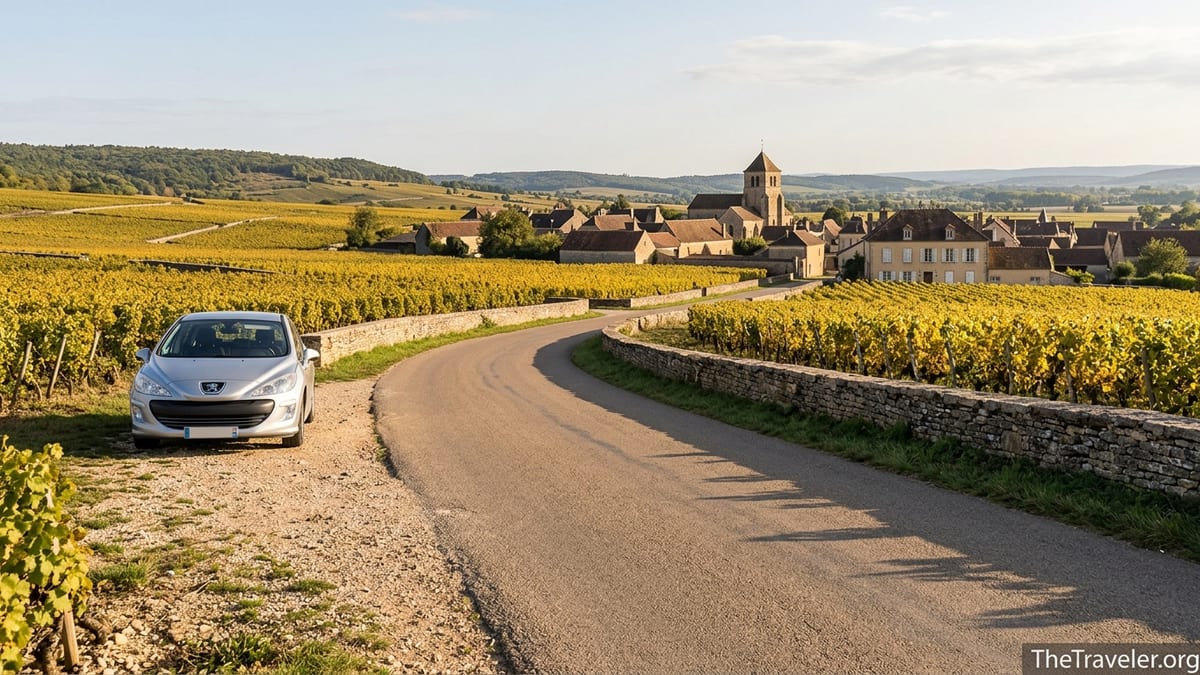
Central France combines three complementary landscapes that are best experienced behind the wheel. The Loire Valley between Orléans and Angers is famous for châteaux such as Chambord, Chenonceau and Amboise, many of them spread along the A10 and A85 motorways but connected by quieter local roads that follow the Loire River. Burgundy, centered on Dijon and Beaune, offers compact wine routes like the Route des Grands Crus, a roughly 60 kilometer signposted road between Dijon’s outskirts and Santenay that passes names such as Gevrey-Chambertin, Vosne Romanée and Meursault. South again, Auvergne’s Chaîne des Puys and Monts Dore ranges are laced with winding departmental roads that pass crater lakes and ancient spa towns.
Distances are short enough that you can cover the three regions in a week if you keep to the autoroutes, but the real charm lies in leaving the A10, A6 and A71 to use D-roads that run through villages instead of around them. This is particularly true in Burgundy, where the official Route des Grands Crus sits west of the main N74 trunk road and dips into small villages with vaulted stone cellars and Romanesque churches. In Auvergne, roads like the D36 and D35 around the Puy de Dôme and the D996 between Clermont-Ferrand and Le Mont-Dore climb high enough to give wide views over the volcano chain. A car gives the flexibility to stop at a farm restaurant in the Livradois-Forez one day and schedule a late afternoon tasting in a Côte de Beaune cellar the next.
Driving here is also relatively low stress compared with coastal hotspots. Outside the July to mid August peak, you will often have sections of country road almost to yourself, and even in summer the density of traffic drops sharply once you leave the autoroutes. Most towns on this route, from Tours and Saumur in the Loire to Beaune and Moulins further east, have well signposted parking and compact historic centers that you can explore on foot once you park the car. That combination of easy access and walkable cores makes central France a comfortable introduction to European driving for visitors used to wider roads.
Car Rental, Driving Rules and Tolls
For a loop through the Loire, Burgundy and Auvergne, renting a compact or intermediate car is usually sufficient. Major rental companies at Paris Charles de Gaulle and Orly airports, as well as at city stations such as Paris Gare de Lyon and Lyon Part-Dieu, typically offer manual hatchbacks such as a Renault Clio or Peugeot 208 as the base category, with daily rates often starting around 40 to 70 euros in shoulder season when booked in advance. Automatic transmission cars, such as a Peugeot 308 or Volkswagen Golf, usually cost at least 20 to 30 euros more per day, and availability can be limited in smaller depots, especially in towns like Tours or Clermont-Ferrand, so early booking is advisable if you do not drive a manual.
Standard French rental packages usually include basic collision damage and theft waivers with a deductible that can range from roughly 1,000 to 2,000 euros for compact models. Full coverage packages that reduce this excess to a few hundred euros or even to zero are sold under names such as Premium, Relax or Super Relax, sometimes adding 15 to 25 euros per day. For a 7 day trip covering several hundred kilometers of rural roads and narrow village streets, many travelers find the reduced excess worth the added cost, especially when considering additional fees for damage administration, roadside assistance or key replacement that can run into the low hundreds of euros. Check in advance whether windscreen, tire damage and roadside assistance are included, as these items are often excluded from basic packages.
Tolls are an important budget consideration. The main autoroutes you are likely to use include the A10 from Paris towards Orléans and Tours, the A85 stretching west towards Angers, the A6 between Paris and Beaune via Auxerre, and the A71 and A75 that form a north south axis through Clermont-Ferrand. Tolls between Paris and Tours by A10 can easily reach around 25 to 30 euros one way for a standard car, and Paris to Beaune via A6 is of a similar order. Most foreign drivers simply take a ticket when they enter a toll section and pay with a chip and PIN credit or debit card at the exit booths displaying green arrows. Electronic badges marketed under names such as Liber-t or télépéage are convenient for frequent visitors, allowing you to use the dedicated lanes and be billed later, but they are not essential for one-off trips.
Fuel is widely available along the autoroutes at service areas, where prices are usually higher, and at supermarket pumps on the outskirts of towns. In 2026, prices for unleaded petrol in France have fluctuated, but travelers commonly report paying in the region of 1.70 to 2.00 euros per liter on main routes, with diesel usually a little cheaper. Many supermarket stations such as those attached to hypermarkets in Tours Nord, Nevers or Clermont-Ferrand accept international cards at automated pumps, although it is wise to keep the tank above a quarter when driving through more remote Auvergne stretches at night, where stations can be spaced further apart.
Parking, Low-Emission Zones and Village Etiquette
Parking conditions vary depending on whether you are in a major town, a château car park or a small village. In the Loire Valley, popular châteaux such as Chambord, Chenonceau and Villandry provide large dedicated parking areas. For example, Chambord’s main car parks sit a short walk from the castle and typically charge a flat rate for several hours, while Chenonceau’s parking remains free for passenger cars most of the year. Smaller sites such as Château d’Azay-le-Rideau or the abbey at Fontevraud often have mixed paid and free parking, with ticket machines taking coins and cards. Arriving before 10 a.m. helps secure shaded spots in high season.
Burgundy towns along the Route des Grands Crus, including Beaune, Nuits-Saint-Georges and Meursault, have a mix of paid street parking and municipal lots. In Beaune, for example, car parks just outside the historic ramparts typically operate on a pay-and-display system, with hourly rates that remain modest compared to big cities, and some areas are free at lunchtime or after 7 p.m. When visiting smaller wine villages like Gevrey-Chambertin or Vosne Romanée, it is common to park in small designated areas near the church or mairie rather than on narrow lanes between vineyard walls. In harvest season, usually September to early October, extra care is needed as vans and tractors move grapes from vineyards to cellars.
Low-emission rules are expanding in French cities. As of 2026, Paris, Lyon and some other large urban areas require Crit’Air stickers for certain vehicles on polluted days, and more permanent low emission zones are being rolled out elsewhere. Most visitors on a central France itinerary can avoid driving deep into big city centers by parking at edge-of-town car parks and walking or taking local transport. If your plan includes overnights in central Lyon or another large city at the beginning or end of the trip, check the latest Crit’Air requirements before departure and consider booking accommodation with on site parking to avoid circling narrow streets with luggage.
In villages, local etiquette is straightforward but important. Speed limits drop to 30 or 50 kilometers per hour, and residents expect drivers to slow well before pedestrian crossings, particularly near schools. When tasting wine in Burgundy, remember that many producers are small family operations; some have tasting rooms with posted hours, while others prefer visits by appointment. Even where tastings are complimentary, it is polite to buy at least a bottle if you enjoyed the wines, or pay a modest tasting fee where advertised. Designate a driver or spit wine during tastings, as French police are strict about drink driving, and roadside checks are not uncommon on main approaches to wine villages and tourist towns.
Scenic Roads Linking Loire, Burgundy and Auvergne
Several natural corridors make it easy to connect the three regions without feeling like you are spending all day on the motorway. One classic loop starts in Tours or Blois in the Loire Valley, explores castles between Chambord and Chinon, then cuts east through the Sologne forests towards Bourges before heading to the vineyards of Sancerre on the upper Loire. From Sancerre, you can work east to Nevers and join smaller roads towards the Morvan Regional Nature Park and on to Beaune, effectively linking river, forest and vineyard landscapes in a single day’s drive if necessary, though many travelers choose to break it with a night near Sancerre or in the countryside around Vézelay.
Within Burgundy, the Route des Grands Crus is the signature drive. The route runs for roughly 60 kilometers from just south of Dijon to Santenay and is clearly signposted as it passes through the Côte de Nuits and Côte de Beaune. It threads through renowned wine villages such as Gevrey-Chambertin, Vougeot, Vosne Romanée, Nuits-Saint-Georges, Beaune and Pommard, with side roads leading up into the Hautes-Côtes for wider views over patchwork vineyards. Driving this section at 50 to 70 kilometers per hour leaves plenty of time to pull into marked lay-bys for photos or stop at cellars that advertise tastings. Lonely Planet and regional tourism boards often suggest allowing at least a full day for this stretch, both to linger in villages and to avoid any temptation to hurry between tastings.
To reach Auvergne from Burgundy, many drivers use the A71 through Nevers and Montluçon to Clermont-Ferrand, but there are slower alternatives that reveal more of rural central France. From Beaune, you might skirt the Morvan via Autun and Château-Chinon, then pass through Moulins and Vichy before joining the A719 and local roads into the Chaîne des Puys. Around Clermont-Ferrand, scenic spurs include the D68 and D941 up towards the Puy de Dôme, where a rack railway carries visitors to the summit, and the D996 and D36 looping through Orcival and Lac de Servières. South of Clermont, the A75 is one of France’s most beautiful motorways, climbing towards the Massif Central plateau and crossing viaducts with far reaching views; even short hops along it, combined with detours into spa towns like La Bourboule or Mont-Dore, give a strong sense of Auvergne’s terrain.
Returning to the Loire, you can drive north from Clermont-Ferrand towards Issoire and Le Puy-en-Velay, then swing back through the Livradois-Forez and Forez regions towards Roanne and the upper Loire valley. From here, riverside roads lead down to Orléans and back towards Blois, closing the loop. These smaller departmental roads, often numbered in the D900s or below, pass through working agricultural villages where café terraces are used more by locals than tourists. Practical stops include supermarket complexes on the fringes of medium sized towns like Issoire, Moulins or Nevers, where you can refuel, stock up on picnic supplies and find ATMs and pharmacies in one place.
Suggested 5, 7 and 10 Day Circuits
A 5 day itinerary works best if you limit your loop and accept that you will see highlights rather than everything. One option for a first visit is to focus on the Loire and Burgundy. Start in Tours, where you can collect a rental car at the TGV station, then spend two days visiting nearby châteaux such as Villandry, Azay-le-Rideau and Chenonceau, basing yourself perhaps in Amboise or a rural guesthouse near the river. On day three, drive east via Orléans and the Sologne forests towards Sancerre, stopping for lunch in a village like Gien or Briare. Continue to Beaune on day four, using the afternoon to explore its historic center and the Hospices de Beaune. Reserve day five for a partial drive along the Route des Grands Crus towards Nuits-Saint-Georges and back before returning the car in Dijon or Lyon.
With 7 days, you can add Auvergne without too much rushing. For instance, begin with two nights in the Loire near Blois, covering Chambord and Cheverny as well as one smaller château. On day three, cross to Burgundy via Sancerre and stay three nights in or near Beaune. Use one full day for the northern half of the Route des Grands Crus up to Gevrey-Chambertin and a second day for the southern half taking in Meursault, Puligny-Montrachet and Santenay. Day six can be a longer driving leg from Beaune to Clermont-Ferrand via Nevers and Vichy, with an overnight either in Clermont-Ferrand itself or at a countryside hotel near Orcines. On day seven, drive a scenic loop around the Puy de Dôme or towards Mont-Dore before dropping the car in Clermont-Ferrand or Lyon.
A 10 day circuit allows slower days and some off the beaten path stops. One realistic route for a June or September trip might begin with three nights in the Loire, splitting time between Amboise and Saumur to see castles, vineyards and troglodyte cellars cut into the tuffeau rock. Day four takes you east to Sancerre and then to the Morvan for a rural inn stay. Days five and six base you in Beaune or a nearby village such as Pommard, with ample time to drive the full Route des Grands Crus, visit cellar doors, and perhaps schedule a guided tasting so one driver can avoid alcohol. Day seven crosses into Auvergne via Moulins and Vichy, ending near Clermont-Ferrand. Days eight and nine are devoted to the Chaîne des Puys and Monts Dore, taking the rack railway to the Puy de Dôme summit, walking short crater rim paths and driving to lakes such as Chambon or Pavin. Day ten is a flexible return towards your departure city, perhaps following the Allier River north before rejoining the autoroute.
On any of these circuits, factor in realistic driving times. Google Maps estimates are often accurate on uncongested motorways like the A71 and A75, but rural roads can be slower, especially behind tractors or in market hours when parking spills partly into the road. As a rule of thumb, assume that 200 to 250 kilometers via a mix of main and minor roads will occupy most of a day once you add coffee stops, viewpoints and the time to find parking in historic centers. Many travelers choose to plan one or two longer transfer days and keep the rest to less than three hours’ driving, leaving more space for châteaux tours or vineyard visits.
Budgeting, Seasons and Practical Tips
Costs on a central France road trip can be managed by mixing splurge activities with free or low cost experiences. A midrange hotel in towns such as Tours, Beaune or Clermont-Ferrand typically runs from around 100 to 150 euros per night for a double room outside peak trade show or festival periods, with countryside guesthouses ranging from 80 euros upward including breakfast. Château entry fees in the Loire often sit between 13 and 20 euros per adult, with Chenonceau and Chambord at the higher end, while some smaller sites or gardens charge less. In Burgundy, village cellars sometimes offer tasting flights for 10 to 25 euros, waived or reduced if you buy bottles, and museum entries are often under 15 euros. Auvergne’s natural attractions are mostly free apart from parking charges at some viewpoints or lakes.
Season matters for both atmosphere and logistics. Late April to June is ideal for green landscapes and longer days, with vineyards in leaf and wildflowers in the Auvergne meadows, yet before the peak summer crowds arrive. September and early October bring grape harvest in Burgundy and golden tones to the Loire vineyards and Auvergne forests. July and August can be hot, with temperatures in the Loire and Burgundy climbing into the high twenties or beyond, and this is when popular châteaux car parks and village centers are busiest. In winter, some rural accommodations close or reduce hours, and snow can affect higher Auvergne passes, though main roads are generally kept clear.
Simple habits make the trip smoother. Keep coins and a contactless card handy for parking meters and smaller toll booths, as not every machine accepts notes. When entering autoroutes, choose lanes marked with a green arrow rather than those signed only with a “t” for télépéage or orange “t” badges, which are reserved for electronic tag holders. In supermarket fuel stations, you may need to authorize a larger amount on your card than the fuel you actually take; the unused balance is usually released after a short delay. For navigation, many travelers rely on a mix of smartphone apps and offline maps, but it is worth carrying a paper regional atlas as a backup for stretches of the Auvergne where mobile signal can be patchy.
Language is less of a barrier than it once was, particularly in touristy Loire and Burgundy locations, where hotel receptionists and many château staff have workable English. In smaller Auvergne villages and at family run wine domaines, French is still the primary language, but a few phrases and a willingness to communicate go a long way. Booking key vineyard visits and special dinners in advance, especially on weekends or during harvest, reduces the risk of disappointment. For the rest, the charm of a road trip in central France lies in the unplanned stops: a roadside fruit stall outside Sancerre, a café terrasse in a Burgundy village square, or a viewpoint over a string of Auvergne volcanoes caught in late afternoon light.
The Takeaway
Driving through the Loire Valley, Burgundy and Auvergne turns central France into an interconnected landscape rather than three separate destinations. With a modest rental car, a basic understanding of French tolls and parking, and a flexible circuit of 5, 7 or 10 days, you can thread together royal châteaux, stone walled vineyards and volcanic panoramas at your own pace. Autoroutes like the A10, A6, A71 and A75 move you efficiently between regions, while quieter D-roads along the Loire, across Burgundy’s Route des Grands Crus and around the Chaîne des Puys reveal the daily life behind the postcards.
The most successful trips balance planning with spontaneity. Book your car and a few key overnights in advance, especially in peak season or during major wine events, and sketch a realistic driving plan that avoids overly long days. Then leave space for slow detours, whether that is following a sign to a farm auberge in Auvergne, diverting into a hilltop village above Beaune, or lingering longer than expected in a château garden in the Loire. Central France rewards unhurried exploration, and a road trip that connects its rivers, vines and volcanoes is one of the richest ways to experience it.
FAQ
Q1. Do I really need a car for this Loire, Burgundy and Auvergne itinerary?
While you can reach main towns like Tours, Dijon, Beaune and Clermont-Ferrand by train, a car is the most practical way to link châteaux, vineyards and Auvergne viewpoints on a single trip. Public transport between smaller villages is limited, especially in the evenings and on weekends, so a rental car greatly increases flexibility.
Q2. Is it better to start the road trip in Paris or in a regional city?
Many travelers find it easier to take a high speed train from Paris to Tours, Dijon or Clermont-Ferrand and pick up a rental car there. This avoids driving in Paris traffic and navigating its low emission rules, while still giving you direct access to the main autoroutes and regional roads.
Q3. How expensive are tolls on the main routes between these regions?
Toll costs vary by exact route, but drivers commonly report paying on the order of 25 to 30 euros one way between Paris and Tours on the A10, and similar amounts between Paris and Beaune on the A6. Shorter hops between regional cities cost less, while some sections of the A75 in Auvergne are toll free, which helps balance the budget.
Q4. Can I visit Burgundy vineyards and still stay within drink driving limits?
Yes, with planning. Many visitors designate a driver who spits wine during tastings, or alternate driving days. Another approach is to book at least one guided tasting or driver service from bases like Beaune or Dijon so no one in your group needs to drive after multiple tastings on that day.
Q5. What type of car is best for narrow village streets and country roads?
A compact hatchback, such as a Renault Clio or Peugeot 208, is generally ideal. These cars are comfortable at autoroute speeds yet small enough to maneuver and park easily in village centers, château car parks and tight hotel garages, and they typically use less fuel than larger SUVs.
Q6. Are there many charging options if I rent an electric or hybrid car?
Charging infrastructure is improving, with more public chargers at supermarket car parks, some château lots and hotels in towns like Tours, Beaune and Clermont-Ferrand. However, coverage in rural Auvergne and small wine villages is still patchy, so if you choose an electric vehicle it is wise to plan charging stops in advance and confirm that accommodations offer on site charging.
Q7. When is the best time of year to drive this route?
Late April to June and September to early October are particularly attractive. Spring brings fresh greenery and quieter sites, while early autumn offers vineyard colors and grape harvest atmosphere in Burgundy, usually with milder temperatures than high summer and fewer crowds at châteaux and viewpoints.
Q8. How much driving should I plan per day on a 7 or 10 day circuit?
For a relaxed pace, many travelers limit most days to two or three hours of actual driving, reserving one or two longer transfer days if needed. This roughly equates to 150 to 250 kilometers per day when using a mix of autoroutes and scenic D-roads, leaving ample time for visits and meals.
Q9. Do I need to reserve château tickets and vineyard visits ahead of time?
For major Loire châteaux such as Chambord and Chenonceau in peak months, advance booking is recommended to avoid queues and secure preferred entry times. In Burgundy, some large wine houses accept walk ins, but many smaller domaines prefer tastings by appointment, especially during harvest and weekends, so emailing ahead is advisable.
Q10. Is it safe and practical to drive in Auvergne’s volcanic areas in winter?
Main roads in Auvergne, including the A75 and access routes to towns like Clermont-Ferrand and Le Mont-Dore, are maintained in winter, but snow and ice can affect higher passes and smaller D-roads. If you plan a winter trip, request winter tires or chains from your rental company, check local weather before driving into higher areas, and be prepared to adapt your route if conditions deteriorate.