


Driving across France is one of the most rewarding ways to experience the country, from lavender fields and cliff-lined coasts to Alpine passes and storybook villages. This guide walks you through a practical, multi-region road trip that links Provence, Normandy, Brittany, the Loire Valley, Dordogne, Alsace and the French Alps, with concrete advice on rental cars, tolls, parking, fuel and scenic routes to help you plan with confidence.
How French Road Trips Work: Practical Basics
France has an extensive motorway system, the autoroutes, which are fast, well maintained and mostly tolled. You will see them signed as A7, A10 and so on. On major north–south or east–west journeys, tolls can easily add up to dozens of euros per day, so it is worth deciding early when you want to pay for speed and when you prefer slower, free national or departmental roads signed as N and D. For instance, driving from Paris toward Provence largely on the A7 is quick but can cost as much as a full tank of fuel, while taking D roads adds an hour or two but saves toll money and passes through villages and countryside.
Fuel is a major budget item. Official statistics in 2024 showed average prices for standard unleaded petrol around the high 1.70s to low 1.80s euros per litre, with some fluctuation month to month. That means filling a compact rental car with a 45 to 50 litre tank often costs roughly 80 to 90 euros at motorway service areas, slightly less at large supermarkets. Diesel is usually a bit cheaper per litre but not always enough to offset higher rental rates for diesel cars.
Speed limits are generally 130 km/h on autoroutes in dry weather, 110 km/h on dual carriageways, 80 or 90 km/h on most other roads and 50 km/h in built-up areas. France uses extensive fixed and mobile speed cameras, and average-speed checks appear in some tunnels and motorway sections. Fines follow you via the rental company, which passes on your details and often charges an administration fee per ticket, so it pays to respect the posted limits.
Parking is highly variable: many small villages offer free parking, especially away from historic centres, while large cities and resort towns rely on paid on-street spaces and underground garages. In places like Nice, Strasbourg or Annecy, you might pay roughly 1.50 to 3 euros per hour in central areas, with cheaper rates on the edge of town plus park-and-ride tram or bus links into the centre.
Renting a Car in France: What to Know
Major rental companies such as Europcar, Hertz, Avis, Enterprise and Sixt are present at airports and rail stations, as well as in larger cities and some smaller towns. For a multi-region road trip that might start in one city and end in another, it often makes sense to collect and return the car at different locations, even if that adds a one-way fee. For example, many travellers pick up a compact car in Paris or at Charles de Gaulle Airport and drop it in Nice or Marseille after touring the south.
For visitors from the United States and other non-EU countries, a valid home licence is typically accepted, but official French guidance indicates that an International Driving Permit or a notarised French translation of your licence is recommended as an accompaniment. In practice, many rental desks hand over the keys on presentation of a passport and home licence alone, yet carrying an International Driving Permit is a low-cost way to avoid potential complications if you are stopped by police or involved in an incident.
Transmission is another key choice. Manual gearboxes remain common in France, but automatics are now widely available and popular with international travellers. They often cost a bit more per day and can sell out in peak periods, such as July and August, so advance booking is important. As an example, a compact automatic booked several months ahead for early summer might cost roughly 45 to 80 euros per day before insurance and fees, depending on demand and pick-up location.
When comparing prices, look closely at insurance and deductible levels. Standard rates usually include basic collision and theft coverage with a deductible that can be several hundred to over one thousand euros. At the counter, staff often encourage extra cover to reduce that deductible. You can decline if you are comfortable with the risk or if you have separate coverage from a credit card or third-party policy, but read the fine print carefully. Also confirm whether cross-border travel is permitted if you intend to dip into nearby countries such as Switzerland, Italy or Germany during an Alpine section of your road trip.
Tolls, Fuel and Smart Money-Saving Tips
French motorway tolls are collected at barriers called péages. You take a ticket when entering a tolled section and pay when exiting, either in cash or with a credit or debit card at staffed or automatic lanes. Contactless payment is now widely supported. In some regions, instead of tickets, there are gantries that record your number plate and charge your account if you have a toll tag. For most visitors in rental cars, straightforward card payment at barriers works well.
Tolls vary by distance and region, but travellers frequently report that on a long cross-country route, such as driving from the Spanish to the Swiss border via central or eastern France, tolls can reach well over 100 euros across several days, sometimes comparable to your total fuel spend. On shorter segments, expect typical tolls in the 10 to 30 euro range for a couple of hours on a major autoroute. Apps such as ViaMichelin or mainstream navigation apps can estimate toll costs for a given itinerary and help you weigh saving time versus saving money.
If you plan extensive motorway use, consider a toll tag offered by companies like Fulli or others that partner with European toll systems. These small electronic devices sit on the windscreen and let you use dedicated lanes without stopping fully. Fee structures often involve a small one-time setup cost and a modest monthly charge only in months when you use the badge, in addition to the tolls themselves. They are particularly useful on summer weekends when queues form at busy toll plazas in regions like Provence or near the Alps.
For fuel, large supermarket chains on the outskirts of towns usually have the best prices. For example, a supermarket station near Avignon or Strasbourg may undercut a nearby motorway service station by several cents per litre, saving several euros on a full tank. In rural Dordogne or mountain areas, stations can be farther apart, so it is wise to refuel when you drop below half a tank rather than waiting for the gauge to reach the last quarter, especially at night or on Sundays.
Scenic Regions and Classic Routes
France’s regional diversity makes it ideal for a multi-week loop that links several landscapes. Many visitors start in Paris, then drive to Normandy and Brittany for Atlantic coastlines and historic sites, continue south to the Loire Valley’s chateaux, head through Dordogne’s river valleys and prehistoric caves, then cross toward Provence and the French Alps before finishing in Alsace or looping back to Paris. Each section offers memorable roads that reward lingering rather than rushing.
In Normandy and Brittany, coastal drives near Étretat, Honfleur, Saint-Malo and the Pink Granite Coast combine cliffs, sandy bays and stone-built port towns. A typical day might see you leave Bayeux after breakfast, visit the D-Day landing beaches following small D roads signposted toward Omaha Beach and Utah Beach, then continue to the fishing town of Port-en-Bessin for dinner. Many small coastal roads here are toll-free, with only occasional parking charges at major sights.
The Loire Valley, stretching between roughly Orléans and Angers, is made for slow driving. Roads that follow the Loire River and its tributaries pass chateaux such as Chambord, Chenonceau and Villandry. Instead of using fast motorways, you can plan a relaxed day between Amboise and Saumur, stopping to tour cellars in Vouvray or Chinon and picnic along the river. Accommodation ranges from farmhouse B&Bs to converted manor houses with on-site parking, sometimes included for guests.
Farther south, Dordogne rewards detours from the main roads. A popular circuit follows the Dordogne River around Sarlat-la-Canéda, La Roque-Gageac, Beynac and Domme, with side trips to prehistoric sites like Lascaux. Small hillside roads wind through walnut groves and golden-stone villages. It is not unusual to drive only 70 or 80 kilometres in a day here because you will stop frequently for viewpoints, markets and lunch terraces overlooking the river.
Provence, the French Alps and Alsace Behind the Wheel
Provence offers several famous scenic roads that are easy to incorporate into a wider trip. In June and early July, many travellers drive through the Valensole plateau for lavender fields in bloom, combining it with the Verdon Gorge. One day’s route might take you from Aix-en-Provence via small D roads to Valensole’s purple fields, then on toward Moustiers-Sainte-Marie and the corniche road along the north rim of the gorge, with viewpoints over turquoise water. In high season, arrive early to beat tour buses and make parking easier in tiny hill villages.
The French Alps feature some of Europe’s most dramatic drives. The Route des Grandes Alpes is a legendary itinerary that links Lake Geneva to the Mediterranean by stringing together several high passes in the French Alps. While cycling is popular here, drivers can also follow segments of the route between Chamonix, Bourg-Saint-Maurice, Briançon and Barcelonnette. Allow time for hairpin bends and photo stops, and avoid attempting long Alpine stages on days of bad weather or when mountain passes may still be closed by late snow, typically early in the season.
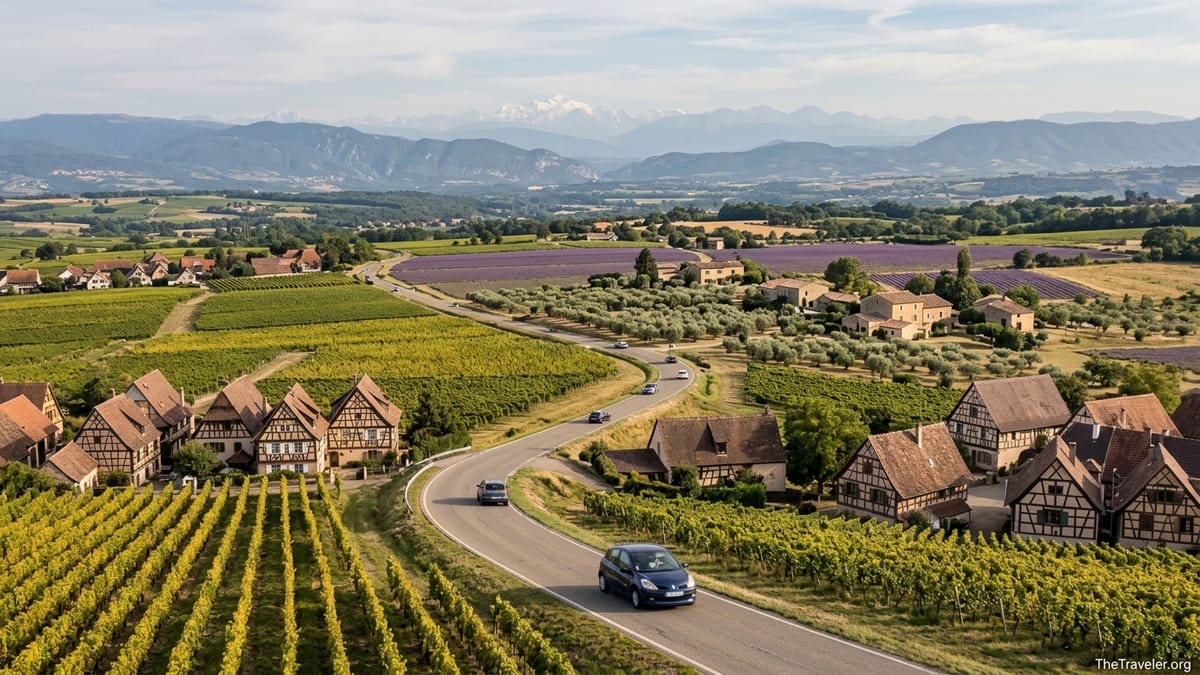
Alsace, on the border with Germany, contrasts sharply with Provence and the Alps. The Alsace Wine Route stretches for roughly 170 kilometres between Marlenheim near Strasbourg and Thann in the south, passing dozens of vine-covered hills and half-timbered villages. Many road trippers base themselves in Colmar and explore short sections north and south on successive days, stopping in villages such as Riquewihr, Kaysersberg, Ribeauvillé and Eguisheim. Distances are short, yet with tastings, strolls and lunch stops, you can easily fill full days without driving more than 60 kilometres.
From the Alsace plains, the Route des Crêtes in the Vosges mountains offers a different perspective. This high ridge road, originally built during the First World War, now gives panoramic views toward the Rhine valley and the Black Forest on clear days. A loop combining Colmar, the wine route up to Kaysersberg, then climbing to the Route des Crêtes and returning via Munster makes a memorable day trip, with picnic spots in mountain meadows and short walks to rocky viewpoints.
Designing Multi-Region Itineraries
Many travellers want to see “all of France” in one trip, but distances and the density of sights mean that it is better to design a realistic itinerary and accept that you cannot do everything. For a two-week holiday focused on driving, one workable loop might start in Paris, head to Normandy and Brittany for three or four nights, continue to the Loire for two nights, then three nights in Dordogne and four nights split between Provence and the nearby Alps before returning the car in Marseille or Lyon and catching a train back to Paris.
Another popular route strings together Paris, the Loire, Dordogne and the southwest before crossing to Provence and the Riviera. For example, you might spend two nights around Amboise or Blois, three in Sarlat-la-Canéda for Dordogne, two in the Luberon hill villages such as Gordes or Roussillon and three on the coast near Nice. If you want to add Alsace, consider starting or ending in Strasbourg and linking it by high-speed train to Paris, then renting a separate car for the Alsace and Vosges section to avoid very long drives.
Think in terms of bases rather than one-night hops. In each region, choose a town that offers a mix of services and character, then plan day trips in loops. For instance, from Avignon, you can drive one day into the Luberon, another toward the Pont du Gard and Uzès, and a third along the Rhône toward the wine villages of Châteauneuf-du-Pape and Gigondas. From Bayeux, you can cover D-Day beaches, the Norman countryside around Pays d’Auge and the harbour town of Honfleur in separate outings.
Season affects both driving conditions and atmosphere. July and August bring heavier traffic, higher prices and more crowded roads around coasts and major sights; village festivals, night markets and long evenings are a plus, but plan for heat, especially in Provence and the south. Late May, June, September and early October often offer a good compromise of pleasant weather and fewer crowds, with vineyard landscapes particularly attractive around harvest time in Alsace, the Loire and Burgundy.
Parking, City Driving and Safety
While French motorways and rural roads are generally comfortable to drive, city centres can be stressful if you are unused to narrow lanes, one-way systems and tight parking garages. In cities such as Marseille, Lyon, Toulouse or Nice, it can be easier to park in a secure underground car park slightly outside the old core and explore on foot, by tram or by bus. Some historic centres, like parts of Strasbourg or Annecy, restrict vehicle access at certain times to prioritise pedestrians, bikes and public transport.
Look for blue-signed P indicators for parking, and pay attention to colour codes on the kerb or road surface in towns that use them. Pay-and-display machines usually accept coins and cards, with the need to place the ticket on your dashboard. In smaller places, hotel or guesthouse car parks may be gravel lots at the edge of the village. When booking accommodation in places such as Sarlat, Colmar or the Luberon villages, always check whether parking is on-site, reserved, nearby public or street-only, and whether there is an extra fee.
In rural regions like Dordogne or high Alpine areas, roads can be narrow, with local drivers moving confidently. Pull into passing places where available and avoid cutting corners on blind bends. In wine regions like Alsace and the Loire, it is best to designate a driver who will limit tastings or use spit buckets at wineries, as France has strict drink-driving laws with low legal blood-alcohol limits.
Security concerns are broadly similar to other Western European countries. Do not leave bags or valuables visible in parked cars, especially at motorway rest areas or remote trailheads. Many travellers use soft duffel bags that are easier to fit in a compact trunk so that all luggage stays out of sight. Lock the car whenever you leave it, even briefly at viewpoint lay-bys along scenic roads.
The Takeaway
A road trip through France that links Provence, Normandy, Brittany, the Loire Valley, Dordogne, Alsace and the French Alps lets you experience the country’s full variety at your own pace. With some planning around car rental, tolls, fuel and realistic daily distances, driving becomes a pleasure rather than a stress.
Map out a handful of regional bases, choose scenic D roads whenever you have time, and reserve autoroutes for long transfers between regions. Keep budgets flexible for tolls and fuel, carry an International Driving Permit alongside your home licence if you are a non-EU visitor, and be ready to adjust your plans around weather, local festivals or a village that captures your imagination.
Above all, allow space in your itinerary for unplanned detours, whether that means stopping at a farm selling goat cheese in the Loire, pausing at a lavender field in Provence or turning up a side road in Alsace because a hillside village looks inviting from a distance. Those spontaneous moments often become the most vivid memories of a French road trip.
FAQ
Q1. Do I need an International Driving Permit to rent a car in France? Many rental companies hand over cars with just a valid home licence and passport, but official guidance suggests that non-EU visitors should carry either an International Driving Permit or a notarised French translation of their licence. It is inexpensive and offers extra peace of mind if you are stopped by police or deal with an insurance claim.
Q2. How expensive are toll roads for a multi-region France road trip? Costs depend on distance and route, but for a two-week journey using autoroutes for the main transfers between regions, it is common to spend from a few dozen to over one hundred euros in total on tolls. Long north–south crossings that stick mostly to motorways tend to be at the upper end of that range.
Q3. Is it possible to avoid tolls and still see most regions? Yes, France has an extensive network of national and departmental roads that are toll-free. They are slower and often pass through villages and roundabouts, but they can be more scenic and reduce costs. Many travellers combine autoroutes for a few big jumps with toll-free roads for local exploring.
Q4. What size of rental car is best for villages and mountain roads? A compact or midsize car is usually ideal. It offers enough trunk space for luggage while still being easy to park in tight village streets and to manoeuvre on narrow mountain roads in the Alps, Dordogne or hilltop villages in Provence.
Q5. When is the best time of year for a multi-region France road trip? Late spring and early autumn, roughly May, June, September and early October, often provide a good balance of mild weather, open mountain passes and fewer crowds. July and August are peak holiday months with heavier traffic and higher accommodation prices, though they also bring lively festivals and long evenings.
Q6. Can I start my road trip in one city and drop the car in another? Yes, one-way rentals are common, for example collecting a car in Paris and returning it in Nice, Marseille or Lyon. Companies usually charge a one-way fee, and availability can be more limited in very small towns, so it pays to check options and prices before fixing your itinerary.
Q7. How do I handle parking in historic centres like Sarlat or Colmar? In many historic towns, on-street spaces within the medieval core are limited or reserved for residents. Visitors typically use signposted public car parks or underground garages just outside the old centre and walk in. Accommodation listings often specify whether they include on-site parking, nearby public parking or street parking.
Q8. Are French fuel stations open late and on Sundays? Large motorway service areas operate around the clock, but smaller town and village stations may close in the evening and on Sundays. Many have automated pumps that accept cards, yet it is still wise to refuel before the gauge drops too low, especially in rural or mountain regions.
Q9. Is driving in the Alps or on narrow Dordogne roads suitable for nervous drivers? Many travellers who are cautious at home adapt well by taking their time, choosing shorter driving days and avoiding the most challenging passes in bad weather. Sticking to main valley roads and giving yourself extra time reduces stress, and it is always acceptable to turn back if a road feels uncomfortable.
Q10. How much time do I need to visit all the regions in this guide? To sample Normandy or Brittany, the Loire, Dordogne, Provence, the Alps and Alsace in one loop, three weeks is more comfortable than two. With less time, it is better to focus on three or four regions in depth rather than rushing briefly through all of them.