


The French Atlantic coast is one of Europe’s easiest regions to explore largely car-free. Fast trains link major cities, regional TER services hug the shoreline, and local trams and buses take you straight to beaches, islands and vineyards. With a bit of planning, you can stitch together Nantes, La Rochelle, Bordeaux, Arcachon, Bayonne and Biarritz into a relaxed rail-based itinerary, renting a car only where it genuinely adds value.
How Rail-friendly Is the French Atlantic Coast?
The Atlantic seaboard from Nantes down to the Basque Country is unusually well set up for train travelers. High-speed TGV services from Paris run to Nantes, La Rochelle, Bordeaux and all the way down the coast via Bayonne and Biarritz, so you can reach your first base in a single rail shot from the capital. Intercités services then stitch together Nantes, La Rochelle and Bordeaux, while TER regional trains handle most of the local hops between cities and coastal resorts.
For example, as of mid 2026 the Intercités Arc Atlantique route links Nantes, La Rochelle and Bordeaux several times a day, giving you a direct spine along the coast without needing to connect inland. Typical journey times are about 2 hours from Nantes to La Rochelle and roughly another 2.5 hours on to Bordeaux, depending on stops and any current work on the line. These trains are reservation-based, air‑conditioned and designed for medium-distance travel, so they feel more like long-distance services than commuter trains.
South of Bordeaux, the classic Bordeaux–Irun railway continues down the coast through Bayonne, Biarritz and on towards the Spanish border. On this section you have a mix of TGVs, Intercités and TER services, which means you can choose between faster, book-ahead long-distance tickets and slower, flexible regional trains. Between Bordeaux and Bayonne, fast trains typically take around 2 hours, while TER options are slower but often cheaper and easier to board at the last minute.
The main limitation of rail on this coastline is not the big-city links but the “last mile” to beaches, islands, marshes and vineyards. To access places like the remote beaches north of Bordeaux’s Médoc peninsula, the smaller islands off La Rochelle, or rural corners of the Marais Poitevin, you will either spend longer on buses and bikes or consider a short car rental. Understanding where those gaps are is key to planning a mostly car-free itinerary that still feels relaxed.
Nantes by Train: Gateway to the North Atlantic Coast
Nantes is one of the easiest rail gateways to the Atlantic. TGVs from Paris Montparnasse frequently cover the journey in about 2 hours, making it a straightforward first stop after an international arrival into Paris. From the station, tram and bus lines radiate through the city, and the historic center around the Château des Ducs de Bretagne is walkable from the main hall. For many travelers, Nantes works as a soft landing before heading on to smaller coastal towns by train.
Within Nantes, the public transport network is good enough that a car rarely makes sense. Three tram lines and a dense bus network cover the main neighborhoods, while the airport shuttle bus connects to the train station in roughly 20–25 minutes. If you stay near Commerce or Hôtel-Dieu tram stops, you can reach most sights, restaurants and the riverside on foot. For example, a couple staying near the Bouffay quarter can roll their luggage from the station in under 15 minutes and rely on the tram for trips further afield.
For coastal day trips without driving, you can combine regional trains and local buses. The TER route south towards La Roche-sur-Yon and La Rochelle gives access to the Vendée coast, while the tram-train to Clisson opens up vineyard country on the Muscadet wine route. Cyclists can take advantage of the Loire à Vélo and Vélodyssée cycle paths, which connect to the city via signposted routes, with bike-friendly TER carriages on many services. This makes it possible, for instance, to train from Nantes to a small station near the river in the morning, cycle a loop through vineyards, then return on an evening train.
Renting a car becomes worthwhile in the Nantes area mainly if you want to explore the scattered beaches of the Loire-Atlantique coast on your own schedule, such as La Baule, Pornichet and smaller coves north of Saint-Nazaire, or if you are a group sharing costs. However, even popular resorts like La Baule are accessible by rail in about an hour via regular TER trains from Nantes, so many visitors simply base in the city or in La Baule itself and skip the car entirely.
La Rochelle and the Islands: When Buses and Bikes Beat a Car
La Rochelle is a classic car-free base, with a compact historic center, two harbors and good onward rail links. TGVs from Paris Montparnasse connect directly to La Rochelle, and Intercités and TER trains link the city with Nantes and Bordeaux. The main station sits about a 15-minute walk from the Vieux Port and most central hotels, and there is a local bus and electric shuttle network for those who prefer not to walk with luggage.
For exploring the town, Saint-Nicolas and the Old Port, a car is more of a hindrance than a help. The core is largely pedestrianized, parking is limited or paid, and local buses and bike-share systems cover the main routes. Many visitors rent bikes or e-bikes from shops near the harbor for a day to ride the seafront promenade, explore parks, or cross the bridge bike path towards the Île de Ré. It is common to see families towing child trailers or using cargo bikes, which are easily hired in peak season.
Reaching the islands is also manageable without driving. The Île de Ré is connected to the mainland by a long toll bridge used by buses, shuttles, taxis and private cars. Regional buses run from La Rochelle’s bus station next to the train station to villages like Saint-Martin-de-Ré and Ars-en-Ré, especially from spring through autumn. Travelers often arrive at La Rochelle by train, take a bus across the bridge, and then use rental bikes on the island, where cycle paths parallel most roads. This works particularly well for couples and small families staying several nights in a single village.
A rental car around La Rochelle becomes worthwhile if you plan to hop between several islands and rural mainland sites in just a day or two, especially with children or bulky beach gear. For instance, combining a day on the quieter Île d’Oléron with visits to scattered oyster farms and marshland birdwatching sites is far easier by car than by coordinating limited bus timetables. However, if your focus is La Rochelle itself and one island base, arrive by train, rely on buses, ferries and bikes, and skip the car.
Bordeaux as a Rail Hub: Urban Trams and Coastal Day Trips
Bordeaux is the main rail crossroads of the Atlantic coast. High-speed TGVs from Paris can cover the journey in around 2 hours, creating an easy jump-off point for further travel to the coast or the Basque Country. Intercités and TER trains then radiate out to Arcachon, Bayonne and Biarritz, as well as inland towards Toulouse and the Dordogne. This makes Bordeaux an ideal base for travelers who want an urban stay with multiple rail-based day-trip options.
The city’s tram and bus network is extensive and frequent, so a car is unnecessary for most visitors. Tram lines run directly from the main Saint-Jean station to the historic center, Chartrons riverside district and modern neighborhoods like Bassins à Flot. By late 2025, a new tram line is scheduled to connect Bordeaux Airport to Saint-Jean station via the city center, giving rail travelers a direct public transport link between planes and trains. This will make it even easier to keep a trip entirely car-free, especially for those arriving on low-cost flights.
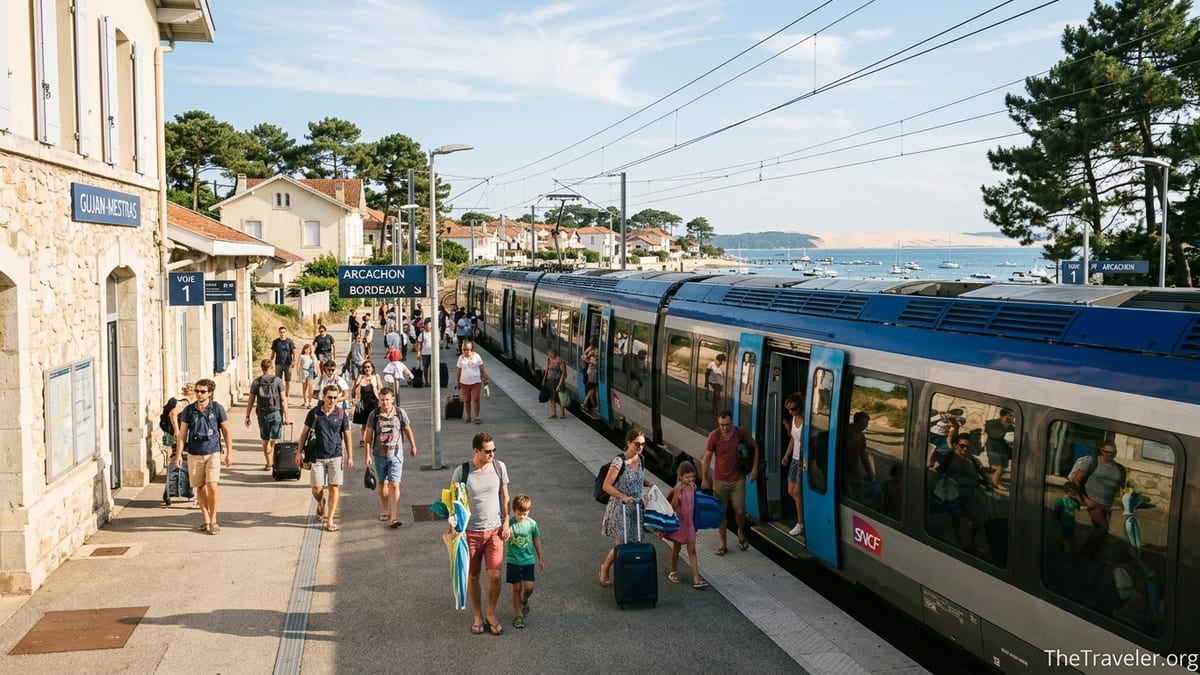
From Bordeaux, one of the most popular car-free excursions is a day trip to Arcachon by TER regional train. The frequent line to the bay typically takes around 50 minutes to 1 hour, with increased frequencies at peak season. Locals routinely use it for commuting, and summer visitors board with beach bags, coolers and folding bikes. Once in Arcachon, the station is a short walk from the seafront, making it practical to arrive late morning, enjoy the beach and town, then return on an evening train without ever needing a car.
Where a rental car becomes attractive is when you want to explore the wine country or more remote coastal stretches in just one or two days. The Médoc châteaux north of the city are technically reachable via a combination of TER trains, local buses and pre-booked winery shuttles, but schedules can be sparse, and distances between estates are significant. A group of four wine enthusiasts might find that renting a compact car for a day or hiring a private driver allows them to visit three or four estates in a relaxed loop, rather than being tied to limited bus times. Likewise, the wild Atlantic beaches north of Lacanau or around the Landes coast are difficult to reach efficiently by public transport, so a car pays off if they are a priority.
Arcachon and the Dune du Pilat: Do You Need a Car for the Coast?
Arcachon is one of the easiest beach towns on the French Atlantic to visit by train. The TER line from Bordeaux runs throughout the day, with services intensified in summer and during commuter periods. At Arcachon, the station sits near the town center, and a level walk brings you to the seafront in under 10 minutes. Many French families take this line for weekend escapes, using beach carts or wheeled suitcases along the flat streets between station and promenade.
Local buses, small boats and bikes help extend your reach around the bay. Seasonal shuttle buses link Arcachon to the Dune du Pilat, Europe’s tallest sand dune, which is about a 15–20 minute drive away. Boat shuttles cross the bay to the Cap Ferret peninsula, where bike rentals await near the pier. It is entirely possible to arrive by train, spend a full day climbing the dune and exploring nearby beaches using buses and walking trails, and then return to Bordeaux by evening train.
However, the more you want to explore beyond the town and headline sights, the more attractive a car becomes. Reaching quieter oyster villages around the Bassin d’Arcachon, such as Gujan-Mestras or the Lège-Cap-Ferret side, can involve multiple bus changes or infrequent services, especially outside July and August. Travelers staying several days and keen to move between different beaches, oyster huts and viewpoints may find that a two- or three-day car rental from Arcachon or Bordeaux allows them much greater flexibility, particularly if they are carrying picnic gear, surfboards or equipment for children.
One hybrid strategy some visitors use is to keep the trip car-free for the city segments, then rent a car only for the Arcachon portion. For instance, you could arrive in Bordeaux by TGV, enjoy two days car-free in the city, then rent a car near Saint-Jean station for three days to explore Arcachon, the Dune du Pilat and some of the Landes coast before returning the vehicle in Bordeaux. This approach concentrates driving into the part of the trip where it offers the biggest payoff, while keeping city days relaxed and car-free.
Bayonne and Biarritz: Basque Country by Rail and Bus
Further south, Bayonne and Biarritz anchor the French Basque coast. The main line from Bordeaux runs down to Bayonne, where many long-distance TGVs and Intercités stop before continuing to Hendaye near the Spanish border. From Bayonne, shorter hops on TER trains or buses connect to Biarritz, Saint-Jean-de-Luz and smaller resorts. This makes Bayonne a practical rail hub, especially if you want easier station access and better onward bus connections than Biarritz itself offers.
Despite its strong beach identity, Biarritz can be done comfortably without a car. The train station is slightly inland, but local buses run regularly between the station, the town center and the beaches such as Grande Plage and Côte des Basques. Many visitors roll their suitcase from the station to a bus stop and are at their hotel in 15 minutes. Once checked in, Biarritz is compact and walkable, with most beaches and restaurants clustered along the cliffs and promenade. Taxis and ride-hailing services fill any gaps for late-night returns.
Bayonne, with its half-timbered houses and riverside quays, is even more rail-friendly. The station is close to the historic center, and its bus network links onward to Biarritz, Anglet and the smaller coastal towns. Travelers who prefer a quieter base sometimes overnight in Bayonne and day-trip to Biarritz and Saint-Jean-de-Luz by TER and bus. For example, you might take a mid-morning TER from Bayonne to Saint-Jean-de-Luz, spend the afternoon on the beach and exploring the old town, then return to Bayonne by train for dinner on the Nive river.
A car becomes most useful in the Basque Country if you want to connect a string of inland villages in one day, visit rural cider houses, or pop across to Spanish Basque towns beyond the main train lines. While Hendaye has an easy cross-border metro-style link to San Sebastián, other cross-border routes rely more on regional buses and require close schedule checking. If your trip is mainly about beach time in Biarritz and visits to a few well-connected towns, trains and buses will usually suffice, and you can avoid dealing with parking in high season.
Practical Car-free Logistics: Tickets, Luggage and Local Transport
Planning a car-free itinerary along the Atlantic coast works best if you coordinate tickets and connections in advance. Long-distance TGV and Intercités trains to and between Nantes, La Rochelle, Bordeaux, Bayonne and Biarritz use dynamic pricing, so booking a few weeks ahead typically yields better fares and seat choices. For regional TER services, fares are often fixed or capped, and in many cases you can buy on the day without a big price penalty, which is useful if you want flexibility for day-trip decisions based on weather.
For luggage, aim for compact, wheeled suitcases or travel backpacks that are easy to lift into overhead racks or park in luggage areas at carriage ends. Most TGV and Intercités trains have dedicated luggage spaces, but regional TER carriages can be more crowded at commuter times, particularly around Bordeaux and Arcachon in summer. If you are traveling with surfboards or very bulky sports equipment, pre-checking the specific train policies and considering a car rental for that portion of the trip can make life much easier. Some travelers also ship a bag ahead using door-to-door services when they plan to spend a week in one rental apartment.
At each base, familiarize yourself with the local transport network. In Bordeaux and Nantes, tram and bus systems operate with unified tickets and day passes that you can buy at station ticket machines or onboard from vending machines at stops. In La Rochelle and Arcachon, check the seasonal shuttle bus schedules to beaches, dunes and island ferry piers, as frequencies can drop sharply outside school holidays. In Bayonne and Biarritz, look up the local bus network maps so you are not reliant on taxis during busy summer evenings, when demand can outstrip supply.
Car rental is most sensibly treated as a targeted tool rather than a default. Instead of hiring a car for the entire trip from Paris, consider renting for just two or three days in Bordeaux or La Rochelle, timed to coincide with the parts of your itinerary that involve scattered rural sights, vineyards or remote beaches. Returning the car to the same city, ideally near the station, usually keeps costs lower than one-way rentals. This hybrid approach lets you enjoy the convenience of rail between major bases while still unlocking off-track areas when it really counts.
The Takeaway
Traveling the French Atlantic coast by train is not only feasible but often more enjoyable than driving, particularly between major hubs such as Nantes, La Rochelle, Bordeaux, Arcachon, Bayonne and Biarritz. Fast TGV and Intercités services get you between cities efficiently, while regional TER trains and local buses cover most of the onward legs to beaches and attractions. In lively ports and cities, a car can be more of a liability than an asset, given parking constraints and strong tram and bus networks.
The key to a smooth, largely car-free trip is to recognize where public transport shines and where it thins out. Urban exploration, classic island stays and headline beach towns are all realistic without driving, especially if you are happy to walk, cycle and time your day trips with bus schedules. When your plans lean towards scattered marshlands, vineyards, rural Basque villages or little-served stretches of coast, a short, well-timed car rental adds genuine value. By combining rail, local transport and selective driving, you can experience the full variety of France’s Atlantic shore without spending your holiday behind the wheel.
FAQ
Q1. Can I travel the entire French Atlantic coast from Nantes to Biarritz using only trains?
You can link all the major hubs by train, including Nantes, La Rochelle, Bordeaux, Bayonne and Biarritz, but some smaller coastal villages and remote beaches still require buses, bikes or a short car rental.
Q2. Do I need to reserve seats on trains between these Atlantic coast cities?
Seat reservations are required on TGV and most Intercités trains, which you should book in advance. Regional TER trains usually do not require reservations, and tickets can often be bought on the day.
Q3. Is Arcachon easy to reach as a day trip from Bordeaux without a car?
Yes. Frequent TER trains typically take under an hour from Bordeaux to Arcachon, and the station is a short, level walk from the seafront, making car-free day trips straightforward.
Q4. How practical is it to visit the Dune du Pilat without renting a car?
In season, shuttle buses connect Arcachon and the Dune du Pilat, so you can arrive by train, take the bus to the dune, spend the day there and return to Bordeaux or stay overnight without driving.
Q5. Should I pick Bayonne or Biarritz as my rail base in the Basque Country?
Bayonne offers better rail and bus connections and a quieter feel, making it a convenient base. Biarritz is closer to the main beaches, but its station is slightly inland and relies more on buses for links to the center.
Q6. When does renting a car around Bordeaux make the most sense?
A car is most useful if you plan to visit multiple Médoc or Graves wineries in one or two days, or if you want to reach remote Atlantic beaches and Landes forest areas that have limited bus services.
Q7. Is La Rochelle a good car-free base for visiting the Île de Ré?
Yes. You can arrive in La Rochelle by train, then use buses and shuttles that cross the bridge to Île de Ré, where well-marked bike paths and local rentals make exploring easy without a car.
Q8. How should I manage luggage if I am moving between several cities by train?
Travel light with wheeled carry-on suitcases or backpacks that are easy to lift and maneuver. Most long-distance trains have luggage racks, but avoiding very large or heavy bags makes boarding and transfers much simpler.
Q9. Are there good public transport options from Bordeaux Airport to the train station?
Yes. Airport shuttles already link the airport and Saint-Jean station, and a new tram line is scheduled to provide a direct airport-to-station connection via the city center, improving car-free transfers.
Q10. Is it easy to combine trains with cycling along the Atlantic coast?
In many areas, yes. TER trains often accept bikes, and routes like La Vélodyssée and local island cycle paths intersect with stations, allowing you to ride one way and return by train, especially around Nantes, La Rochelle and Arcachon.