


Stretching from the historic harbor of La Rochelle to the surf beaches of the Basque Country, France’s Atlantic coast is made for road trips and rail-based escapes. Compact distances, frequent trains and a string of character-filled stops mean you can comfortably design a 5, 7, 10 or 14 day itinerary that links La Rochelle, the Atlantic islands, Arcachon and the Dune du Pilat, the Landes coast and the Basque trio of Bayonne, Biarritz and Saint-Jean-de-Luz. This guide lays out realistic routes with overnight bases, door-to-door travel times and concrete examples to help you turn the map into a workable holiday plan.
How to structure a French Atlantic Coast itinerary
The stretch between La Rochelle and the Basque Country is relatively short by European road trip standards, roughly 450 to 500 kilometers if you drive from La Rochelle down to Saint-Jean-de-Luz without big detours. That makes it tempting to try to “do it all” in a few days. In reality, the coast rewards a slower pace. Distances may be modest, but summer traffic, single-carriage roads and the temptation to stop at beaches and oyster shacks quickly add time. A drive from La Rochelle to Arcachon, for example, is about 250 kilometers and typically takes around 2.5 to 3 hours by car in normal conditions; by train, it often involves a connection via Bordeaux and takes closer to 4 hours.
The backbone of most itineraries is a north–south arc: La Rochelle and the nearby Atlantic islands, the Arcachon Bay with the Dune du Pilat, the Landes coast around Biscarrosse, Mimizan, Hossegor and Seignosse, then the Basque Country anchored by Bayonne, Biarritz and Saint-Jean-de-Luz. You can comfortably cover this over 10 to 14 days with two or three nights in each main base. Shorter 5 and 7 day itineraries work best if you focus on just two or three hubs and accept that you will not see everything in one trip.
Transport is flexible. Many visitors combine train and occasional car rental. High-speed trains link Paris to La Rochelle and Bordeaux, and regional trains continue down to Bayonne and Saint-Jean-de-Luz. From Bordeaux, you can be in Arcachon in about 50 minutes by direct regional train and in Bayonne in roughly 2 hours on the Bordeaux–Irun coastal line, which serves Arcachon’s hinterland, Dax, Bayonne, Biarritz and Saint-Jean-de-Luz. Those who prefer full independence often rent a car in La Rochelle or Bordeaux and drive the whole route, returning it in Biarritz or back in Bordeaux at the end.
Budget-wise, this part of France spans a range. In high season, a mid-range double room in La Rochelle’s old town or central Biarritz often runs around 130 to 200 euros per night, while campsites or simple guesthouses on the Landes coast can come in closer to 60 to 100 euros. A plate of Atlantic oysters around Arcachon or Cap Ferret commonly costs around 15 to 25 euros depending on the size and setting, while a casual lunch of a seafood plancha and a glass of white wine might be in the 20 to 30 euro range per person. These concrete numbers help you gauge whether you want to balance nights between pricier hubs and more affordable coastal towns.
5-day French Atlantic Coast route: La Rochelle and Arcachon Bay
A five day itinerary is ideal for travelers who want a focused taste of the Atlantic coast without rushing all the way to the Basque border. A realistic structure is three nights in La Rochelle with a full day on Île de Ré, followed by two nights in Arcachon to experience the bay and the Dune du Pilat. This works both with a rental car and entirely by public transport, using local buses and regional trains supplemented by taxis when needed.
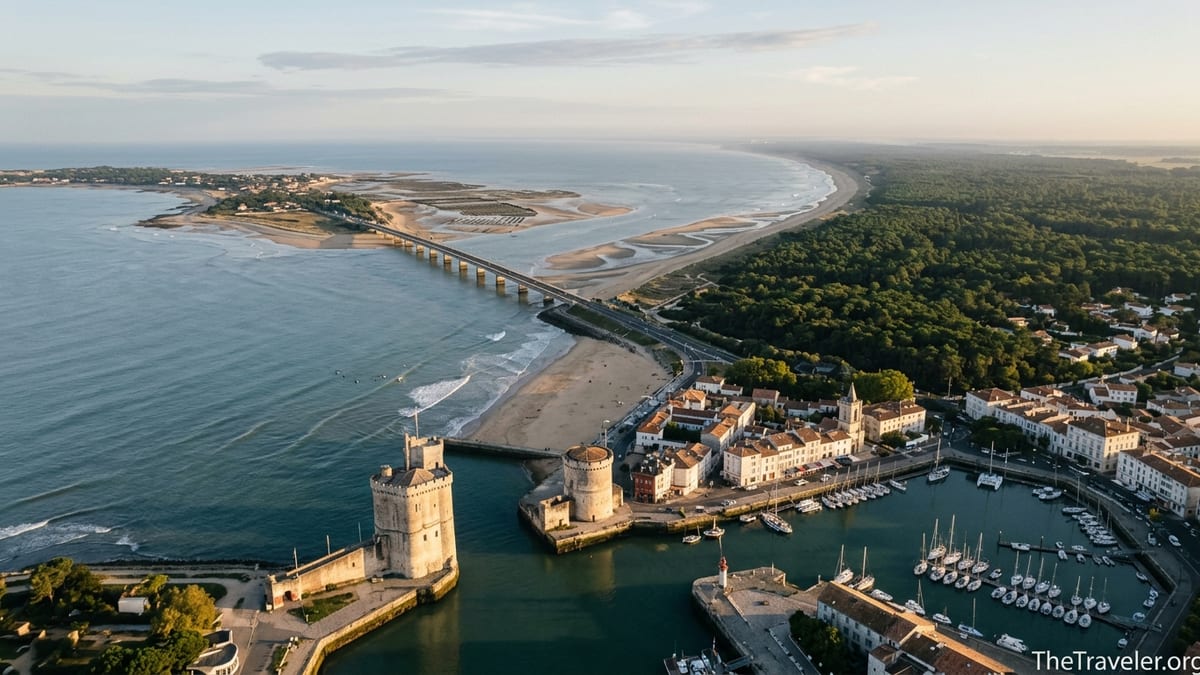
Day 1 and 2 can be centered on La Rochelle. Use the first day to settle into a hotel in the Vieux Port area, wander the medieval towers that guard the harbor and dine along the quays on mussels marinière or grilled fish. On day 2, head to Île de Ré via the road bridge that connects the island to the mainland just west of La Rochelle. Cyclists can rent bikes in La Rochelle or on the island itself. The island has around 100 kilometers of marked cycle paths, and a popular loop from Saint-Martin-de-Ré through the salt marshes to Ars-en-Ré and back is roughly 30 to 40 kilometers, manageable in a slow full day with café and beach stops.
On day 3, travel from La Rochelle to Arcachon. By car, you follow the A10 and A63 motorways and smaller connecting roads south, budgeting about three hours of wheel time, plus an extra hour or two if you plan a detour for lunch near Bordeaux or to refuel. Without a car, you usually take a train from La Rochelle to Bordeaux and then a direct regional train from Bordeaux-Saint-Jean station to Arcachon, which altogether takes around 3.5 to 4 hours including the connection. A mid-afternoon arrival gives you time for a walk along the Arcachon waterfront and perhaps an early seafood dinner in the Ville d’Été district.
Spend day 4 on a Dune du Pilat and Arcachon Bay combination. In season, shuttle buses connect Arcachon train station to the dune car parks in roughly 30 minutes, or you can drive yourself and park at the official visitor center. From there it is a short but steep walk up soft sand or seasonal stairs to the ridge, which rises to around 100 to 110 meters above sea level and stretches for about 3 kilometers. Many travelers budget two to three hours to climb, walk and take in the views over the bay and the pine forests of the Landes. Back in Arcachon, a late afternoon boat tour across to the oyster farming villages on the Cap Ferret peninsula provides a vivid introduction to local life, with tasting plates of oysters and prawns served at simple timber cabanes right by the water.
7-day route: From La Rochelle to the Landes surf coast
With a full week, you can add the wide beaches and pine forests of the Landes, a region that runs south of Arcachon down toward Bayonne. A balanced 7-day route might look like three nights in La Rochelle with time on Île de Ré, two nights in Arcachon, and two nights on the Landes coast around Biscarrosse, Mimizan or Hossegor. This still skips the Basque border towns but layers in a completely different coastal mood, from family-friendly lakes to world-class surf breaks.
From Arcachon on day 5, drive or take a regional bus to Biscarrosse-Plage or Mimizan-Plage, both classic Landes resorts backed by dunes. The distance from Arcachon town to Biscarrosse-Plage is only about 35 to 45 kilometers and usually takes under an hour to drive. To Mimizan-Plage it is roughly 70 to 80 kilometers, around 1.5 hours by car depending on traffic. Travelers without a car can use a combination of regional buses that in high season link Arcachon, Biscarrosse and the lakes, though schedules are more limited outside summer, which is why many visitors opt for at least a few days of car rental in this part of the trip.
Day 6 is your Landes immersion day. Expect vast sands, Atlantic rollers and a scent of maritime pines. Around Biscarrosse and Mimizan, the ocean-front beaches often have lifeguarded zones in summer, and a series of freshwater lakes sit just inland, where families can swim, rent pedal boats or paddleboards in more sheltered conditions. Further south, stations like Hossegor and Seignosse are easy to reach by car from Biscarrosse or Mimizan in 1 to 2 hours and offer a more surf-focused scene, with board rental shops along the seafront and in commercial zones like Hossegor’s “Surf Avenue” area.
On day 7, you can loop briefly into the Basque Country before heading to a departure hub. From Hossegor or Seignosse, it is only about 40 kilometers to Bayonne, often under 45 minutes by car in normal traffic. Bayonne’s railway station ties you into the Bordeaux–Irun line, so you might drop your rental car there and continue by train to Bordeaux in around 2 hours or to Hendaye at the Spanish border in under an hour. That makes Bayonne a practical point to end a 7 day itinerary, with time in the morning for a stroll along the Nive and Adour rivers, Basque pastry tastings and a last seafood lunch before boarding your train.
10-day route: Adding the Basque Country
A 10 day itinerary lets you take in the full sweep of La Rochelle, the Atlantic islands, Arcachon Bay, the Landes coast and the Basque towns without rushing. A classic structure is three nights in La Rochelle (with one or two day trips to Île de Ré), two nights in Arcachon, two nights around Hossegor or Seignosse, and three nights split between Bayonne, Biarritz and Saint-Jean-de-Luz. The exact pattern depends on whether you prefer urban atmosphere, surf culture or smaller fishing ports.
By day 6 or 7 you will likely be heading south from the Landes into the Basque Country. From Hossegor to Bayonne is a short hop, then another 10 to 15 kilometers on to Biarritz, which many travelers choose as a base. Biarritz offers an urban surf resort mix, with Belle Époque villas on cliffs, the famous Grande Plage, a compact center with boutiques and bistros, and frequent trains from the main station connecting back to Bordeaux and onward to Paris. A taxi from Biarritz station to a central hotel often costs around 15 to 25 euros depending on traffic and time of day.
Saint-Jean-de-Luz, about 20 kilometers south of Biarritz, is the softer counterpoint: a sheltered crescent beach, a fishing port and a walkable old town known for pastry shops and the historic church where Louis XIV married Maria Theresa of Spain. Regional trains run from Biarritz to Saint-Jean-de-Luz in roughly 15 to 20 minutes, so even without a car you can base in one and day-trip to the other. With a car, you might drive the corniche road between them, stopping at viewpoints above the Atlantic and small coves popular with local swimmers.
In a 10 day plan, many travelers allocate at least one full day to Bayonne itself. As the historical and administrative heart of the French Basque Country, Bayonne is less about beaches and more about architecture and food. Half-timbered houses line the rivers, and the old quarter is dense with pintxo-style wine bars and shops selling Bayonne ham, Espelette pepper products and Basque textiles. Late afternoon is an excellent time to wander here, as locals fill terrace tables. A practical pattern is to arrive by midday train from the north, check into a guesthouse near the cathedral, spend the afternoon and evening in Bayonne, then move on to coastal Biarritz or Saint-Jean-de-Luz the next day.
14-day slow travel route: Islands, dunes, forests and Basque villages
With two full weeks, you can slow the pace and build in rest days, detours and even a taste of the inland Basque hills. A realistic 14 day route might start with four nights in La Rochelle including at least two days on Île de Ré, followed by three nights around Arcachon and the Dune du Pilat, three nights on the Landes coast between Biscarrosse and Hossegor, and four nights in the Basque Country split between Bayonne, a coastal town like Saint-Jean-de-Luz and perhaps a village in the foothills such as Espelette or Ainhoa.
Those extra nights mean you can move around the islands more deeply. On Île de Ré, for instance, a full day can be dedicated to exploring the northwestern tip around Les Portes-en-Ré and the Lilleau des Niges nature reserve, a magnet for birdlife, with lunch at a simple terrace restaurant serving local potatoes and grilled fish. Another day could focus on the south of the island, biking from Sainte-Marie-de-Ré along coastal paths and stopping at family beaches and small surf spots. Distances between villages are short, often only 5 to 10 kilometers, so you can adapt each day to your energy level and the weather.
In Arcachon, a three night stay permits a combination of dune time, bay exploration and relaxed town life. Beyond the classic half-day at the Dune du Pilat, you might reserve a second day for a full circuit of the bay by boat in summer, with a stop in the oyster villages of Gujan-Mestras or on the Cap Ferret side. Boats sometimes operate as hop-on, hop-off shuttles between the jetties, so you can plan a lunch at a wooden cabane and then continue across the water rather than retracing your steps. A third day in Arcachon might be as simple as a leisurely beach day under striped parasols, with a walk through the 19th-century villas of the Ville d’Hiver district late in the afternoon.
The Landes and Basque segments also benefit from slower rhythms. Two or three nights in Hossegor or Seignosse allow you to choose surf lessons when conditions are gentle, alternate between ocean beaches and calmer water on the marine lake, and try a local night market. In the Basque Country, four nights give you bandwidth for a day trip inland to villages like Espelette, known for its strings of red peppers hung on whitewashed facades, or to the small train up La Rhune on the Spanish border. These rural excursions typically take 30 to 60 minutes by car from the coast and can be combined with lunch at a farm inn serving grilled lamb or trout from local rivers.
Practical transport and travel-time planning
One of the most common mistakes when planning the French Atlantic coast is underestimating how often you will want or need to stop. While navigation apps may show 45 minute hops between towns, real-world travel in summer often expands with beach detours, coffee stops and traffic around larger hubs. As a rule of thumb, when you see a 1 hour predicted drive between coastal towns in July or August, consider allowing 1.5 hours if you have time-sensitive reservations, especially between Bordeaux and Arcachon or around the Basque coastal towns.
By rail, the main structuring node is Bordeaux-Saint-Jean station, which connects TGV high-speed lines from Paris with regional services to La Rochelle, Arcachon and the Basque coast. Trains from Bordeaux to Arcachon take around 50 minutes on direct services, while Bordeaux to Bayonne is usually around 2 hours, with some trains continuing on to Biarritz, Saint-Jean-de-Luz and Hendaye closer to the Spanish border. Advance booking often yields better fares, and in summer, popular Friday and Sunday services can sell out of cheaper ticket classes, so reserving a week or two ahead is sensible if your dates are fixed.
Car rental is widely available in La Rochelle, Bordeaux and Biarritz, including at airports and central railway stations. A compact manual car in summer might cost from around 50 to 80 euros per day before fuel and tolls, with automatic transmission often more expensive. When comparing pick-up locations, consider that returning a car in a different city usually incurs a one-way fee. Many travelers pick up in La Rochelle or Bordeaux and drop in Biarritz or Bayonne to avoid driving back north, then finish the trip by train or flight. For parking, expect to pay for central hotel parking in cities like La Rochelle and Biarritz, whereas many coastal campsites and smaller hotels in the Landes include parking in the nightly rate.
Cycling is another way to move modest distances. The EuroVelo 1 / Vélodyssée route runs along much of this coast, often separated from traffic on forest trails. Sections between La Rochelle, Royan, the Médoc, Arcachon and down into the Landes are particularly popular, with mostly flat terrain. Some travelers incorporate a two or three day mini-cycle tour into a longer trip, perhaps riding from La Rochelle to Île de Ré and back or between Arcachon and a Landes resort while sending their main luggage ahead by car with a companion or using luggage transfer services where available.
Where to stay: Matching bases to your style
Your choice of overnight bases shapes the feel of the trip as much as the route itself. La Rochelle suits travelers who enjoy historic urban centers. The old port area is compact, and many mid-range hotels cluster within a 10 minute walk of the harbor towers, making it easy to step out in the evening without using your car. Families may prefer hotels slightly back from the waterfront with larger rooms or apartments, while couples often prioritize harbor views even at a premium.
On Île de Ré, bases like Saint-Martin-de-Ré and La Flotte work well without a car because they have lively harbors, restaurants and bike rental shops within a short stroll. Accommodation ranges from simple chambres d’hôtes to boutique hotels with small pools hidden behind stone walls. Prices in July and August are high and many places require stays of several nights, so travelers on tighter budgets sometimes stay in La Rochelle and visit the island by bus or car for the day instead.
Arcachon, Biscarrosse and Mimizan are good choices for classic beach-resort stays. In Arcachon, four distinct quarters offer different vibes, from the central Ville d’Été along the main beach to the elevated Ville d’Hiver with 19th-century villas. Mid-range hotels along the seafront often command higher rates but give direct access to the promenade and boat jetties. Further south, Hossegor and Seignosse cater strongly to surfers and younger travelers, with hostels, surf camps and design-led hotels alongside traditional holiday villages and campsites. Many properties here bundle in surf lessons or board rental, and you will see plenty of guests walking barefoot to the beach with boards under their arms.
In the Basque Country, Bayonne, Biarritz and Saint-Jean-de-Luz each offer distinct accommodation personalities. Bayonne’s hotels and guesthouses lean toward city-break stays, often in historic buildings close to the cathedral and riverside. Biarritz has more upscale boutique hotels and spa properties, some perched on cliffs with sea views. Saint-Jean-de-Luz, with its family-friendly beach and compact old town, is popular with multi-generational groups who favor apartment rentals or aparthotels with small kitchens, so they can mix restaurant dinners with home-cooked seafood bought directly from the quayside stalls.
The Takeaway
The French Atlantic coast between La Rochelle and the Basque Country is a region where a week feels full but unhurried and two weeks opens up layers of islands, dunes, forests and villages. The key to a satisfying itinerary is not to tick every coastal town but to choose a handful of strong bases and accept that beach days, bike rides and long seafood lunches are part of the experience, not distractions from it. Whether you follow a compact 5 day loop between La Rochelle and Arcachon, a 7 day trip that adds the Landes, a 10 day sweep that reaches the Basque towns or a 14 day slow journey with inland detours, realistic travel times and overnight allocations will keep the trip enjoyable.
Think in terms of clusters: La Rochelle plus Île de Ré, Arcachon plus the Dune du Pilat, the Landes surf coast, and the Basque triangle of Bayonne, Biarritz and Saint-Jean-de-Luz. Give each cluster at least two nights so you have one full day without packing or driving. Factor in seasonal realities like heavier July and August traffic, the need to pre-book popular surf camps and the higher prices of peak dates. With those practicalities handled, the French Atlantic coast is one of Europe’s easiest regions to turn from an idea on a map into a concrete, memorable journey.
FAQ
Q1. Is it realistic to travel the French Atlantic coast without renting a car?
Yes, it is realistic if you are willing to focus on larger hubs. Trains link La Rochelle, Bordeaux, Arcachon, Bayonne, Biarritz and Saint-Jean-de-Luz, and local buses connect to islands and beaches in high season. However, a car makes reaching smaller Landes resorts and some inland Basque villages easier, so some travelers mix rail with a short car rental mid-trip.
Q2. How many nights should I spend in La Rochelle versus Île de Ré?
For a 7 to 10 day itinerary, many travelers split three or four nights between them, for example two nights in La Rochelle to enjoy the old harbor and museums and one or two nights on Île de Ré to experience quieter evenings and early-morning bike rides. On shorter trips, it is common to stay in La Rochelle and visit Île de Ré as a single long day trip.
Q3. When is the best time of year to follow these itineraries?
Late May, June, September and early October balance pleasant weather with fewer crowds and generally lower accommodation prices than in July and August. Peak summer brings warm sea temperatures and a lively atmosphere but also busier roads, booked-out surf schools and higher nightly rates, so advance planning is more important then.
Q4. Are the beaches around Arcachon and the Landes suitable for children?
Many families visit these areas. Arcachon Bay has sheltered, gently shelving beaches that are well suited to younger children, while the open Atlantic beaches of the Landes and Basque Coast can have powerful waves and rip currents. In those areas, it is important to choose lifeguarded zones, follow flag advice and consider spending time at nearby lakes or more protected bays when conditions are rough.
Q5. How expensive is food and drink along the French Atlantic coast?
Costs vary, but travelers can plan on around 15 to 25 euros for a casual main course in a mid-range restaurant in La Rochelle, Arcachon or Biarritz, with seafood often slightly higher. A glass of regional wine may be around 4 to 8 euros, and a morning coffee and croissant might come to 3 to 5 euros at a café. Self-catering via markets and supermarket picnics helps control costs, especially for families.
Q6. Do I need to book Dune du Pilat or boat trips in advance?
Visiting the Dune du Pilat itself does not usually require a ticket for the natural site, but in high season, parking lots can fill and shuttle buses or boat connections across Arcachon Bay can be busy. It is wise to check current local advice and consider reserving specific boat excursions or guided tours in advance, particularly for weekend or peak-season dates.
Q7. Is it easy to combine surfing with sightseeing on these routes?
Yes, the Landes and Basque segments are ideal for combining surf lessons or free surfing with more general touring. You can, for example, book a three-day course in Hossegor or Seignosse, surfing in the morning and sightseeing in Bayonne, Biarritz or inland Basque villages in the afternoon. Many surf schools offer flexible packages that can be slotted into a broader road trip.
Q8. Are these itineraries suitable for travelers who do not speak French?
They are generally suitable. In major towns and tourist areas such as La Rochelle, Île de Ré, Arcachon, Hossegor, Bayonne and Biarritz, staff in hotels, restaurants and activity centers are used to international visitors and often speak at least basic English. Learning a few French phrases for greetings, ordering and directions still improves interactions and is appreciated locally.
Q9. Can I follow these routes with a motorhome or campervan?
Yes, many travelers explore this coast by motorhome or campervan. The region has a dense network of campsites and dedicated motorhome stopovers, though popular coastal spots can be busy in summer and may require advance reservations. Be aware of local rules on wild camping and overnight parking outside official areas, which are often restricted near the coast.
Q10. How far in advance should I book accommodation in peak season?
For July and August, it is sensible to book key bases at least two to three months ahead, particularly on Île de Ré, in Arcachon and in well-known surf resorts or Basque coastal towns. Outside peak school holiday periods, you will usually find more last-minute availability, although specific boutique hotels and sea-view rooms can still sell out early on weekends.