

The French Atlantic coast between La Rochelle and the Basque Country combines long sandy beaches, historic ports, oyster-farming villages and some of Europe’s best beginner and intermediate surf. For a first-time visitor it can feel like a long, slightly confusing strip of dunes and resorts. This guide walks you south from La Rochelle to the Basque Coast, explaining what each stop offers, how to move around, what you can expect to pay in 2026, and how to build a realistic itinerary around beaches, food and the ocean.
Understanding the French Atlantic Coast From La Rochelle to the Basque Country
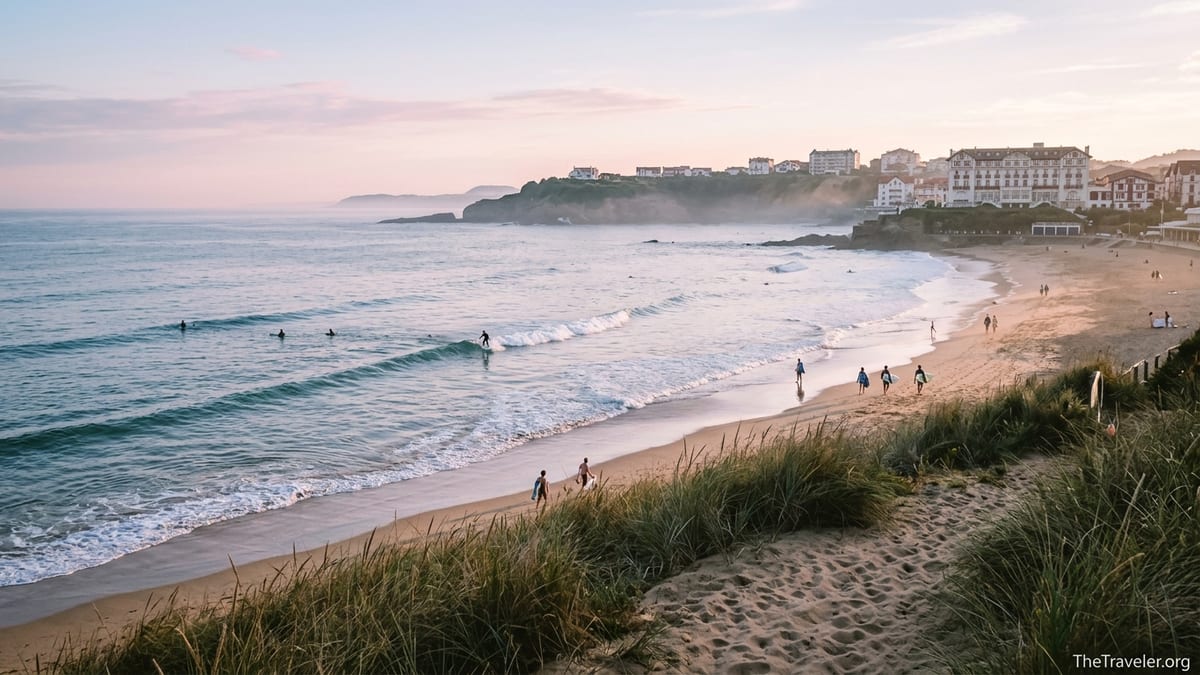
The stretch from La Rochelle to the Spanish border covers several distinct coastal areas. Around La Rochelle and the nearby islands of Île de Ré and Île d’Oléron you find low-key cycling paths, oyster huts and family beaches. Further south in Vendée and the Landes coast, long pine-backed beaches face the full Atlantic swell and feel wilder. At the southern end Biarritz and the Basque Coast mix Belle Époque architecture, a strong surfing culture and easy access by air and rail.
Distances are manageable but not trivial. La Rochelle to Arcachon by direct train typically takes around 3 hours, while Arcachon to Biarritz by train via Bordeaux is usually 3 to 4 hours depending on connections. Driving the full stretch from La Rochelle to Biarritz is around 5 to 6 hours in light traffic. For a first trip, many visitors sensibly focus on one or two clusters, for example La Rochelle with Île de Ré plus a few days in Arcachon, or Landes beaches combined with Biarritz and the Basque villages.
Climate is milder than the Mediterranean but less predictable. In July and August water temperatures sit roughly between 20 and 23 degrees Celsius on much of this coast, so most people swim in regular swimwear, sometimes adding a light 2 mm neoprene top. In May, June, September and October the water is cooler and a 3/2 mm wetsuit makes long sessions more comfortable, especially for surfing or stand-up paddleboarding. Storms can roll in outside high summer, which is good for surfers but can mean rough seas for casual swimmers.
The region is popular with French families and northern Europeans, but outside July and August prices are often noticeably lower and crowds thin out. If you want warm enough water for daily swims and open seasonal restaurants without peak-season congestion, late June or early September are excellent compromise periods along almost the whole coast.
La Rochelle and the Islands of Île de Ré and Île d’Oléron
La Rochelle itself is a compact, walkable port city with good rail connections and its own small airport serving seasonal flights. The old harbor area, framed by its medieval towers, is where many visitors stay. In 2026, mid-range hotels around the Vieux Port often quote double rooms in the range of about 120 to 180 euros per night in late June, rising in July and August. More budget-conscious travelers look a few blocks inland, where simple two-star hotels and guesthouses can drop below about 100 euros per night outside the very peak weeks.
Many first-time visitors pair La Rochelle with at least one of its offshore islands. A toll bridge connects the city to Île de Ré, while Île d’Oléron lies further south and is also reachable by road. Both islands are popular with French families and have an extensive network of cycle paths. Typical bike rental shops in resort villages like Saint-Martin-de-Ré or La Flotte charge roughly 12 to 20 euros per day for a standard adult bicycle, with discounts for multi-day rentals. E-bikes and cargo bikes cost more but are widely available in summer.
On Île de Ré, beaches like Plage des Gollandières near Le Bois-Plage-en-Ré combine family-friendly sand with nearby cafes, while the northern tip around Les Portes-en-Ré feels quieter and slightly more remote. Simple self-catering apartments or small holiday houses on the island often start around 700 to 900 euros per week in shoulder season for a basic one-bedroom, with prices rising significantly in August and in the chic northern villages. Oyster shacks around Ars-en-Ré or Rivedoux-Plage often serve plates of six to twelve local oysters with bread and a glass of white wine for somewhere in the broad range of 12 to 25 euros depending on size and setting.
Île d’Oléron is larger and a little less polished, which many travelers appreciate. Pine forests back wide beaches like Plage de Vert-Bois and Plage de la Conche. Camping is an important part of the accommodation mix, from simple municipal campgrounds that might charge in the region of 20 to 35 euros per night for a pitch with electricity for two people in high season, to four-star holiday parks with pools and children’s clubs. For a first-time visitor without a car, Île de Ré is easier to reach from La Rochelle thanks to frequent buses over the bridge, whereas Oléron tends to work best with a rental car.
Vendée and the Family-Friendly Atlantic Resorts
South from La Rochelle, the Vendée coast offers long beaches, modestly sized resorts and a family-focused atmosphere. Towns like Les Sables-d’Olonne, Saint-Gilles-Croix-de-Vie and Saint-Jean-de-Monts are geared to summer holidays with promenades, small amusement parks and plenty of holiday apartments. From a practical perspective, this is a convenient area for first-time Atlantic visitors who want a car-free holiday, since many resorts have compact centers and flat terrain that makes walking and cycling between the beach, accommodation and shops straightforward.
Accommodation in Vendée is often more affordable than in the sought-after Basque Coast. In June 2026 it is still common to see mid-range hotels or well-rated guesthouses a few streets back from the seafront advertising double rooms between about 90 and 140 euros per night, while older but tidy rental apartments can sometimes fall below that threshold. Supermarkets are plentiful and local open-air markets run several mornings a week in most towns, so self-catering is easy. Beachfront cafes typically charge around 3 to 4 euros for a coffee on the terrace, and 15 to 22 euros for a main dish such as grilled fish of the day or moules-frites.
The beaches in Vendée are generally wide and sandy with gentle slopes into the sea compared to the steeper profiles further south. Lifeguard-supervised sectors are well marked in high season. There are beginner-friendly surf schools in spots like La Tranche-sur-Mer and Saint-Gilles-Croix-de-Vie, but waves tend to be less consistent than in the Landes or Basque Country, which suits families more interested in safe swimming and sandcastles than all-day surfing. If you are planning a mixed-generation trip with children and grandparents, Vendée’s combination of flat terrain, shallow beaches and accessible pricing can work well.
Transport-wise, Vendée has regional train connections to larger cities like Nantes and La Rochelle, plus local buses. However, if you want to explore multiple towns and smaller beaches on the same trip, a rental car or at least bicycles will make life much easier. For a first-timer arriving from Paris, one common pattern is to take a high-speed train to La Roche-sur-Yon or Nantes, then rent a car for a week, using a base in Les Sables-d’Olonne or Saint-Jean-de-Monts.
Arcachon, the Bay and the Dune du Pilat
Further south, Arcachon Bay forms a triangular inland sea between Cap Ferret, Arcachon and the Atlantic. The town of Arcachon itself has direct regional trains to Bordeaux and on to Paris, which makes it one of the most accessible seaside destinations in this guide without a car. The atmosphere combines 19th-century villas, family beaches and year-round local life. In June 2026, mid-range hotels within walking distance of the beach and station typically list doubles around 120 to 200 euros per night, depending on view and category, with prices peaking in August.
The Dune du Pilat on the ocean side of the bay is Europe’s highest sand dune, rising to just over 100 meters above sea level and stretching nearly three kilometers in length. From Arcachon town you can reach the dune by local Baïa buses in season, which is the recommended option to avoid parking difficulties near this protected site. Municipal figures for 2025 and early 2026 show well over a million visitors using the main access path each year, so going early in the morning or late in the day is wise if you prefer fewer crowds and softer light for photos.
Once on top of the dune, you look across Arcachon Bay to the oyster farms, the Banc d’Arguin sandbank and the lighthouse at Cap Ferret. Many visitors bring a small picnic, but glass bottles are discouraged and the site managers ask people to carry all rubbish back down. In high season a temporary staircase often makes the climb easier, though you can always walk up directly on the sand. Allow at least half a day to combine a visit to the dune with a swim on the nearby ocean beaches such as Plage de la Salie or with a return to central Arcachon for seafood.
Food on the bay centers on oysters, mussels, prawns and simple grilled fish. On the Cap Ferret side, wooden oyster huts in villages such as L’Herbe or Le Canon serve tasting plates on terraces overlooking the water. A typical order in 2026 might be a dozen Bassin d’Arcachon oysters with bread, butter and a glass of local white wine for somewhere in the 18 to 30 euro range, with more casual spots at the lower end and designer terraces charging more. In Arcachon town, brasseries along the waterfront mix seafood platters with standard French dishes, so even non-seafood eaters find choices.
The Landes Coast From Biscarrosse to Hossegor
South of Arcachon the Landes coast is a long sweep of dunes backed by pine forest, punctuated by resorts such as Biscarrosse-Plage, Mimizan-Plage, Contis, Seignosse, Hossegor and Capbreton. This is prime territory for surfing and long beach walks. The scale is bigger than further north: some beaches here feel almost endless, with only dune grass and lifeguard flags to break the horizon. Strong Atlantic swell and occasional rips mean that beginners should respect local conditions and stick to supervised zones.
Hossegor, Seignosse and Capbreton in particular have become international surf hubs. According to regional tourism listings, there are dozens of surf schools accredited along this stretch, with group lessons commonly priced from around 35 to 45 euros for a two-hour beginner session, and five-lesson packages often in the range of 150 to 220 euros per person depending on the school and season. These packages usually include board and wetsuit hire and combine basic theory with plenty of time in the water. For example, some well-known Hossegor schools advertise 5-session courses of around two hours per day over a week, aimed at getting first-timers to stand and ride small green waves.
Accommodation along the Landes coast is a mix of campsites, surf camps, holiday villages and a smaller number of hotels. Large four-star camping resorts near Seignosse or Moliets might charge around 60 to 120 euros per night in July for a mobile home that sleeps four, while classic surf camps in Hossegor targeting younger international visitors often propose shared rooms or tents with half-board meals and daily surf coaching for somewhere from about 450 to 800 euros per week. Families often prefer self-catering apartments within cycling distance of the beach, which in high season can range widely but will typically be several hundred euros per week even for compact spaces.
For a first visit focused on the Landes, it helps to think in terms of mobility. Public transport is limited once you are away from the few train stations, so a car or at least bicycles are useful. Many visitors rent bikes directly from surf shops or beachside outlets for roughly 10 to 18 euros per day, using them to move between accommodation, surf spots, lakes and town centers. Inland freshwater lakes at Biscarrosse and Soustons offer calmer swimming, stand-up paddleboarding and sailing, which can be a good contrast to the ocean if you are traveling with less confident swimmers.
Biarritz and the French Basque Coast
At the southern end of this guide’s route, the Basque Coast offers a different mood again. Biarritz combines grand seafront hotels, steep cliffs and a strong surf culture that dates back to the 1950s. It is easy to reach for a short break thanks to a nearby airport, plus rail connections that bring you from Bordeaux in roughly 2 to 2.5 hours by train and from Paris in about 4 to 5 hours on faster services. Local bus networks link Biarritz with neighboring towns like Bayonne, Anglet, Saint-Jean-de-Luz and Hendaye.
On a typical first visit, travelers stay near La Grande Plage or Côte des Basques in Biarritz. In summer 2026, double rooms in mid-range hotels a short walk from these beaches often fall in a broad band between 140 and 260 euros per night, with boutique properties and seafront views rising higher. To reduce costs, some visitors choose guesthouses a little inland or stay in neighboring Bayonne or Anglet and use frequent buses to reach the beaches. For self-caterers, compact studios close to the Biarritz seafront can command weekly rates well above 800 euros in August but may be significantly cheaper in June or September.
Surfing is central to the Basque Coast identity. Biarritz’s Côte des Basques beach is a classic longboard and beginner spot at many tides, with multiple surf schools operating directly on the sand. Prices are similar to Landes, with group beginner lessons often around 35 to 50 euros for about 1.5 to 2 hours including gear, and multi-lesson packs bringing the per-session cost down. More advanced surfers gravitate to nearby reef and point breaks or to the neighboring town of Anglet, which has a series of beach breaks aligned along a long promenade.
Food in the Basque Country blends Atlantic seafood with regional specialties like pintxos (small bar snacks), axoa (a veal and pepper stew) and gâteau basque, a dense pastry typically filled with cream or black cherry jam. In Biarritz or Saint-Jean-de-Luz you might spend around 3 to 4 euros per pintxo in a busy bar, with a glass of local white Irouléguy or Txakoli for 4 to 6 euros. Set lunch menus at smaller bistros often run in the 19 to 28 euro range for two or three courses, representing good value compared to ordering à la carte at dinner.
Practicalities: Transport, Accommodation Types and Budgeting
For international visitors, the main gateways for this coast are Paris, Bordeaux and to a lesser extent Nantes. From Paris, high-speed trains run to La Rochelle, Rochefort, Niort, Bordeaux and Biarritz, usually with at least one or two departures per day to each during the main travel months. Booking several weeks in advance often yields significantly lower fares. Bordeaux acts as a central hub: you can change there for Arcachon, the Landes stations and Biarritz. For example, a typical summer pattern might see hourly or near-hourly local trains from Bordeaux to Arcachon taking about 50 to 60 minutes.
Once on the coast, public transport works best around larger centers such as La Rochelle, Arcachon, Biarritz and Bayonne, where local buses and regional trains cover nearby towns. In contrast, the more remote stretches of the Landes and some parts of Vendée are difficult without a car. If you plan to surf in Hossegor or explore small villages on Île d’Oléron, a rental car for at least part of your trip is usually worth the cost. When reserving a car in France, automatic transmissions are often more expensive and less widely available than manuals, so book early if you do not drive stick.
Accommodation options run from municipal campsites to five-star hotels. Municipal campsites, often run by local councils, can be simple but well located near beaches or rivers, and in high season may charge roughly 20 to 40 euros per night for a basic pitch for two, excluding any rental of equipment. Classic French two- and three-star hotels dominate in towns like La Rochelle, Arcachon, Les Sables-d’Olonne and Saint-Jean-de-Luz, with breakfast commonly offered as an extra for about 9 to 16 euros per person. Vacation rentals through agencies or platforms are widespread, particularly in Vendée, Landes and on the islands, and typically price weekly rather than nightly.
For daily costs, a rough planning figure for a mid-range couple in 2026 might be 120 to 200 euros per night for accommodation in high summer, 50 to 80 euros per person per day for meals and drinks if mixing supermarket picnics with sit-down dinners, plus transport and any paid activities. Surf lessons, bike rentals and boat trips on Arcachon Bay or around the islands are usually the main extra costs. A basic two-hour boat excursion around Île de Ré’s coastline or across Arcachon Bay, for example, might fall in the low double digits per person, with small-group sailing or oyster-tasting cruises costing more.
Beaches, Surfing Conditions and Safety for First-Timers
Beaches along this stretch share some common traits but also have important differences. Around La Rochelle and the islands, many beaches sit inside sheltered bays or behind sandbanks and are oriented in different directions, which often results in smaller waves. This makes them suitable for families and casual swimmers, though seaweed and tidal flats are common in some spots. In Vendée many beaches are open to the ocean but remain gently shelving, with long shallows at low tide and large supervised zones in summer.
By contrast, the Landes and Basque beaches face the full Atlantic and see more powerful swell. Famous surf spots such as Hossegor’s La Gravière and Anglet’s beach breaks can be well beyond the comfort zone of inexperienced swimmers during strong swells, with heavy shorebreak and rip currents. Local authorities respond by clearly marking lifeguard-patrolled areas with colored flags and, in some towns, closing the water when conditions are judged too dangerous. For first-time visitors it is wise to swim only in these supervised zones, pay attention to flag colors, and avoid going into the water when you see red flags or no lifeguards present.
If you want to learn to surf, consider the time of year. June, July and September often offer smaller, more manageable waves for beginners on much of the coast compared with the largest autumn and winter swells. Beaches like Côte des Basques in Biarritz, some of the southern Hossegor beaches at moderate swell, and gentler sandbars in Vendée can all work for lessons. A typical first-timer might book a 5-lesson package in Hossegor in late June, spending mornings in waist-deep water learning to pop up and afternoons cycling to lakes or markets, finishing the week able to paddle into small waves without someone pushing them.
For equipment, local surf shops and schools almost always include wetsuits and boards in lesson prices, and they offer rentals by the hour or day. In July 2026, many shops on the Landes and Basque beaches advertised soft-top beginner board rentals in the ballpark of 15 to 30 euros per half-day, with discounts for multiple days. If you are new to the sport, a lesson at the start of your trip is a sound investment in safety and technique.
Food, Wine and Local Culture Along the Coast
One of the pleasures of this region is how the food shifts as you travel south. Around La Rochelle and the islands, seafood and salt marsh products are prominent. Menus feature oysters, clams, mussels and dishes like mouclade, mussels cooked with cream and curry. Pineau des Charentes, a fortified wine from nearby inland vineyards, often appears as an apéritif. Casual harborfront restaurants might offer fixed-price lunch menus including a starter, main and dessert for roughly 18 to 25 euros, which can be more economical than dinner.
In Vendée and Arcachon, seafood remains central but family-friendly fare such as rotisserie chicken, pizzas and crêpes is widely available in resort centers. Markets in towns like Les Sables-d’Olonne or Arcachon sell local goat cheeses, strawberries and regional specialties such as préfou, a garlic bread often served warm. Self-catering travelers often combine market produce with supermarket basics, using rental kitchens or campsite barbecues to keep costs under control.
Further south in the Landes and Basque Country, grilled fish and shellfish sit alongside richer regional dishes. In Biarritz and Bayonne, pintxos bars allow you to sample many small dishes without committing to a full restaurant sitting. It is common to stand at the counter with a plate of two or three pintxos and a drink, then move to another bar, turning dinner into an informal crawl. Local pastries such as gâteau basque and kanougas caramels from Bayonne make popular souvenirs. Basque cultural life also comes through in festivals, pelota matches and music; check local tourism offices for event listings if you want to add a village festival or concert to your trip.
Wine regions lie just inland from much of this coast. Bordeaux is the most famous, and many restaurants along the Arcachon and Landes coast pour red and white Bordeaux by the glass in the 4 to 7 euro range. Closer to the Basque Country, you will see Irouléguy wines from the foothills of the Pyrenees, and on both sides of the border light, slightly sparkling Txakoli appears on wine lists. Designated drivers should of course abstain, and it is worth remembering that many coastal towns have frequent checks on main exit roads during summer evenings.
The Takeaway
For a first-time visitor, the French Atlantic coast rewards a bit of focus. Rather than trying to see everything from La Rochelle to the Spanish border in one short trip, choose one or two key areas that match your interests. If you like cycling, oysters and village life, basing yourself in La Rochelle with side trips to Île de Ré or Île d’Oléron makes sense. If you dream of learning to surf and do not mind a car-based holiday, the Landes around Hossegor or Seignosse are ideal. If you want a blend of culture, city life and beaches with easy transport, Arcachon and Biarritz both serve as strong anchors.
Costs in 2026 are significant in peak summer, especially for seafront accommodation, but traveling in June or September, booking trains early, and mixing restaurant meals with market picnics can keep a trip manageable. Whatever combination you choose, allow time to slow down: stay on the beach until the evening lifeguards pack up, watch surfers under the sunset at Côte des Basques, or sit at an oyster hut in Arcachon Bay until the light fades.
This coast is not about ticking off a list of monuments. It is about rhythm, tides and a particular Atlantic light. If you build your first itinerary around that idea, choosing just a handful of well-connected bases, you will leave with a strong sense of place and many reasons to return.
FAQ
Q1. When is the best time of year for a first trip to the French Atlantic coast?
For warm water, open seasonal restaurants and manageable crowds, late June and early September are excellent. July and August bring the warmest sea and fullest program of events but also the highest prices and busiest beaches. Outside this window, May and October can still be pleasant for walking and surfing, though some tourist services reduce their hours.
Q2. Do I need a car to explore La Rochelle, Arcachon and Biarritz?
You can comfortably visit La Rochelle, central Arcachon and Biarritz without a car, using trains, local buses and bikes. Each has a compact core where beaches, accommodation and restaurants are close together. A car becomes more useful if you want to explore the islands’ interiors, smaller villages on Arcachon Bay, or scattered surf beaches in the Landes, where public transport is thin.
Q3. How expensive is accommodation in high season on this coast?
In July and August 2026, expect many mid-range hotels near the beach to range roughly from 140 to 260 euros per night for a double room in popular spots like Biarritz, Hossegor or Île de Ré. Simpler inland hotels, municipal campsites and older apartments can be cheaper, while seafront boutique hotels and large family houses cost considerably more. Booking several months ahead usually improves both choice and price.
Q4. Is the Atlantic safe for children and non-swimmers?
Yes, but with conditions. Sheltered bays around La Rochelle, Île de Ré, Île d’Oléron and some Vendée resorts often suit families thanks to gentler waves. On the open Atlantic beaches of Landes and the Basque Country, waves and currents can be strong, so children and weaker swimmers should only bathe in lifeguard-supervised zones and obey local flag systems. It is wise to ask lifeguards about daily conditions before going into the water.
Q5. Where should a beginner surfer base themselves for lessons?
Beginner surfers do well in towns with multiple schools and varied spots, such as Hossegor and Seignosse in Landes or Biarritz and Anglet on the Basque Coast. These areas have plenty of accredited schools offering group lessons and multi-day courses, plus rentals and surf-friendly infrastructure. Côte des Basques in Biarritz and some of the southern Hossegor beaches at moderate swell are classic learner areas when conditions are not too powerful.
Q6. Can I rely on English in hotels and restaurants?
In tourist-heavy towns like La Rochelle, Arcachon, Hossegor and Biarritz, staff in hotels, surf schools and many restaurants usually speak at least basic English. In smaller villages and inland markets, English is less common. Learning a few simple French phrases for greetings, ordering and directions is appreciated and often makes interactions smoother, especially outside peak season.
Q7. What should I pack for a summer trip to this coast?
For June to September, pack light clothing, a warm layer for windy evenings, a sun hat, sunglasses and high-SPF sunscreen. If you plan to surf or spend long hours in the water, you can rent wetsuits locally, but bringing your own rash vest or shorty suit is convenient. Comfortable walking shoes or sandals and, if you will be cycling, padded shorts or gloves can make active days more enjoyable.
Q8. How far in advance should I book trains and accommodation?
For July and August, it is sensible to book popular coastal accommodation three to six months in advance, especially on Île de Ré, in Arcachon Bay and in Biarritz. High-speed train tickets from Paris and Bordeaux typically go on sale several months ahead and are often cheaper when bought early. For shoulder-season trips in May, June, September or October, you can usually book with shorter notice, though weekends and public holidays still fill up.
Q9. Are there options for travelers on a tighter budget?
Yes. Municipal campsites, simple inland hotels and older apartments offer more modest prices than seafront properties. Cooking for yourself using local markets and supermarkets, choosing set lunch menus instead of nightly restaurant dinners, and traveling in June or September rather than August all help reduce costs. Using regional trains and buses instead of renting a car for the entire trip can also save money if you focus on well-connected towns.
Q10. How many bases should I choose for a one- or two-week trip?
For a one-week first visit, two bases are usually enough, for example La Rochelle plus Île de Ré, or Arcachon plus Biarritz. For two weeks you might choose three: La Rochelle or the islands, one stay on the Landes coast like Hossegor or Seignosse, and a final stop in Biarritz or Saint-Jean-de-Luz. Keeping the number of bases low reduces packing and travel days and lets you settle into the rhythm of each place.