

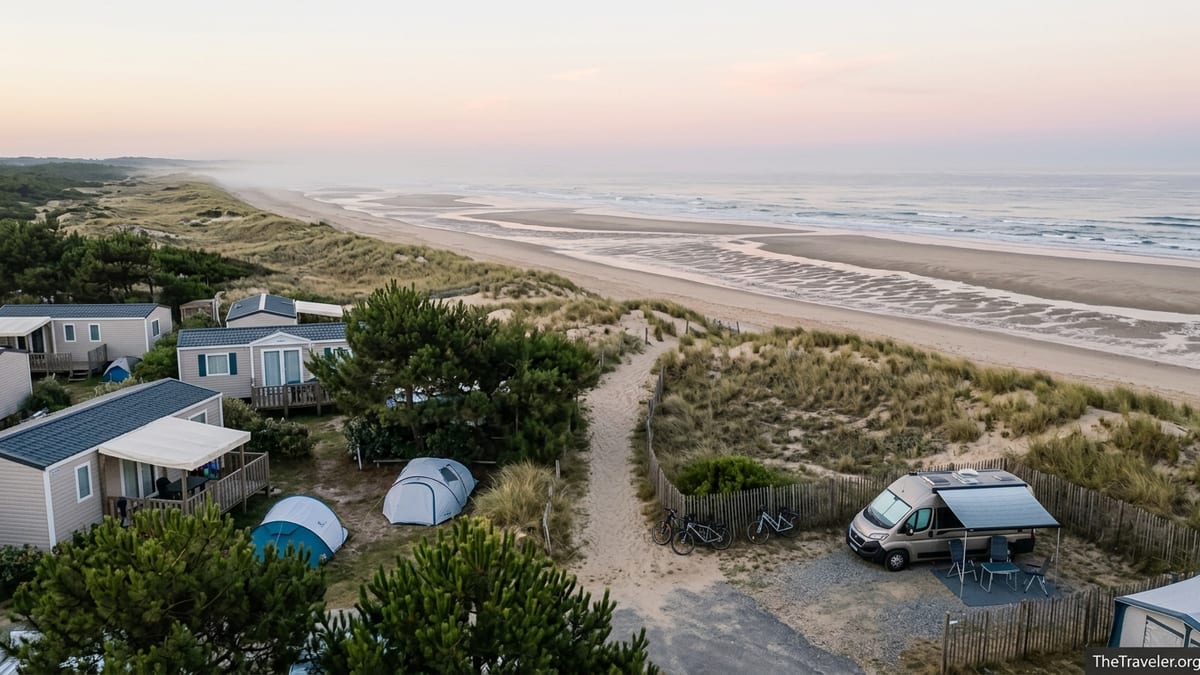
The French Atlantic coast is one of Europe’s classic camping regions, where long sandy beaches, pine forests and laid-back surf towns line the shore from the Vendée down to the Basque Country. Whether you want a simple pitch behind the dunes, a five-star holiday village with a waterpark, or a well equipped stop for your campervan, this guide highlights real-world options and how to book them across the Vendée, Île d’Oléron, Landes, the Arcachon Bay and the Basque Coast.
How French Atlantic Coast Camping Works
Camping on France’s Atlantic seaboard is built around three main types of places to stay. First are classic campsites with a mix of bare pitches for tents and campervans plus a few rental units. Second are holiday parks, often four or five star, which feel closer to open-air resorts, with large pool complexes, kids’ clubs and a wide range of mobile homes. Third are simple campervan aires, basic but well located stops ideal for touring along the coast. Many coastal communes now also run their own municipal campsites that keep prices relatively low but still offer beach access and shaded pitches.
In summer, especially from mid July to late August, demand is intense across all these regions. At a popular Vendée beachfront campsite, a basic pitch in high season typically starts around 30 to 40 euros per night, with two bedroom mobile homes often from roughly 70 to 120 euros per night depending on facilities and proximity to the sea. On the Landes and Basque coasts, which attract many surfers and families, prices for four star parks with big pool areas are often similar or slightly higher in peak season, though shoulder months like June and early September are noticeably cheaper.
Most larger campsites and holiday parks are bookable through their own websites and via specialist booking platforms that aggregate coastal camping across France. These platforms let you filter by direct beach access, covered pools, children’s clubs or pet-friendly rules, and often show live availability through into summer 2026 and beyond. Smaller municipal sites and campervan aires may not take reservations at all, instead operating on a first-come-first-served basis, which suits flexible road trips outside the busiest weeks.
Across the Atlantic coast you will find a consistent mix of facilities. Many sites include at least one heated pool, a snack bar or restaurant, fresh bread deliveries in the morning and bike hire. Four and five star parks add water slides, indoor pool domes, wellness areas and organised activities from morning aquafit to evening concerts. For campervans, several coastal destinations now promote dedicated motorhome circuits with serviced aires close to beaches and bike paths, published in up to date English language brochures for 2026.
Vendée: Family-Friendly Beachfront Parks
The Vendée coast, south of Nantes, is lined with long, gently shelving beaches and numerous family campsites. Around Saint Jean de Monts and La Tranche sur Mer you will find several parks with almost direct access to the sand. For example, a four star site in Saint Jean de Monts promoted for its beachside setting offers a pedestrian path of about 70 metres from the park gate to the dunes, with a heated pool, children’s club and a mix of touring pitches and mobile homes. Typical July pricing there is advertised from around 35 euros per night for a bare pitch and from about 70 euros per night for a two bedroom mobile home.
Recent roundups of the best seaside campsites in the Vendée consistently mention options such as Camping Côté Plage near Saint Jean de Monts, where pitches sit behind the coastal forest with direct access to the Parée du Jonc beach, or La Belle Henriette near La Tranche sur Mer, which faces a protected coastal lagoon. Further north on the island of Noirmoutier, sites like Le Caravan’île and Huttopia Noirmoutier offer a wilder feel close to tidal flats and dunes, popular with families who like cycling the flat island lanes and exploring oyster farms between beach sessions.
When choosing in the Vendée, look closely at how “seafront” is defined. Some parks sit immediately behind the dune line with a short sandy path to the water, while others are set back a few hundred metres but still within easy walking or cycling distance. If you plan to swim with young children, the Vendée’s Atlantic-facing beaches around Saint Jean de Monts and Saint Gilles Croix de Vie are valued for their wide tides and gradually shelving sand, although lifeguard coverage still varies by resort and season. Booking is usually essential for late July and August, and many families reserve the same mobile home or touring pitch a year in advance.
For motorhomes, the Vendée also offers a network of campervan aires operated by both communes and national providers. These are often located near the promenade in coastal resorts, with serviced spaces for a modest nightly fee. They work well if you want to mix short stays in simple aires with a few nights in a full facility campsite to enjoy pools and kids’ entertainment.
Île d’Oléron and the Charente Coast
South of the Vendée, the Charente-Maritime coast and Île d’Oléron provide a slightly wilder, island atmosphere while still offering well equipped campsites. On Oléron itself, five star holiday village La Brande is a good example of the modern “camping club” model. It occupies about five and a half hectares of landscaped grounds, roughly 300 metres from a small beach at high tide, and offers an indoor heated pool, outdoor pools, water slides, play areas and a range of mobile homes, chalets and pitches for tents and campervans.
Across the island, the official tourism portal lists numerous open-air hotels and campsites threaded between oyster marshes and pine forests. Some, such as St-Tro’Park or Les Embruns, sit near the island’s bike network that links beaches, fishing villages and the famous Oléron lighthouse. These sites typically blend pitches with rental mobile homes and often feature covered pools for cooler shoulder seasons, a practical point if you are visiting in May or late September when Atlantic weather can be changeable.
Prices on Oléron are broadly comparable to the Vendée, although five star parks and those closest to scenic coves or family beaches can command a premium in high summer. A basic two bedroom mobile home in a four star park can often start in the region of 80 to 130 euros per night in August, with lower rates in June. To secure ferry crossings and the better located rentals, it pays to book by early spring, especially if you are travelling during French school holiday periods.
For campervans and motorhomes, transport brochures for the island highlight bus stops serving both coastal villages and campsites, making it feasible to leave your vehicle on a pitch and explore by public transport and bike. Several sites on and around Oléron are clearly signposted from the main approach roads, but overnight parking outside official aires or campsites is increasingly restricted near popular beaches, so planning ahead is advisable.
Landes Coast: Surf, Pine Forests and Large Holiday Parks
The Landes stretch of the Atlantic coast, from roughly Biscarrosse down to Hossegor, is characterised by immense pine forests and straight, energetic surf beaches. It is also one of France’s densest regions for large scale holiday parks and campsites. Around Moliets et Maâ, Messanges and Vieux Boucau, the regional accommodation guides list everything from natural camping areas through to five star resorts like Le Saint Martin or Club Marina Landes, many located within walking or cycling distance of the ocean through the dunes.
These parks cater strongly to families and surfers. Many offer surf schools either on site or via partners, plus extensive pool complexes with slides, lazy rivers and kids’ splash zones that provide a safer water option when Atlantic conditions are rough. A four star “nature” campsite at Moliets, for instance, markets its shaded forest setting about 600 metres from the beach, with an on site grocery shop, restaurant and entertainment programme stretching through July and August. Regional camping directories for 2024 and 2026 show dozens of such parks clustered around the main beach resorts.
If you travel in a campervan, the Landes tourist offices actively promote touring routes. A 2026 English language guide for motorhomes in southern Landes lists recommended aires close to lakes and beaches, including a serviced stop near Moliets about 600 metres from the shore. Facilities usually include electricity hook ups, waste disposal and often shaded pitches under the pines. Many are open roughly from spring to early autumn, with specific 2026 opening dates such as early April to early October published by some rural campsites.
Booking strategy in Landes depends on your style. Surfers often prefer flexible, shoulder season trips, arriving in June or September when crowds are lighter and water still relatively warm, and can sometimes secure spacious tent pitches without advance reservations. Families visiting in school holidays, by contrast, should book mobile homes or dedicated touring pitches several months ahead, particularly at parks with direct beach access or those marketed heavily to international guests from Germany, the Netherlands and the UK.
Arcachon Bay: Between Lagoon and Ocean
The Arcachon Bay area, west of Bordeaux, offers a distinct setting with its sheltered basin, oyster villages and access to the open Atlantic near the Dune du Pilat. Here you can choose between campsites on the quiet inner basin, good for calmer swimming and boat trips, and parks closer to the ocean beaches around La Teste de Buch and Biscarrosse for waves and vast dunes.
On the basin side, a three star campsite at Audenge demonstrates what to expect from mid range sites in this area. It promotes reasonable prices and three star services including a pool, children’s play area and easy access to basin beaches, with options to stay either on caravan pitches or in rental accommodation. Guests can combine days on calm bay waters with excursions to the nearby lakes or ocean beaches of the Côte d’Argent, reachable by car or bike.
Closer to Arcachon town itself, chains such as Huttopia operate forest sites within cycling distance of both the bay and the Atlantic beaches. At Huttopia Arcachon, for example, you can camp with a tent, caravan or motorhome under pines, or rent wood clad chalets and glamping tents. The site offers services like electric bike hire, a pool and organised family activities in peak season, creating a good base for exploring the town, the Ile aux Oiseaux and the Dune du Pilat.
For those seeking true beachfront, look for campsites located directly on the shores of the basin or behind the outer dunes. Some small independent sites sit almost on the sand, with a simple road or path between pitches and the water. These tend to book out early for summer, in part because they have relatively few rental units and rely heavily on repeat guests. Prices in and around Arcachon can be a little higher than in rural parts of Landes, so visiting in June or September is a common strategy for better value and more space.
Basque Coast: From Biarritz to Saint Jean de Luz
At the southern end of the French Atlantic coast, the Basque shoreline around Biarritz, Bidart and Saint Jean de Luz combines compact bays, cliff-backed beaches and a vibrant surf scene. Campsites here are often more compact than in Landes but make up for it with dramatic views and quick access to coves and coastal paths. Saint Jean de Luz, a historic fishing port and well known resort close to the Spanish border, has several four star campsites listed by the local tourism office, including Atlantica and Itsas Mendi, both of which accept online bookings and cater to families.
Just north of Saint Jean de Luz, the Acotz district is something of a camping hub. Local information lists more than a dozen campsites there, including Tamaris Plage, Inter Plages and several others that stretch along the cliffy coastline between fields and the sea. One standout is a four star international campsite at Erromardie, highlighted in recent camping features for its location directly facing the Atlantic with unobstructed sea views and direct beach access. Many guests choose seafront pitches or mobile homes here specifically for sunsets over the water.
Biarritz and Bidart also host several open-air hotels and campsites, some perched on bluffs with views over surf breaks. While they may not all offer direct sand access, a short walk or local bus ride usually connects you to well known beaches such as the Grande Plage in Biarritz or the long sands at Bidart. The Basque Coast is popular with both families and dedicated surfers, so expect a cosmopolitan mix of French, Spanish and international visitors in peak season, and be prepared for higher nightly rates than in some northern stretches of the coast.
The Basque region is especially attractive for road trips combining France and Spain. From a base at a campsite near Saint Jean de Luz, you can drive or take cross border buses to San Sebastián and other Spanish Basque towns on day trips. When touring by campervan, consider alternating between full facility campsites near beaches and simpler aires inland to keep costs manageable while still accessing the coastal highlights.
Beachfront vs Pools, Mobile Homes vs Campervans
When narrowing down where to stay, a key decision is whether you prioritise direct beach access or on site pool complexes. Along the Vendée and Landes coasts, some campsites sit right behind the dunes with simple pools, while inland parks a few kilometres from the sea may invest heavily in waterparks with multiple slides and covered pools. Families with younger children often prefer a holiday park with extensive pools and shallow play areas, accepting a short drive or cycle to the beach. Older kids and surfers may be happier at a simpler dune side site where they can walk straight to the waves.
Accommodation type is another big choice. Mobile homes dominate the rental market in four and five star parks, usually sleeping four to six people with two or three bedrooms, a compact kitchen and a deck. They are ideal if you fly into a nearby airport such as Nantes, Bordeaux or Biarritz and hire a car, since you do not need to bring camping gear. In high season you can expect two bedroom mobile homes near the coast to start around 70 to 90 euros per night in simpler parks, rising for newer models with air conditioning or sea views.
Tent campers and campervan travellers enjoy more flexibility, especially outside late July and August. Many sites keep a proportion of pitches unreserved for short stays, particularly in June and September, letting you tour down the coast from the Vendée to the Basque Country without pre booking every night. However, for stays of a week or more at popular beachfront parks, even with a tent it is wise to reserve a specific pitch category, such as shaded “confort” pitches with electricity.
If you are travelling in a larger motorhome, pay attention to access roads and pitch sizes. Some older campsites in established resorts have narrow internal lanes and compact pitches better suited to smaller vans, whereas more modern parks, especially in Landes and around Arcachon, tend to design wider plots with easy manoeuvring. Checking site maps and recent photos before booking can help avoid tight squeezes, particularly if you tow a trailer or carry bikes on the rear.
Booking Tips, Seasonality and Practicalities
Along the French Atlantic coast, the main summer season runs from late June to early September, with absolute peak weeks during French school holidays in late July and most of August. During this period, popular campsites in Vendée resort towns, the main Landes surf hubs and Basque resorts like Saint Jean de Luz often fill weeks in advance. Many regular guests make reservations almost a year early to secure the same pitch or mobile home, especially on seafront rows.
If you have flexibility, June and early July or the first half of September can be ideal. Water temperatures are usually comfortable by late June, pools and most services are fully open, yet prices are often lower and crowds thinner. On booking platforms, you will frequently see noticeable price steps between early July and the main French holiday crossover dates, so adjusting your arrival and departure by a few days can make a financial difference.
For booking channels, you can either reserve directly with campsites or use specialist camping and holiday park platforms that cover large parts of the French Atlantic. These platforms are useful for comparing several regions at once, filtering for dog friendly policies, kids’ clubs or accessible facilities. They also often highlight promotional offers, such as discounts on longer stays outside peak dates or deals linked to social benefit schemes that reduce the cost of family camping holidays in certain Vendée parks.
Practical considerations include transport and packing. The coast is well served by airports at Nantes, La Rochelle, Bordeaux and Biarritz, with onward car rental. Trains run from Paris to La Roche sur Yon for the Vendée, to La Rochelle for Oléron access, to Arcachon from Bordeaux and to Bayonne and Saint Jean de Luz for the Basque Coast. Most campsites assume guests arrive by car or campervan, so plan on driving or hiring bikes if you want to explore the wider region. For gear, even in the height of summer it is worth packing warm layers and waterproofs, as Atlantic weather can shift quickly from sun to showers.
FAQ
Q1. Do I need to book French Atlantic coast campsites far in advance?
In peak season from late July to about the third week of August, it is strongly recommended to book several months ahead, especially for beachfront sites and mobile homes. Outside these weeks, many campsites along the Vendée, Landes, Arcachon and Basque coasts have more flexibility, and in June or early September you can often find pitches with shorter lead times.
Q2. Are there truly beachfront campsites where I can walk straight to the sand?
Yes, particularly in the Vendée, Landes and Basque regions. Some campsites sit just behind the dunes or directly facing small bays, with only a short path separating pitches or mobile homes from the beach. When booking, look for wording about direct beach access and check maps or photos to see how close you will actually be to the water.
Q3. What facilities can I expect for families with young children?
Family oriented holiday parks on the Atlantic coast usually provide heated pools, shallow splash areas, playgrounds and kids’ clubs in high season. Many also have evening entertainment, on site restaurants, takeaways and bakeries. When comparing options, check whether pools are covered for cooler days and whether the kids’ club offers activities in your child’s age range and language.
Q4. Is camping on Île d’Oléron or near Arcachon suitable without a car?
It is possible but requires more planning. Both Oléron and the Arcachon Bay have bus services and extensive cycle paths connecting many campsites with beaches and villages. If you arrive by train, choose a campsite close to public transport stops and consider renting bikes on site. For full flexibility to explore remote beaches and inland lakes, however, a car or campervan remains the most convenient option.
Q5. How much should I budget per night for a family of four?
Budgets vary by region, season and comfort level. In high summer, a tent or campervan pitch with electricity in a mid to high range campsite often runs from around 30 to 50 euros per night. A two bedroom mobile home in a four star park can easily range from about 70 to over 130 euros per night, with five star beachfront resorts at the upper end. Outside peak weeks, nightly rates can drop significantly.
Q6. Are dogs allowed in French Atlantic coast campsites?
Many campsites in Vendée, Oléron, Landes, Arcachon and the Basque Coast accept dogs, sometimes with restrictions on certain rental units or an extra nightly fee. Always check pet policies before booking, and be aware that some beaches restrict dogs during daytime hours in summer, although there are usually signed sections or times when dogs are permitted on the sand.
Q7. What is the best time of year for surf-focused camping trips?
For consistent Atlantic swells with milder crowds, many surfers target late spring and early autumn, particularly May, June, September and early October. Campsites in Landes and the Basque Coast typically remain open through these months, and water temperatures are often still comfortable, though a good wetsuit is advisable. High summer can also be fun but is busier in the water and on land.
Q8. Can I rely on campervan aires instead of full campsites?
You can travel largely using campervan aires along the Atlantic coast, especially outside peak weeks, but it is wise to mix in some nights at full campsites. Aires are excellent for short stops near beaches or towns, with essential services like waste disposal and hook ups, yet they usually lack pools, play areas and wider facilities. Combining both options offers more comfort and flexibility.
Q9. How strict are rules about wild camping near the coast?
Wild camping and overnight parking outside designated areas are increasingly controlled along the French Atlantic coast, particularly near popular beaches and dunes. Many communes enforce local regulations and may issue fines or move vans on if they are parked overnight where it is not permitted. To avoid problems, use official campsites and aires, which are widely available from the Vendée down to the Basque Country.
Q10. Where should I start if I have one week to explore?
With one week, it can be simplest to choose a single base in either the Vendée, Landes, Arcachon or Basque Coast and explore locally rather than moving every night. For example, a family might choose a large holiday park near Saint Jean de Monts or Moliets for easy beach access and pools, while couples interested in food and culture might base themselves near Arcachon town or Saint Jean de Luz and use the campsite as a hub for day trips.