


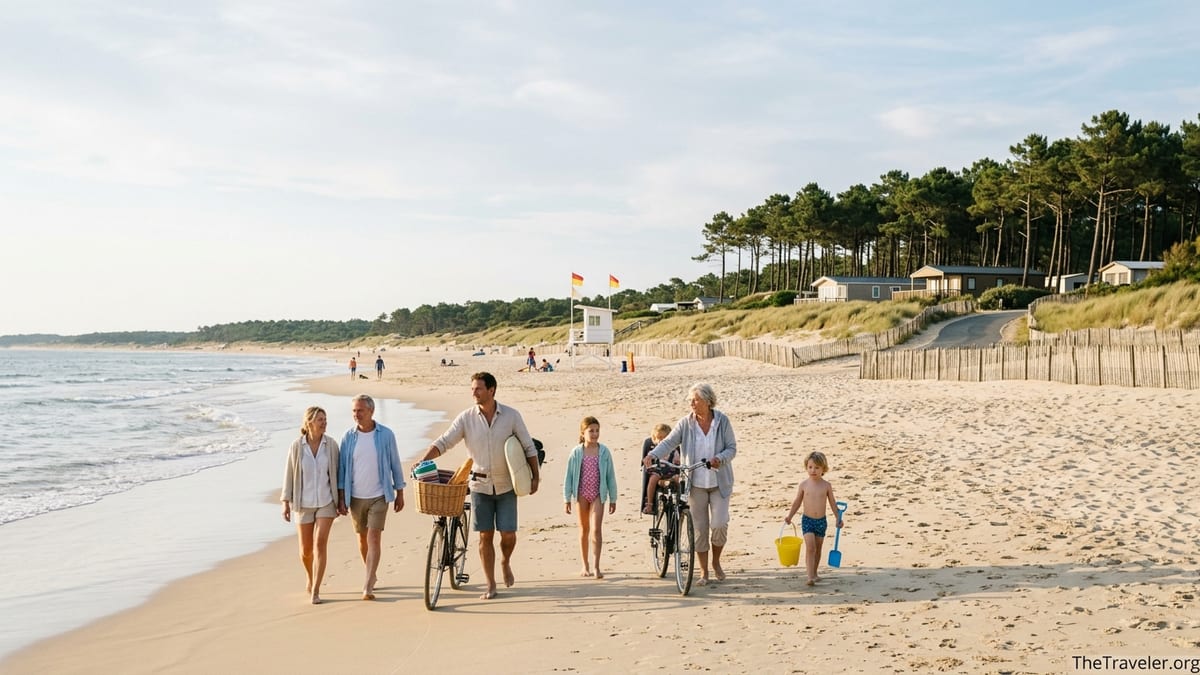
The French Atlantic Coast offers some of Europe’s most family friendly seaside holidays, with long sandy beaches, pine forests, car free cycle paths and a growing choice of holiday parks and campsites. For many families, the real question is not whether to go, but which stretch of coast to choose. This guide compares four of the most popular regions for visitors from the UK, Ireland and northern Europe: Vendée, Charente Maritime, Landes and the French Basque Country. It focuses on what matters most to families: safe sandy beaches, cycling, islands, attractions, accommodation options and the overall feel of each destination.
How the French Atlantic Coast Works for Families
The French Atlantic Coast from the Vendée down to the Basque Country is remarkably consistent in its family appeal. Expect broad sandy beaches, Atlantic waves, lifeguard patrols in high season and a string of resorts where campsites and holiday parks sit just behind dunes and pine forests. Many families drive from the UK via Saint Malo, Cherbourg, Caen or Roscoff, or arrive by air into Nantes, La Rochelle or Biarritz, then settle into one base for one or two weeks.
In practice, the coast divides into distinct zones. Vendée and parts of Charente Maritime feel gently traditional and are famous for child friendly resorts such as Saint Jean de Monts, Les Sables d’Olonne and Saint Georges de Didonne, backed by flat terrain and extensive cycle paths. Further south, the Landes is wilder, with endless dunes and surf beaches like Mimizan Plage and Contis, while the Basque Country around Biarritz and Saint Jean de Luz becomes hillier and more dramatic, with rocky headlands and a famous surf culture.
Across the whole coast, holiday parks and campsites are a major draw. In Vendée, large parks cluster around Saint Hilaire de Riez and La Tranche sur Mer, often with big pool complexes and kids’ clubs. In the Landes, forest campsites such as Les Dunes de Contis sit in the pines a few kilometres from the beach and provide direct access to traffic free cycle routes through the forest and along the Velodyssey Atlantic cycling route. Families can choose between these park style resorts and quieter small campsites, apartment complexes and villas.
Choosing between the four regions usually comes down to priorities. If you want the most reliable sunshine within a day’s drive of the Channel ports, Vendée and southern Charente Maritime are strong candidates. If your teenagers want surf lessons and a lively scene, Landes and the Basque Country stand out. Families with young children and pushchairs often favour the gentler beaches and sheltered bays around the Charente Maritime islands or Saint Jean de Luz.
Vendée: Classic Family Resorts and Gentle Cycling
Vendée markets itself as the “Coast of Light” and its mix of wide beaches, low key resorts and family oriented holiday parks makes it one of the most popular regions for first time Atlantic Coast visitors. The main resorts such as Saint Jean de Monts, Saint Hilaire de Riez, Saint Gilles Croix de Vie and Les Sables d’Olonne sit on long, gently shelving beaches ideal for paddling and sandcastle building. Many of these resorts carry French “Family Plus” accreditation, which signals facilities such as children’s clubs, playgrounds and lifeguard patrolled beaches in high summer.
The terrain in Vendée is largely flat, with a network of coastal cycle paths linking beaches, forest and marshes. Around Saint Jean de Monts and Saint Hilaire de Riez, families can follow traffic free routes through pine forest to quiet stretches of sand, with plenty of short loops suitable for children on smaller bikes. Inland, the Marais Breton marshes offer peaceful, windmill dotted landscapes for easy rides. This makes Vendée a good choice if you plan to bring or rent bikes and want everyday rides of 5 to 15 kilometres rather than ambitious touring.
Holiday parks are a dominant accommodation type in this region. Large campsites near Saint Hilaire de Riez and La Tranche sur Mer combine mobile home rentals with extensive waterparks, lazy rivers, covered pools and evening entertainment, often at mid range prices compared with Mediterranean resorts. A family of four can often find a two bedroom mobile home in June or early July for a relatively moderate weekly budget, with higher prices in late July and August. Smaller three star sites in the hinterland offer quieter stays, sometimes near lakes suitable for kayaking and stand up paddleboarding.
Vendée also works well as a base for day trips. Puy du Fou historical theme park sits inland and is widely regarded as one of France’s most impressive family attractions, with evening shows, recreated villages and re enacted battles. Many families combine three or four beach days with a full day at Puy du Fou and a visit to coastal villages such as Sion sur l’Océan, where rocky ledges and dunes frame walking and cycling paths between forest and sea.
Charente Maritime: Islands, Safe Swimming and Easy Rides
South of Vendée, Charente Maritime has a subtly different feel, shaped by its two famous islands and a series of gently curving bays. The islands of Île de Ré and Île d’Oléron are the main family magnets. Both are connected to the mainland by bridges, so they are easy to reach by car, and both are renowned for sandy beaches and extensive cycling networks that make it possible to get around almost entirely by bike. On Île de Ré, flat terrain and dedicated paths explain why many families leave the car parked for the week and rely on rental bikes with child seats or trailers.
For safe swimming, Charente Maritime offers several well sheltered options. The large bay at Saint Georges de Didonne near Royan is popular with families for its shallow water and supervised beaches, and many of the 18 lifeguard patrolled beaches on the Marennes Oléron coast are specifically signposted for young children. On the north and east coasts of Île d’Oléron, beaches like Foulerot and La Brée les Bains stay relatively calm and shallow at low tide, which suits toddlers and nervous swimmers, while the west coast has higher surf and is more suited to bodyboarding and surf schools for older children.
Cycling is one of Charente Maritime’s star attractions. Île de Ré alone has a dense network of cycle tracks crossing salt marshes, vineyards and forests, with well signed routes from ports such as Saint Martin de Ré to the Phare des Baleines lighthouse at the island’s western tip. Families regularly combine a morning ride of around 10 to 20 kilometres with an afternoon on a beach like La Conche des Baleines. On Île d’Oléron, greenways ring the west and south coasts, allowing riders to travel safely between Saint Denis, Boyardville and pine backed beaches such as Vert Bois without joining main roads.
In terms of attractions and accommodation, Charente Maritime gives plenty of choice beyond the beach. Many families staying near Royan visit Zoo de la Palmyre, one of France’s best known zoos, often combining it with nearby beaches like La Grande Côte or Saint Palais sur Mer. On Île de Ré and Île d’Oléron, salt marsh nature tours, oyster tasting cabins and boat trips to Fort Boyard or the La Rochelle area add variety. Accommodation ranges from simple municipal campsites on the islands to upmarket holiday parks with pools and kids’ clubs, apartment hotels on the waterfront at La Rochelle and character rentals in village centres like Ars en Ré or La Flotte.
Landes: Wild Dunes, Surf Schools and Forest Holiday Parks
The Landes coast stretches in a long, almost straight line of dunes and pine forest from north of Arcachon to the edge of the Basque Country. It is sometimes called the Côte d’Argent for its shimmering beaches. For families, the Landes offers a more “wild coast” feel than Vendée or Charente Maritime, with big skies, Atlantic swells and huge beaches such as Mimizan Plage, Biscarrosse Plage, Hossegor and Contis. Many of these resorts are small towns tucked just behind the dune line, with surf shops, ice cream parlours and relaxed beachfront promenades.
This region is particularly attractive if your children are old enough to enjoy surf lessons or bodyboarding. Resorts such as Hossegor and Seignosse are famous in the surf world and host international competitions, but smaller destinations like Mimizan Plage and Moliets also have well established surf schools that take children from around eight years old for small group lessons. Lifeguard patrolled zones are clearly marked in high season, and many beaches use flag systems to indicate swimming conditions, which parents appreciate on days with stronger waves.
Holiday parks in the Landes tend to be tucked into the pine forests just inland from the dunes. Les Dunes de Contis, for example, is a large family campsite located a few kilometres from the long sandy beaches, with several hundred pitches, mobile homes, pools and slides and easy access to forest cycle paths. Prices in these parks are often competitive outside the peak late July and August weeks, and families who enjoy an outdoorsy, camping atmosphere usually find good value here. Many sites run supervised kids’ activities and evening entertainment that caters to international guests, including English speakers.
Cycling in the Landes is about forest rides and long distance routes rather than village hopping. The Velodyssey, France’s Atlantic cycling route, runs down the coast, and many family friendly sections follow traffic free paths parallel to the shoreline, shaded by pines. It is common for families to cycle 5 to 10 kilometres through the forest to reach a quieter access path to the beach, or to ride between lakeside resorts such as Biscarrosse and Parentis. The region’s large freshwater lakes also provide sheltered swimming, sailing and stand up paddleboarding that can be more suitable than the open ocean for younger children.
French Basque Country: Scenic Bays and Cultural Day Trips
At the southern end of the French Atlantic Coast, the Basque Country feels distinct from the Landes. The coastline from Anglet to the Spanish border is more indented and rocky, with headlands and smaller bays replacing the straight dune backed beaches further north. Resorts such as Biarritz, Anglet and Saint Jean de Luz are framed by hills and, on clear days, views of the Pyrenees. This scenery, combined with a strong Basque cultural identity, gives family holidays here a different flavour.
For younger children and more cautious swimmers, the key asset is the large, sheltered bay at Saint Jean de Luz. The main town beach is located at the end of a semi enclosed bay which is naturally protected from the North Atlantic swells. Families can walk there directly from the historic town centre, and many parents with toddlers specifically choose Saint Jean de Luz for this safer swimming environment compared with open Atlantic beaches. Biarritz also offers a mix of larger beaches and smaller coves, as well as rock pools that appear at low tide.
Cycling opportunities in the Basque Country exist but are more limited for very young riders because the terrain is hillier and some cycle routes briefly join roads. However, family friendly sections of the Velodyssey between Biarritz and Saint Jean de Luz allow riders to experience coastal scenery without needing to be expert cyclists. Published itineraries from local and national cycling bodies describe day rides on a mixture of cycle paths and quieter roads, which older children and teenagers generally enjoy. In addition, promenades in Biarritz and Anglet are well suited to gentle family bike rides or scooter outings.
The Basque Country also stands out for its cultural and cross border day trips. From Biarritz or Saint Jean de Luz, families can take short train rides to inland towns such as Bayonne or to the Spanish city of San Sebastian for tapas style lunches and an urban beach experience. Local attractions include small aquariums, museums and a rack railway up La Rhune mountain, which offers panoramic views across the Pyrenees and the Atlantic coast. Accommodation ranges from beachfront apartments and traditional Basque villas painted in white and red to medium sized campsites on the hills behind the coast.
Comparing Beaches, Holiday Parks and Practicalities
When you compare Vendée, Charente Maritime, the Landes and the Basque Country purely on beaches, all four offer soft sand and summer lifeguard patrols. The main differences come in sea conditions and setting. Vendée and much of Charente Maritime have gently shelving, straight beaches that feel wide open and handle crowds well. The Landes beaches are even larger but are more exposed to Atlantic swells, so waves are usually bigger. The Basque Coast has a patchwork of bays and coves, from the open surf beaches near Biarritz to the sheltered harbour style beach in Saint Jean de Luz.
Holiday parks and campsites are most concentrated in Vendée, Charente Maritime and the Landes, where plots of flat land behind dunes and forests lend themselves to large sites with pools and entertainment. Families who want a “park and stay” experience with minimal driving once they arrive may lean towards these three regions. The Basque Country has fewer very large parks close to the sea and more smaller campsites and rental complexes. In practice, that means the Basque coast often suits families who value characterful towns and day trips over on site waterparks.
Travel logistics and driving times may also shape your choice. Vendée is typically the quickest to reach by car from northern ferry ports, which can mean a shorter overall journey with smaller children. Charente Maritime is slightly further but still manageable in a day’s drive with stops, and La Rochelle’s airport offers seasonal flights from several European cities. The Landes and Basque Country are furthest from the Channel but are within reach of the large airports at Bordeaux and Biarritz, which helps families who prefer to fly and rent a car.
Budget wise, prices vary significantly within each region according to proximity to the sea, time of year and facilities. As a broad pattern, high season weeks on Île de Ré, in central Biarritz or in especially upmarket resorts can be noticeably more expensive than inland or less fashionable areas of Vendée or the Landes. Families willing to travel in June, early July or early September often find better value and quieter beaches across all four regions.
How to Choose the Right Region for Your Family
Choosing between these four parts of the French Atlantic Coast ultimately comes down to your children’s ages, interests and how active you want your holiday to be. Families with toddlers who prioritise calm bathing conditions and easy buggy friendly promenades often find Charente Maritime or Saint Jean de Luz in the Basque Country the best fit. The gently curving bays, supervised beaches and compact village centres make life straightforward when naps and early bedtimes shape the day.
If your ideal day is built around cycling, both Île de Ré and Île d’Oléron in Charente Maritime stand out for their car free paths and flat terrain. Vendée also offers extensive cycle routes but often with more road crossings and a slightly more suburban resort layout. The Landes provides wonderful forest cycling on the Velodyssey and local greenways, which is perfect for older children and teenagers who enjoy longer rides through nature rather than short hops between cafes and markets.
For surf and older kids who want a sense of independence, the wave exposed beaches of the Landes and Basque Country are highly appealing. Resorts like Hossegor, Seignosse, Biarritz and Anglet have youth oriented surf schools, skateparks and a more energetic evening atmosphere in summer, with live music on terraces and night markets. Parents should, however, be comfortable with stronger waves and pay close attention to lifeguard advice and flag systems. In contrast, Vendée and Charente Maritime feel more overtly family focused, with amusement parks, small funfairs and mini golf courses taking centre stage.
Accommodation style can also steer your choice. If you enjoy large holiday parks with extensive facilities, look first at Vendée, Charente Maritime’s mainland coast and the Landes. If you would rather stay in a stone built village house, a whitewashed island cottage or a Basque townhouse, then Île de Ré, Île d’Oléron and the Basque Coast offer more of these characterful rentals. In all cases, booking well ahead for late July and August is important, particularly for popular islands and seafront properties.
The Takeaway
For families, the French Atlantic Coast is less about a single “best” destination and more about matching one of four excellent regions to the holiday you have in mind. Vendée offers classic family resorts, gentle cycling and big value holiday parks within a relatively easy drive of the Channel ports. Charente Maritime adds islands, car free cycling networks and some of the safest, most sheltered beaches for younger children, together with attractions such as La Rochelle’s historic harbour and Zoo de la Palmyre.
Further south, the Landes turns the volume up on wild dunes, surf culture and forest based holiday parks, ideal for active families and teenagers who want to learn to surf or spend long days on near empty beaches. The French Basque Country delivers dramatic scenery, a distinctive culture and memorable day trips, anchored by the reassuringly calm bay at Saint Jean de Luz and the lively streets of Biarritz and Bayonne.
Whichever area you choose, you can expect long beaches, Atlantic sunsets, bike rides under the pines and a relaxed, outdoorsy rhythm to daily life. With a little planning around your children’s ages, preferred activities and your travel budget, the French Atlantic Coast can deliver a family holiday that feels adventurous yet reassuringly straightforward, and one that many visitors are keen to repeat in future years.
FAQ
Q1. Which French Atlantic region is best for a first family trip?
For a first visit, many families choose Vendée or Charente Maritime because of the flat terrain, gentle beaches and wide choice of holiday parks close to the sand.
Q2. Where are the safest beaches for young children and nervous swimmers?
Saint Jean de Luz in the Basque Country and the bays around Royan and Saint Georges de Didonne in Charente Maritime are particularly sheltered and popular with families.
Q3. Is Île de Ré or Île d’Oléron better for cycling with kids?
Both islands have excellent, mainly flat cycle paths. Île de Ré feels a little more compact, while Île d’Oléron offers slightly wilder scenery and longer forest and dune rides.
Q4. Are the Atlantic waves too strong for children in the Landes?
The Landes often has powerful surf, but lifeguards mark safer swimming zones and local surf schools are used to teaching children. On rough days, nearby lakes provide calmer water.
Q5. Do we need a car, or can we rely on bikes and public transport?
A car makes life easier in all four regions, especially on the mainland. On Île de Ré and Île d’Oléron many families park the car for most of the week and get around mainly by bike.
Q6. How far in advance should we book a holiday park or campsite?
For late July and August, it is sensible to book several months ahead, especially for popular areas such as Île de Ré, the Royan coast, Hossegor and the Basque resorts.
Q7. Are there good rainy day attractions for children?
Yes. Options include aquariums in La Rochelle and Biarritz, Puy du Fou theme park inland from Vendée, indoor swimming pools on many campsites and small local museums and play centres.
Q8. How does the cost compare with the Mediterranean coast?
Prices vary, but many families find campsites and mid range rentals on the Atlantic slightly better value than equivalent properties on the Côte d’Azur in peak season.
Q9. Is the French Atlantic Coast suitable for families without a car?
Staying in town centres such as La Rochelle, Saint Martin de Ré, Biarritz or Saint Jean de Luz can work without a car, using bikes, local buses and trains, but overall options are more limited.
Q10. When is the best time of year for a family holiday here?
Late June, early July and early September often balance warm weather, open facilities and manageable prices. Late July and August are livelier but also busier and more expensive.