


The French Atlantic coast has a reputation that borders on mythical for European surfers: long sandy beaches, powerful winter swells and laid-back resort towns that live and breathe wave culture. For travelers, the challenge is not finding waves but choosing where to base themselves. Hossegor, Lacanau, Capbreton, Biscarrosse, Biarritz and Saint-Jean-de-Luz all promise surf, schools and camps, yet they offer very different experiences depending on your level, budget and the time of year you visit.
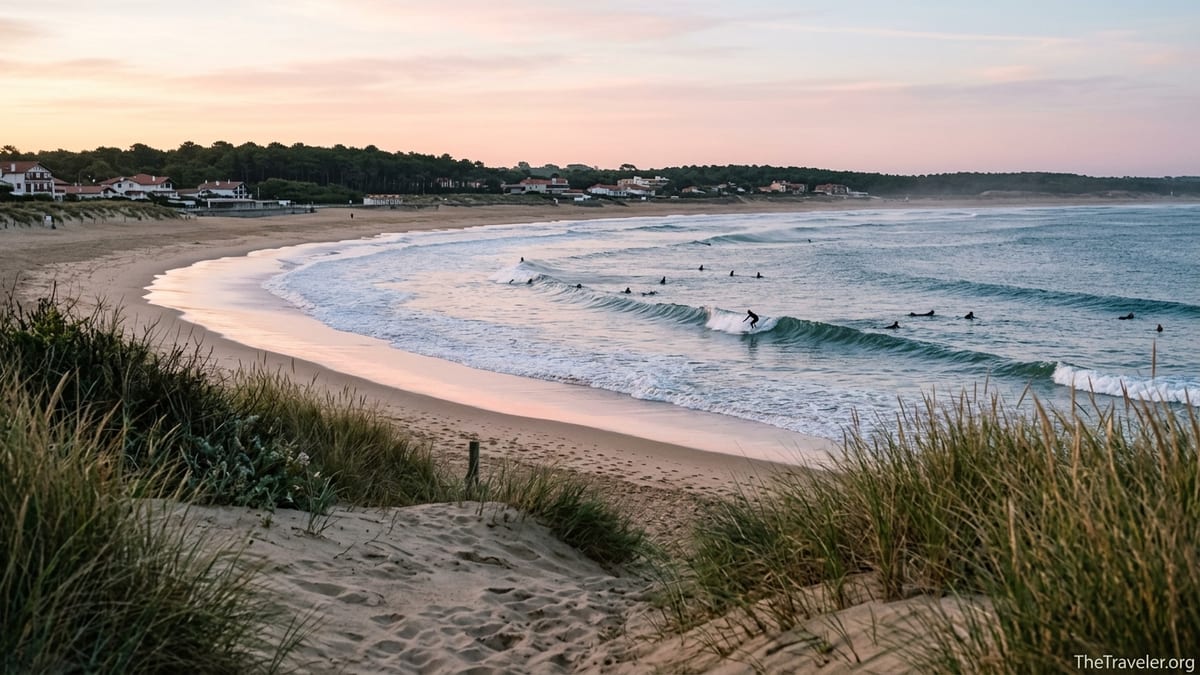
How the French Atlantic Coast Surf Zones Compare
Between the Gironde estuary and the Spanish border, the coast breaks into two broad zones. North of Bayonne you have the Landes and Gironde beaches: Lacanau, Biscarrosse, Capbreton and Hossegor. These are classic beach breaks with almost uninterrupted sandbanks and plenty of punch when the swell arrives. South of Bayonne, the Basque Country around Biarritz and Saint-Jean-de-Luz mixes beach and reef setups, with more sheltered bays and dramatic headlands.
For most visiting surfers, Hossegor and Biarritz are the big names. Hossegor and neighboring Capbreton sit at the heart of the Landes, where deep Atlantic ocean meets an abrupt sand shelf, producing hollow, powerful waves that host major competitions in autumn. Biarritz is the historic cradle of European surfing, with a compact town center, multiple beaches and surf culture woven into daily life.
Lacanau and Biscarrosse are popular with French families and first-time surfers, offering long sandy beaches, plenty of surf schools and slightly less competitive lineups than Hossegor in peak season. Saint-Jean-de-Luz, tucked inside a protective bay, is less famous internationally but highly appreciated by learners and cautious intermediates who want smaller, more manageable conditions when the open beaches are thundering.
All six destinations are easily combined on a road trip. Many visitors, for example, might spend three or four nights in Lacanau or Biscarrosse to warm up on mellow summer beach breaks, then continue south for a week around Hossegor, Biarritz and Saint-Jean-de-Luz to experience more powerful waves and the Basque Country’s food and nightlife.
Best Seasons: When to Go for Your Level
Seasonality matters more on this coast than almost anywhere else in Europe. Winter, roughly December to March, is prime time for expert surfers chasing heavy barrels and long-period swells. For beginners and most intermediates, it is generally too big, too cold and too stormy, especially on the exposed beach breaks of Hossegor, Capbreton, Biscarrosse and Lacanau.
Spring, from April to early June, is an excellent compromise. In Hossegor and Capbreton, you will see a mix of chest-high to overhead days, with water temperatures climbing into the mid-teens Celsius by May. Surf schools reopen, but lineups are still relatively uncrowded. In Biarritz, early-season visitors can enjoy milder conditions at Côte des Basques, where surf schools typically start group lessons in April and run through to October. Many camps in Biscarrosse and Lacanau advertise spring packages that include a full week of lessons, accommodation and equipment rental, often at lower prices than in July and August.
Summer, from late June to August, is the mainstream holiday season. Swells tend to be smaller and less consistent, but the water is warm enough for a thin wetsuit or even a shorty, and sandbanks are generally forgiving. This is the easiest time of year for complete beginners. Towns like Lacanau-Océan, Biscarrosse-Plage and Capbreton fill with surf schools offering three- to five-day courses aimed at people who have never touched a board. Biarritz’s main beaches, and sheltered areas around Saint-Jean-de-Luz, become big aquatic playgrounds where learners share the lineup with longboarders and stand-up paddlers.
Autumn, particularly September and October, is considered the golden period for intermediate to advanced surfers. In Hossegor, the famous beach breaks can fire with strong, clean groundswell while the water is still warm from summer. Accommodation rates drop below August peaks, and many surf camps promote “surfer’s September” specials targeted at those who already stand up reliably and want to refine technique. In Biarritz and Saint-Jean-de-Luz, autumn brings more push to the waves but still includes smaller days suitable for progressing intermediates, especially at sheltered bays and sandbottom coves.
Hossegor & Capbreton: Powerhouse Waves and Surf Camps
Hossegor and Capbreton are often marketed as the European answer to California or Australia for consistent, quality surf. The coastline is a succession of beach breaks, with spots like La Gravière known for heavy, hollow tubes that regularly attract professional contests in late September and October. For travelers, this power has a double edge: it is thrilling for experienced surfers but can be intimidating or outright dangerous for novices on bigger days.
For learners, the good news is that the shoreline around Hossegor and Capbreton offers plenty of more forgiving banks, especially on smaller summer swells and at higher tides. Local surf schools typically adapt by shifting their lesson locations daily, choosing sandbars with gentler whitewater for first-timers. On a typical July morning, you might see half a dozen schools running beginner groups in shallow water at Plage Centrale or slightly south toward Capbreton’s Santocha area, while more confident surfers sit further out on the peaks.
Surf camps in this area cater strongly to international travelers. Many offer week-long packages that bundle shared dorm accommodation, breakfast, daily surf lessons and board rental. Prices commonly sit in the mid-range bracket for Western Europe; for example, a high-season week in a basic dorm with five days of lessons often comes in around what you would pay for a simple hotel room without lessons in Biarritz. Vans and camper culture are also widely accepted. Visitors frequently book a pitch at one of the well-situated campgrounds behind the dunes and walk through pine forest paths to the beach with board under arm.
Nightlife and non-surf amenities are also part of Hossegor’s appeal. The town center and the beachfront promenade have a dense cluster of surf shops, board repair workshops, cafes and bars. In peak season, beach bars near La Nord and the marina in Capbreton host evening events that attract a mix of local riders, seasonal workers and visitors. For travelers who want their first surf trip to include a strong social component, this area is usually livelier after dark than Biscarrosse or Saint-Jean-de-Luz.
Lacanau & Biscarrosse: Accessible Beach Breaks for Learners
Lacanau-Océan, in the Gironde department, has positioned itself clearly as an accessible surf resort for French and international beginners. The town is built directly behind the dunes, with surf shops and schools lining the main streets that run down to the central beach. South of town, areas like South Beach are commonly recommended as learner-friendly zones, with slightly softer waves and good supervision from lifeguards and instructors during the main season.
Surf schools in Lacanau often run series of five-lesson packages across a week, timed to match low-tide windows when the sandbanks are at their most forgiving. Some outfits, such as multi-activity lodges and “surf house” style accommodations, combine lessons with yoga, bike rental or trips to the nearby lake. A practical example: a beginner staying in Lacanau in July might book a five-morning course, borrow a soft-top board for the afternoons and spend evenings in the pedestrianized town center where cafes and ice cream shops stay open late.
Biscarrosse-Plage plays a similar role for the Landes further north. The main beach has several peaks that work on small to medium swells, and a number of schools offer group lessons targeting first-timers and early intermediates. Surf camps in the area range from simple camping-based operations, where guests sleep in pre-pitched tents or wooden bungalows, to slightly more upscale lodge-style accommodations around the pine forests and lakes. Families frequently choose Biscarrosse because non-surfing days can be filled with cycling through the forest trails, swimming in the freshwater lakes or visiting local markets in Biscarrosse-Bourg.
The key distinction compared with Hossegor and Biarritz is scale and intensity. Lineups in Lacanau and Biscarrosse are still busy in late July and August, but the atmosphere is typically more relaxed, with fewer advanced shortboarders competing aggressively for the best waves. For many learners, especially those who feel intimidated by high-level surfers, this can make the experience more enjoyable and less stressful.
Biarritz: Historic Surf City with Mixed-Level Beaches
Biarritz holds a special place in surf history as one of the first European towns to embrace the sport in the late 1950s. Today, the city offers a range of surfable beaches within walking distance of the center. Côte des Basques is often highlighted as a particularly suitable spot for beginners and longboarders on small to medium swells, thanks to its sand bottom and relatively mellow takeoff zones when conditions are right.
During the main season, roughly June to September, surf schools line the promenade and operate directly from the sand, providing boards, wetsuits and changing facilities on site. Many run three- or five-session packages where guests meet at a fixed time each day. An example itinerary for a first-time visitor could be a four-night stay in a mid-range guesthouse near the center, with late-morning group lessons at Côte des Basques, afternoon exploration of the old port and evening dinners in casual bistros that cater to post-surf appetites.
Biarritz is also a solid choice for mixed-ability groups. While some members take lessons on gentler days at Côte des Basques or the southern corner of Grande Plage, more experienced surfers can explore nearby spots around the lighthouse or head north to Anglet, which offers a series of punchier beach breaks. On very big swells, conditions on the open beaches may become challenging for all but experts, but sheltered nooks around the harbor occasionally provide manageable reform waves for practicing takeoffs and straight-line riding.
As a city, Biarritz offers more urban comfort than the pine-fringed resorts further north. Boutique hotels, spa complexes and higher-end restaurants sit alongside surf shops and casual eateries. This makes it particularly attractive for travelers who want to combine surfing with more traditional city-break pleasures, or for couples where one partner surfs intensely while the other prefers markets, museums and leisurely coastal walks.
Saint-Jean-de-Luz & the Sheltered Basque Bays
South of Biarritz, the character of the coastline changes as sandy stretches give way to rocky headlands and enclosed bays. Saint-Jean-de-Luz is set around a large, horseshoe-shaped bay protected by sea walls and natural reefs. This geography means the town often enjoys calmer water than the open beaches to the north, which can be a major advantage for beginners when northwest swells are running.
Within the bay, areas such as Sainte-Barbe are known for gentle waves on suitable days, attracting longboarders, stand-up paddlers and surf schools that specialize in learner-friendly sessions. When a strong swell hits the Basque coast and Hossegor’s main peaks are double overhead, these sheltered spots can still offer small, rideable lines that are far less intimidating. For a cautious first-timer or for families with young teenagers, this makes Saint-Jean-de-Luz a useful back-up base or day-trip option.
Surf schools in and around Saint-Jean-de-Luz frequently advertise flexible programs: if conditions in the bay are too calm to surf, instructors may shuttle students to more exposed beaches nearby, such as the open stretches between Guéthary and Hendaye, to ensure there is enough power in the waves. Prices for lessons are broadly comparable with Biarritz, and many schools offer small-group or private coaching for intermediates looking to progress from whitewater to green waves.
As a town, Saint-Jean-de-Luz feels more traditional and less overtly surf-branded than Hossegor or Lacanau. Visitors come as much for the Basque architecture, seafood restaurants and compact old town as for the waves. For a surf trip that prioritizes culture and cuisine as highly as time in the water, combining a few days here with more surf-focused stops in Hossegor or Biscarrosse can create a well-balanced itinerary.
Choosing the Right Base by Skill Level and Budget
For complete beginners, the most forgiving options are Lacanau, Biscarrosse, Biarritz’s Côte des Basques and the bay of Saint-Jean-de-Luz in small to moderate conditions. These spots offer abundant surf schools, consistent summer whitewater and relatively gentle slopes on the beach, which make it easier to manage board carry and wipeouts. In high season, expect group lesson prices to cluster in a similar range across towns, with some variation based on group size and whether equipment is included outside lesson times.
Early intermediates, who are starting to paddle out to the lineup and catch unbroken waves, often choose Biscarrosse or Lacanau for the first part of a trip, then move down to Hossegor or Capbreton in September or early October when swells become more powerful but the crowds begin to thin. Many surf camps in Hossegor market intermediate weeks that feature smaller group sizes, video analysis and guided surf sessions where coaches drive participants along the coast to find the best sandbanks each day.
Advanced surfers generally gravitate toward Hossegor, Capbreton, Anglet and some of the more exposed Basque reefs near Biarritz. For them, autumn and winter bring the kind of heavy surf that put these areas on the world map. However, even experienced riders often appreciate having a second base or a rental car to escape to sheltered bays like Saint-Jean-de-Luz when conditions on the main beaches become too unruly or when strong winds make the open coast unsurfable.
Budget-wise, camping and surf camps in the Landes (especially around Biscarrosse and Hossegor) can be more economical than hotel-based stays in central Biarritz or Saint-Jean-de-Luz. On the other hand, those without a car might find Biarritz more practical, as its train connections and local buses link surfable beaches and make it possible to run a full surf trip using public transport. A typical one-week beginner camp in the Landes including dorm bed, breakfast and daily lessons often costs in the same ballpark as four or five nights in a mid-range hotel in Biarritz with separate paid lessons.
The Takeaway
The French Atlantic coast is not a single surf destination but a chain of distinct micro-worlds. Hossegor and Capbreton deliver the headline-grabbing barrels, Lacanau and Biscarrosse offer spacious learner-friendly beach breaks wrapped in pine forests, and Biarritz and Saint-Jean-de-Luz provide a blend of surf and culture framed by Basque architecture and cuisine.
For a first surf trip focused on learning the basics in a manageable environment, it makes sense to start with Lacanau, Biscarrosse, Biarritz’s Côte des Basques or the bay of Saint-Jean-de-Luz, ideally between late May and early October. Those who already have some experience and want to push their limits will find Hossegor and Capbreton at their best in September and October, while still being able to retreat to calmer spots further south if needed.
Ultimately, the best strategy is to think in terms of a corridor rather than a single town: choose two or three bases within a 200-kilometer stretch, match each to your current level and tolerance for crowds, and be prepared to move with the forecast. With a bit of planning and flexibility, the French Atlantic can deliver the kind of surf holiday that keeps you coming back season after season.
FAQ
Q1. Which French Atlantic surf town is best for complete beginners?
For complete beginners, Biarritz’s Côte des Basques, Lacanau-Océan, Biscarrosse-Plage and the bay of Saint-Jean-de-Luz are strong choices in summer, as they combine gentle sand-bottom waves with plenty of reputable surf schools used to teaching first-timers.
Q2. When is the best time of year to surf Hossegor for intermediates?
Intermediates usually find Hossegor most enjoyable in late spring and especially September and early October, when swells have more power than in midsummer but are not yet as consistently heavy and stormy as in midwinter, and the water remains relatively warm.
Q3. Do I need a car for a surf trip to this part of France?
You can surf-travel without a car, particularly if you base yourself in Biarritz, which has a train station and local buses to nearby beaches, but having a vehicle makes it much easier to chase the best sandbanks around Hossegor, Capbreton, Lacanau and Biscarrosse.
Q4. Are there surf camps suitable for solo travelers?
Yes, there are many camps in Hossegor, Capbreton, Biscarrosse and Lacanau that specifically welcome solo guests, offering shared dorms, communal meals and group activities so that people traveling alone can quickly meet others with similar interests.
Q5. How many lessons does a beginner typically need to stand up?
Most healthy adults manage to stand up on a foam board in the whitewater within two to five lessons, though progressing to catching unbroken waves and turning reliably usually takes more sessions and consistent practice over several trips.
Q6. What wetsuit thickness should I bring?
In summer, a 3/2 mm full suit is usually sufficient from Lacanau to Biarritz, while spring and autumn often call for a 4/3 mm; in winter, locals commonly wear 4/3 or 5/4 mm suits with boots, gloves and hoods on the colder days.
Q7. Is Biarritz too crowded for beginners in August?
Biarritz is very busy in August, both in the town and in the water, but beginners can still learn by booking lessons with established schools that manage group sizes and safety; those seeking a quieter atmosphere might prefer June, early July or September.
Q8. How do Lacanau and Biscarrosse compare for first surf trips?
Lacanau has a slightly more compact, resort-style feel with its central beach and pedestrian streets, while Biscarrosse combines its surfable beaches with access to large freshwater lakes and campsites in the pines, making both attractive but subtly different choices for a first trip.
Q9. Are there sheltered options when the swell is too big?
Yes, when the open beaches of Hossegor, Capbreton or Anglet are oversized, surfers often head south toward the protected bay of Saint-Jean-de-Luz and nearby coves, which can significantly reduce wave size and make conditions more manageable.
Q10. Can families with children combine surfing with other activities?
Families will find plenty of non-surf options in every town mentioned, from cycle trails in the Landes forests and lake swimming around Biscarrosse and Lacanau to aquarium visits, coastal walks and markets in Biarritz and Saint-Jean-de-Luz, making surf sessions easy to fit into a broader holiday.