


Driving the French Atlantic coast from the Vendée and La Rochelle down to Arcachon, the Landes and Biarritz is one of France’s most satisfying road trips. Long beaches, pine forests and oyster ports line the route, but the experience is shaped as much by practicalities as by scenery. This guide focuses on how to drive the route comfortably and confidently, with clear advice on rental cars, tolls, parking, coastal byways, island detours and realistic overnight stops.
Choosing and Renting a Car for the Atlantic Coast
La Rochelle is a natural starting point if you are arriving by air or train. La Rochelle – Île de Ré airport sits a short taxi ride from the city, with major car rental brands such as Hertz, Europcar, Sixt, Alamo and Thrifty operating directly in the terminal or just outside in the parking area. Booking ahead in high season is essential, particularly for automatic transmission cars, which can sell out weeks in advance on July and August dates. Expect a compact manual car to be one of the better-value categories, which is usually sufficient for two to four travelers with moderate luggage.
For a road trip focused on small coastal towns and occasional sandy car parks, a compact or intermediate car is generally better than a large SUV. Parking bays in older town centers like La Rochelle’s Vieux Port, Arcachon’s Ville d’Été and Biarritz’s streets behind the Grande Plage can be tight, and underground garages often have height limits that make bulky vehicles awkward. A standard hatchback with decent ground clearance will handle everything from autoroutes to forest access roads around the Landes without feeling cumbersome in town.
If you are collecting the car in the Vendée, you will find similar rental options in larger hubs such as La Roche-sur-Yon, Les Sables-d’Olonne and at regional train stations. Many travelers arriving in Paris choose to take a TGV directly to La Rochelle or Niort and pick up a car there, rather than driving out of the capital’s traffic and ring roads. This can keep the driving portion of your trip focused on the more relaxed Atlantic coastline.
Standard rental conditions in France usually include unlimited mileage and basic insurance with an excess. It is worth considering a policy that reduces the excess if you plan to park frequently in public car parks or parallel-park in narrow streets. When comparing offers on aggregator sites, pay attention to the pickup fuel policy (full-to-full is the norm), opening hours for Sunday pickups and returns, and whether cross-border fees apply if you plan to dip into Spain after Biarritz.
Understanding Roads, Tolls and Fuel Costs
The backbone of this road trip is a mix of toll motorways and free national or departmental roads. From the Vendée toward La Rochelle you are mostly on non-toll routes like the D137 and D105, cutting through marshland and low countryside. South of La Rochelle, the A837 and then the A10 can carry you quickly past Rochefort and Saintes if you want to cover distance, while the N137 and D733 offer slower but more scenic alternatives closer to the Charente estuary.
From Bordeaux toward Arcachon and the Landes, the A63 becomes the main north–south motorway. It is tolled for long stretches, run by concession companies, and prices are reviewed annually. On a typical passenger car journey between Bordeaux and Biarritz you should expect tolls in the range that feels noticeable but not extreme, depending on your exact entry and exit points. You can pay with major credit and debit cards at most booths, which is often easier than handling cash. Keep your ticket safe, as losing it generally means paying the maximum section fare.
If you prefer to minimize tolls, you can follow parallel routes like the D1250 and D810 through the Landes, passing towns such as Mimizan, Contis and Capbreton. These roads are slower, with roundabouts and occasional congestion near resorts on summer weekends, but they bring you closer to the long belt of pine forest and give access to quieter beach stops. A common compromise for many drivers is to use the A63 for longer jumps, then exit to explore on the D-roads for an hour or two before rejoining the motorway.
Fuel prices fluctuate but are broadly comparable with the rest of France. Supermarket forecourts, such as those attached to large hypermarkets at the edge of towns like La Rochelle, Rochefort, Biganos, Mimizan and Bayonne, tend to be cheaper than motorway service areas. French government-backed fuel-price comparison tools are widely used by local drivers to plan refueling stops along major routes, which can save a noticeable amount over a weeklong trip. Whatever you choose, aim to refuel before driving deep into the forested Landes at night, where petrol stations can be spaced far apart.
Driving from La Rochelle to Arcachon: Coastal Options and Island Detours
Leaving La Rochelle, you have a tempting choice: head straight south toward Rochefort and the Gironde, or make an early detour west to the islands. The bridge to Île de Ré rises from the La Rochelle suburbs and brings you to a landscape of low whitewashed villages, salt marshes and beaches. While the bridge itself is a toll structure, access by car is straightforward, and parking in villages such as Saint-Martin-de-Ré or La Flotte typically means using paid harbor-front lots or free peripheral spaces with a short walk into the center. Spending a night on Île de Ré at the start of your journey gives the road trip an immediate holiday tone before you turn south.
Back on the mainland, the drive to Rochefort on the N237 and then the N137 is efficient and uncongested outside rush hours. If you have time, the detour to Fouras and the view toward Fort Boyard offers a first taste of the open ocean. Continuing toward Saintes and then Royan, you can stay close to the coast on a string of departmental roads that weave through small resort towns like Saint-Palais-sur-Mer and Vaux-sur-Mer. These stretches reward slow driving, with frequent access to Atlantic viewpoints, but in July and August traffic can slow to walking pace around lunchtime and late afternoon.
To cross the Gironde estuary you have two main choices: loop inland via Bordeaux on fast roads, or take the ferry between Royan and Le Verdon-sur-Mer. The ferry is a short roll-on, roll-off crossing that breaks up the driving day and keeps you in a maritime frame of mind. Booking a space for your car is advisable in high season, when local holidaymakers also use this link. Once across, you can follow the D1215 and D106 along the Médoc peninsula, where pine forest meets wide beaches and modest seaside resorts like Montalivet-les-Bains and Soulac-sur-Mer.
As you approach Bordeaux, you can skirt the city on the ring road if you wish to avoid urban traffic, but it is worth considering an overnight stop here to break the trip between La Rochelle and Arcachon. Many travelers choose a hotel with secure parking near the tram lines, then leave the car for a day to explore the historic center on foot. From Bordeaux, the A63 and then the A660 lead west to Arcachon, but a more scenic and slightly slower route heads through the Landes forest past Saucats and Le Barp, where you will share the road with cyclists and campervans bound for the coast.
Arcachon, the Dune du Pilat and Parking at Major Sights
Arcachon itself is compact, with distinct quarters such as the seaside Ville d’Été and the villa-dotted Ville d’Hiver. Street parking near the beach is heavily regulated, with paid bays and tight time limits in summer. Many drivers opt for purpose-built underground or multi-storey car parks a few minutes’ walk from the waterfront, accepting the daily charge in exchange for peace of mind. Once you have parked, Arcachon is best explored on foot or by bicycle along the waterfront promenade and through the shady streets above town.
South of Arcachon, the approach to the Dune du Pilat is one of the most emblematic drives on the coast. A short spur road leads through dense maritime pines to a large paid car park at the base of the dune on the forest side. Visiting the dune itself is free, but parking is not, and pricing is structured by duration, with higher rates in the peak season months that help fund management and conservation of the fragile site. Busy summer days can see queues forming on the access road and the main car park reaching saturation, at which point drivers are directed to overflow lots or advised to delay their visit.
For a more relaxed experience at the Dune du Pilat, plan to arrive early in the morning or later in the day, when light is softer and daytime heat less intense. The walk from the car park to the base of the dune is on paved and then sandy paths, and seasonal stairways may be installed to help you climb the slope. There are services at the reception area, including toilets and simple snack outlets, but you should still carry water, especially if you intend to walk along the crest toward the quieter southern end overlooking the Landes forest and the Banc d’Arguin.
Drivers sometimes try to access the dune via smaller coastal car parks like Le Petit Nice or La Salie Nord further south, combining beach time with dune views. These lots are more limited in space and can be busy on hot weekends, with height restrictions or soft sand at the edges that may challenge heavily laden vehicles. Whichever approach you choose, obey parking signs carefully, as stopping on forest tracks or verges can damage protected habitats and may lead to fines or towing during periods of heightened fire risk.
Through the Landes: Forest Roads, Lakes and Quiet Beach Towns
South of the Arcachon basin, the Landes region stretches in a long, straight line of pine trees, dunes and freshwater lakes. The main A63 runs inland and out of sight of the ocean, but drivers who prefer coastal scenery often shift to the network of departmental roads: the D652 and D218 around Biscarrosse, or the D626 and D652 as you move toward Mimizan and Contis. These routes pass through low-key resort towns that cater more to family holiday rentals and campsites than to large hotels, so parking is generally easier and less formal than in big cities.
For example, Biscarrosse-Plage has expansive surface car parks behind the dunes that fill up late in the morning but usually have turnover throughout the day. Many are paid during peak months, with simple pay-and-display machines or app-based systems; in shoulder seasons you may find parking free or charged at a reduced rate. Short detours inland bring you to lakeside beaches on the Étang de Cazaux-Sanguinet or Étang de Biscarrosse, where parking is often shaded and less crowded than on the oceanfront, making them good swimming stops on a long drive.
Further south, the D83 and D652 wind through tall forest to places such as Mimizan-Plage, Contis and Lit-et-Mixe. These towns are ideal for an overnight pause between Arcachon and Biarritz if you like quieter evenings, long walks on almost-empty beaches and simple seafood restaurants clustered around a single main street. Many campsites and holiday parks in this stretch offer parking directly at your chalet or pitch, which can be more convenient than dealing with urban garages. Bear in mind that in high summer, one-way systems and temporary traffic controls are sometimes introduced to handle weekend changeover days for holiday rentals.
Because distances between towns in the Landes can be deceptively long, plan your fuel and rest stops in advance. Motorway service plazas along the A63 offer predictable facilities, but if you spend most of your day meandering on the D-roads, watch for signs indicating supermarket zones at the edge of towns like Mimizan, Léon or Soustons. These are the easiest places to find both fuel and large, free car parks where you can stretch your legs or stock up on groceries before returning to the coast.
Arriving in Biarritz and the Basque Coast
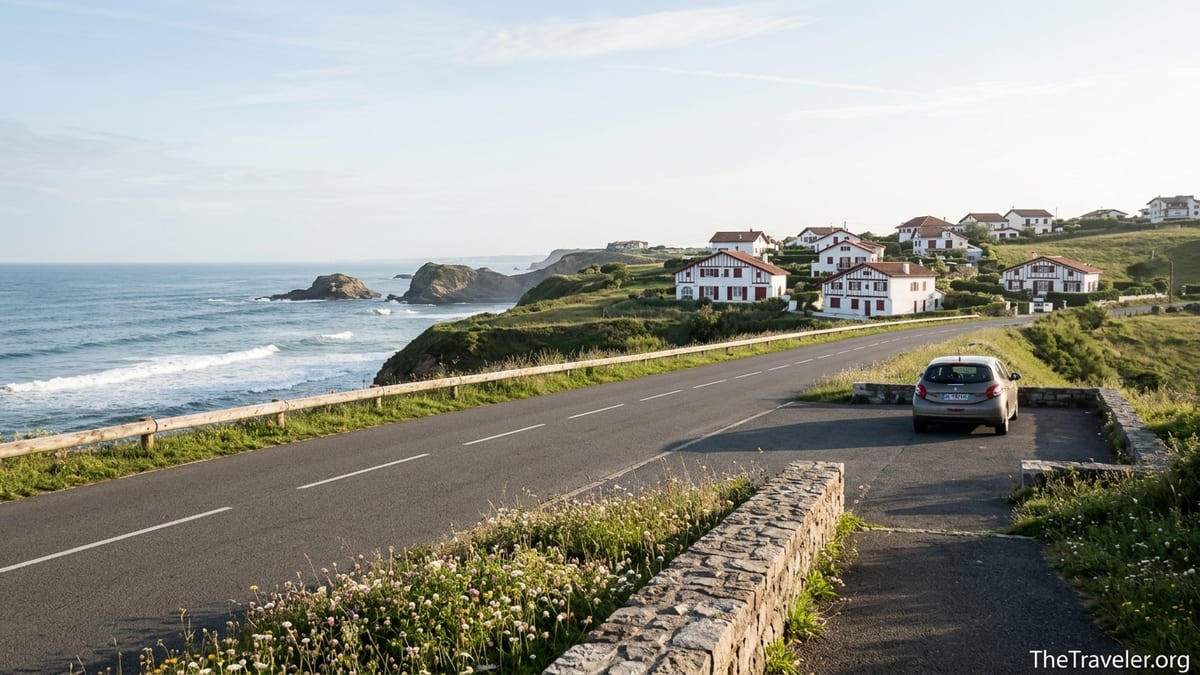
The character of the coast changes as you cross into the Pays Basque. Villages shift from pine-fringed resorts to hillside towns with whitewashed houses trimmed in red or green, and the coastline becomes more rugged. Approaching Biarritz on the A63, you can either stay on the motorway almost to Bayonne and use signed exits into Biarritz, or peel off earlier to follow the D810 through Hossegor, Capbreton and Boucau. This latter route passes a series of surf-focused towns and is a pleasant final leg if you are not in a hurry.
Parking in Biarritz requires more forethought than in the Landes. The town is compact and popular with both domestic and international visitors, particularly around the Grande Plage, the Rocher de la Vierge and the Port des Pêcheurs. Many drivers opt for underground car parks near the beachfront or in the commercial center, accepting daily or overnight fees in exchange for security. On busy days it can be easier to choose accommodation that includes private parking, whether that is a spot in a hotel garage or a courtyard behind a guesthouse.
Once you have parked, Biarritz is best navigated on foot. Sloping streets and stairways connect the main beaches, and the most atmospheric parts of town are in pedestrian or traffic-calmed zones. If you plan day trips along the Basque coast, to places like Bayonne, Saint-Jean-de-Luz or Hendaye, consider leaving your car at a park-and-ride facility or in a peripheral lot and using local trains or buses to avoid repeated parking searches in small historic centers. In peak season, this strategy can save both time and stress.
Many travelers end their coastal road trip at Biarritz before heading inland to the foothills of the Pyrenees or crossing into Spain. If you are returning your rental car in Biarritz or at nearby Biarritz Pays Basque airport, build in extra time to navigate traffic on the access roads, particularly on Saturday mornings when holiday rentals turn over. Fuel up in advance at a supermarket station on the outskirts rather than relying on limited options near the airport or rail station.
Recommended Overnight Stops and Sample Itineraries
How you break up the journey between the Vendée and Biarritz depends on your pace and interests, but certain overnight stops recur for good reason. A three or four night itinerary might look like this: La Rochelle or Île de Ré on the first night, Bordeaux or Arcachon on the second, a quiet resort in the Landes on the third, and Biarritz on the final night. This pattern balances city time with relaxed beach evenings and keeps individual driving days to a manageable three to four hours, excluding stops.
For a slower weeklong trip, you can add extra nights. Start with two nights in La Rochelle, using a hotel near the Vieux Port that offers underground parking, then spend a night on Île de Ré. Head south to Arcachon for two nights, giving you a full day for the Dune du Pilat and a boat excursion on the basin. Continue with one or two nights in Mimizan-Plage or Hossegor, staying in a small hotel or rental apartment with on-site parking, before finishing with two nights in Biarritz. This rhythm lets you settle into each place rather than unpacking the car every day.
If you are traveling in July or August, prioritize locations where you can leave the car parked for 24 to 48 hours without worry. In La Rochelle that might mean a hotel just outside the pedestrian zone with a reserved space; in Arcachon a guesthouse up the hill in the Ville d’Hiver; in the Landes a lakeside campsite where your pitch doubles as your parking; in Biarritz a hotel on the outskirts with a short bus or walking link to the center. This reduces your exposure to congested seafront streets and busy coastal roundabouts at peak times.
Travelers in shoulder seasons such as late May, June, September and early October will find both roads and accommodations quieter and often more affordable. In these months, you can be more spontaneous with overnight stops, deciding in the late afternoon whether to continue to the next town or linger where you are. Even so, booking at least the first and last nights of your trip is sensible, especially if you must align with specific flight or train departures.
The Takeaway
A road trip down the French Atlantic coast from La Rochelle to Biarritz is as much about smart logistics as it is about beaches and sunsets. Choosing a practical rental car, understanding when to use toll motorways and when to drift onto slower forest roads, and planning around parking at major sights like the Dune du Pilat can transform a beautiful but potentially crowded region into a relaxed driving adventure.
By mixing well-chosen overnight stops in La Rochelle, Arcachon, the Landes and Biarritz with occasional detours to islands and lakes, you can keep driving stages short and varied. The reward is a journey that feels coastal and continuous, from the pastel harbors of the Vendée and Charente-Maritime to the surf breaks and Basque houses of the far southwest. Approach the route with flexibility, allow time for unplanned swims and café stops, and the Atlantic coast will more than repay the planning you put into the drive.
FAQ
Q1. Do I need a car to explore the French Atlantic coast between La Rochelle and Biarritz?
Having a car is not strictly essential, but it makes the trip far more flexible, especially for reaching quieter beaches, lakes and forest trails that are poorly served by public transport. Trains connect major hubs like La Rochelle, Bordeaux and Biarritz, yet many of the most appealing coastal towns and dune areas lie several kilometers from the nearest station.
Q2. Is it difficult to drive and park in La Rochelle, Arcachon and Biarritz in summer?
Driving is straightforward, but traffic and parking can be challenging in July and August, particularly around seafronts and historic centers. You can reduce stress by choosing accommodation with on-site or reserved parking, arriving early in the day at popular sights, and using underground or multi-storey car parks instead of circling for curbside spaces.
Q3. How expensive are motorway tolls on the A63 between Bordeaux and Biarritz?
Toll costs vary by exact route and distance, but for a standard passenger car you should budget for a noticeable, though manageable, amount on a one-way trip between Bordeaux and Biarritz. Many travelers mix toll sections with free departmental roads to balance speed and cost, and payment by credit or debit card at toll booths is widely accepted.
Q4. When is the best time of year to do this Atlantic coast road trip?
The most comfortable months for driving and parking are late May, June, September and early October, when the weather is usually mild, the sea is often warm enough for swimming, and roads are less congested. July and August bring the liveliest atmosphere but also heavier traffic, higher accommodation prices and fuller car parks at major beaches and the Dune du Pilat.
Q5. Can I visit Île de Ré and still have time to reach Arcachon in the same day?
It is technically possible to cross to Île de Ré from La Rochelle in the morning and reach Arcachon by evening, but it makes for a long and rushed day. Most travelers who want to enjoy the island’s villages and beaches without clock-watching choose to stay at least one night on Île de Ré or in La Rochelle before moving on.
Q6. Is parking at the Dune du Pilat free?
No, parking at the main reception area for the Dune du Pilat is paid, with rates varying by length of stay and season. The revenue helps support site management and conservation. Visiting the dune itself remains free on foot, and arriving early or late in the day helps avoid queues at the access road and pay stations.
Q7. Are the coastal roads through the Landes suitable for nervous drivers?
Yes, the main departmental roads through the Landes are generally wide, flat and well maintained, with good visibility. Traffic flows calmly outside peak holiday weekends, and speeds are moderated by roundabouts and occasional village zones. Nervous drivers often find these forest-lined roads less stressful than dense urban traffic or winding mountain passes.
Q8. Should I book accommodation and car parks in advance in July and August?
In high summer it is sensible to book accommodation well in advance, especially in hotspots such as La Rochelle, Arcachon and Biarritz. While individual car parks are not usually reservable, some hotels and guesthouses allocate limited garage or courtyard spaces that must be reserved at the time of booking. Campsites in the Landes also fill early for peak weeks.
Q9. Is it easy to cross into Spain from Biarritz at the end of the trip?
Yes, continuing into Spain from Biarritz is straightforward. The A63 leads south toward the border near Hendaye, connecting with Spanish motorways, and there are alternative coastal roads with views over the Bay of Biscay. Check in advance whether your rental agreement allows cross-border travel and whether additional insurance or fees apply.
Q10. Can I do this road trip with an electric vehicle?
It is increasingly feasible to drive this route with an electric vehicle, as charging infrastructure has expanded along motorways and in major towns. However, you will need to plan charging stops carefully, particularly in more rural stretches of the Landes, and confirm in advance that your accommodation or chosen car parks offer compatible chargers or nearby public stations.