


Few travel decisions in central France feel as deliciously difficult as choosing between the Loire Valley and Burgundy. One promises turreted Renaissance castles mirrored in calm rivers, the other rolling vineyards producing some of the world’s most coveted wines. Both are within easy reach of Paris, both offer memorable food and scenery, and both can anchor anything from a two-night escape to a week-long deep dive. The key is matching each region’s strengths to the kind of trip you want.
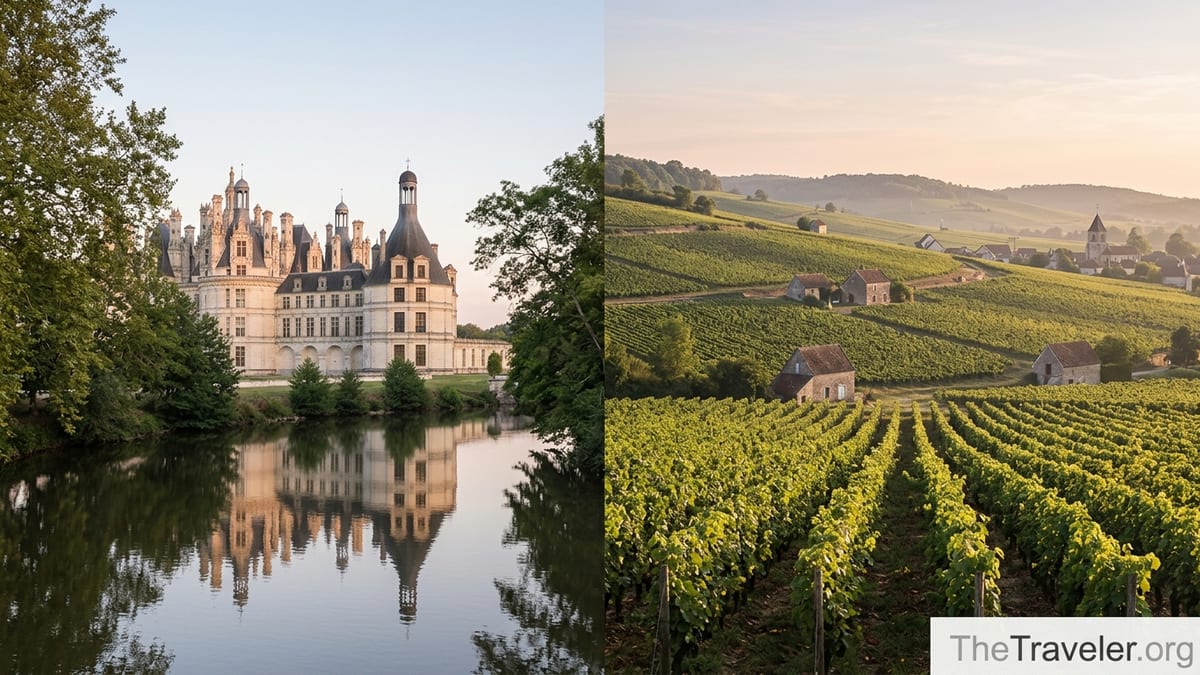
Loire Valley vs Burgundy at a Glance
The Loire Valley, stretching roughly between Orléans and Angers, is first and foremost about châteaux. Names like Chambord, Chenonceau, Amboise and Azay-le-Rideau define the landscape, their pale stone walls rising out of forests and riverside meadows. You will find vineyards and wine tasting, especially around Saumur and Vouvray, but most travelers come with castles at the top of their list and wine as a pleasant extra.
Burgundy, focused around Dijon and Beaune, in contrast is a wine region that happens to have handsome towns and abbeys attached. Here the big draws are appellations such as Gevrey-Chambertin, Nuits-Saint-Georges and Meursault, and the UNESCO-listed “climats” of the Côte d’Or, those small, named vineyard parcels that wine lovers whisper about. You might tour a medieval hospital at the Hospices de Beaune or a Romanesque basilica at Vézelay, but between visits your eyes are always on the vines.
In practical terms, the Loire generally feels more relaxed and spread out, ideal for scenic drives and castle-hopping, while Burgundy feels more compact and intensive, especially if you are keen on structured tastings and cellar visits. For many travelers with 5 to 7 days, a natural choice emerges: Loire for romance, castles and leisurely countryside, Burgundy for deep wine immersion, village-to-village touring and long dinners.
Budget can also tip the scales. Burgundy’s most famous wines are among the priciest in the world, and tasting flights at top domaines or wine bars in Beaune can easily cost more than a château entry ticket in the Loire. The Loire’s wines and accommodation are often a bit gentler on the wallet, which makes it attractive for families or travelers watching costs.
Castles vs Vineyards: What You Actually See
If your mental image of France involves turreted roofs and formal gardens, the Loire Valley delivers almost immediately. From Paris, a high-speed train to Blois or Tours takes around 1 hour 20 minutes, and within a short drive you can be standing in the vast double-helix staircase of Château de Chambord, exploring the riverside arches of Chenonceau or looking out over the Loire from the royal château in Amboise. Many visitors base themselves in Amboise or Tours and spend 2 or 3 days visiting two châteaux per day, interspersed with farmers’ markets and river walks.
The experience is architectural and visual as much as historical. At Chambord you might rent bikes to circle the game-filled forest parkland that surrounds the château. At Chenonceau you can stroll through flower-filled parterres planted for each season and then step inside to see kitchens suspended above the Cher River. Even smaller sites like Château d’Azay-le-Rideau, mirrored perfectly in its moat, feel made for slow wandering and photography rather than rushing between museum rooms.
Burgundy’s iconic sights are subtler but no less distinctive. In Beaune, the 15th-century Hospices de Beaune, with its patterned glazed-tile roof, is the signature monument. It tells the story of a charitable medieval hospital funded by surrounding vineyards, and its atmospheric halls and tiny chapel provide a different kind of “castle” experience. Around it, miles of low-slung stone walls enclose rows of Pinot Noir and Chardonnay vines marching up sunlit slopes, with small stone cabottes (vineyard huts) dotting the landscape.
Here your “sightseeing” might be a morning touring the cellars at a négociant house in Beaune, where millions of bottles age under stone vaults, followed by an afternoon driving or cycling the Route des Grands Crus between Dijon and Santenay. Stops might include the villages of Pommard, Volnay and Puligny-Montrachet, each with one or two streets, a church, and tasting rooms where you compare Premier Cru and village-level wines. It is less about a single jaw-dropping building, more about a chain of small, vivid experiences that build into a deeper understanding of wine.
Towns, Atmosphere and Scenery
The Loire Valley’s main hubs, such as Amboise, Blois, Saumur and Tours, have an airy, riverfront feel. Streets tend to be wide and relatively flat, lined with creamy tuffeau-stone buildings. In Amboise, the château dominates the town, with cafés clustered in its shadow and a lively Sunday market along the river. Saumur, further west, mixes troglodyte dwellings carved into cliffs with elegant 19th-century facades and a hilltop castle, while Tours offers a denser, more urban base with a student buzz and half-timbered houses around Place Plumereau.
Scenically, the Loire is about big skies and broad horizons. The river frequently splits into sandbanks and islands, with willows leaning toward the water and herons stalking the shallows. Vineyards appear in pockets around places like Vouvray and Chinon, but they rarely dominate the view the way Burgundy’s do. Instead, patchworks of fields, woodland and river terraces create a softer, more pastoral backdrop for drives and bike rides.
Burgundy’s main towns feel more enclosed and historic. Beaune’s center is tightly wrapped in medieval walls with cobbled streets radiating from the Hospices. Dijon, the region’s largest city, combines grand ducal palaces and mustard shops with lively food markets. Even smaller spots like Nuits-Saint-Georges and Meursault have compact cores of stone houses and wine cellars, often quieter in the afternoon when locals retreat and tasting rooms close for lunch.
The surrounding scenery in Burgundy is all about the slope. Vineyards climb gentle hills in rigorously ordered rows, often oriented to catch optimal morning or afternoon sun. Country roads like the D974 thread through a sequence of wine villages, each separated by a few minutes’ drive or 20 to 30 minutes of leisurely cycling. It is a landscape that invites slow exploration and repeated stops at viewpoints or village plazas, especially in late afternoon when the light softens and the vines start to glow.
Food, Wine and Signature Experiences
Both regions eat very well, but in different ways. The Loire Valley leans toward lighter, river-influenced cuisine: freshwater fish like sandre and pike-perch, goat cheeses such as Sainte-Maure, and seasonal vegetables. In Amboise, a mid-range bistro might offer a lunch menu featuring rillettes de Tours, a fish dish in beurre blanc, and a tarte Tatin-style dessert, paired with a glass of dry Vouvray. Prices in the 20 to 30 euro range for a fixed-price lunch are still common outside the most touristy establishments.
Wine in the Loire plays a versatile supporting role. You will encounter crisp Sauvignon Blanc from Sancerre, Chenin Blanc in still and sparkling forms from Vouvray, and Cabernet Franc reds and rosés from Chinon and Saumur-Champigny. In and around Saumur, many producers open their limestone cellars for tastings of sparkling Crémant de Loire and Saumur Brut, which often provide Champagne-like freshness at a noticeably lower price point. A simple tasting of three or four wines might cost under 15 euros, sometimes waved if you purchase bottles.
Burgundy’s table is richer and more indulgent. Classic dishes include boeuf bourguignon, coq au vin, oeufs en meurette (poached eggs in red wine sauce) and escargots with garlic-parsley butter. In Beaune, it is common to see prix-fixe menus at traditional restaurants built around these specialities, with a starter, main and dessert for 35 to 50 euros. For a splurge, the region has a concentration of Michelin-starred dining rooms where tasting menus run much higher, often built around seasonal truffles, game and local cheeses like Epoisses.
Wine is the headline act in Burgundy. Even casual wine bars in Beaune will list flights of village and Premier Cru wines, allowing you to compare how Pinot Noir from Volnay differs from Pommard, or how a Meursault white contrasts with a Puligny-Montrachet. Organized tastings at cellars or wine schools in Beaune typically run 60 to 120 euros for focused sessions with several wines and expert guidance. Because appointments are common, especially at prestigious domaines, planning ahead is part of the experience.
Getting There, Getting Around and Trip Length
Both regions are straightforward to reach from Paris by train, although the details differ. For the central Loire, travelers often take a high-speed TGV from Paris Montparnasse to Saint-Pierre-des-Corps or Tours, or an intercity train from Paris Austerlitz to Blois, in roughly 1 hour 15 to 1 hour 30. From there, renting a car makes château-hopping simpler, since major sites such as Chambord, Chenonceau and Azay-le-Rideau sit well outside town centers. Some visitors rely on organized day tours that pick up in Tours or Amboise and visit two or three châteaux in a day, which works well if you prefer not to drive.
The Loire can be visited as a very long day trip from Paris, but most travelers find 2 or 3 nights far more comfortable. With two full days, you can focus on a cluster like Amboise, Chenonceau and Chambord. With four or five nights, you might split your stay between Amboise and Saumur, adding wine tasting in Chinon or a day along the Loire à Vélo cycling route. Distances between châteaux are not huge, but they add up, and the slower backroads that make the region so charming also mean more time in the car.
Burgundy’s main rail gateway is Dijon, roughly 1 hour 40 minutes by high-speed train from Paris Gare de Lyon. From there, it is about 20 minutes by regional train to Beaune, or you can pick up a rental car in either city. Travelers focused on wine tasting often base in Beaune for 3 or 4 nights, using a combination of car, e-bikes or guided tours to explore villages such as Pommard, Volnay, Meursault, Puligny-Montrachet and Nuits-Saint-Georges.
In terms of trip length, Burgundy shines for travelers with at least 3 days on the ground who enjoy slow, repetitive exploration: revisiting favorite wine bars, returning to the Beaune market on Saturday morning, or adding a day trip to Dijon. While you can technically do a single-night stop, the rhythm of tastings, long lunches and afternoon walks suits a longer stay. Connection times work well for combining Burgundy with southern France or Switzerland, which can be useful if you are building a bigger European itinerary.
Accommodation, Budget and Trip Style
In the Loire Valley, accommodation spreads widely between towns and countryside. You will find small hotels in Amboise and Blois, chambres d’hôtes (guesthouses) in villages, and château-hotels hidden down country lanes. A typical mid-range hotel room in Amboise or Tours often falls in the 120 to 180 euro range per night for a double, depending on season and proximity to the center. Rural guesthouses can be slightly less, while château properties, with landscaped grounds and perhaps a pool, tend to sit higher.
The Loire’s spread-out geography supports a road-trip style of travel. Couples might rent a compact car and design a loop over 4 or 5 nights, staying in two or three bases and visiting one major château plus a secondary site each day. Families appreciate the space and flexibility of self-catering gites or farm stays, where outdoor space softens long days of sightseeing. Bike-friendly hotels and rental shops in Amboise, Tours and Saumur also make it easy to add a day of cycling between vineyards and villages.
Burgundy’s accommodation is more concentrated. Beaune and Dijon offer a range of small hotels, inns and apartments, with many properties occupying historic townhouses. Prices for comfortable, centrally located rooms in Beaune often fall around 150 to 220 euros per night for a double in high season, reflecting the strong wine tourism market. In the countryside, wine estates sometimes operate their own guest rooms or small inns, which can cost similar amounts but include vineyard views and perhaps a cellar visit.
Because tastings, restaurant meals and bottle purchases can add up quickly, Burgundy often ends up costing slightly more per day than the Loire, even when hotel prices appear similar. However, the region can be surprisingly good value if you focus on village-level wines at casual bistros, choose one or two structured tastings rather than daily appointments, and travel outside the busiest harvest and auction periods. For couples celebrating a special occasion, a splurge night at a vineyard hotel with a gourmet dinner can be a highlight of the entire trip.
Choosing by Traveler Type: Couples, Families and First-Timers
For many couples, especially on honeymoons or anniversary trips, the Loire Valley’s romantic profile is hard to ignore. Evening light on the Loire at Amboise, a slow stroll through Chenonceau’s gardens, or a picnic in the park at Chambord while deer graze in the distance all lend themselves to that classic “France” feeling. Days can be structured or loose, and the combination of castles, small towns and gentle countryside keeps things varied without demanding detailed planning.
Burgundy also works very well for couples, but the vibe is different. Here, romance often lives indoors at candlelit dinners, during two-hour tastings in medieval cellars or on late-afternoon walks through vineyards turning gold in autumn. It especially suits pairs where at least one person is enthusiastic about wine and happy to talk soil types and vintages, or where both travelers enjoy long meals and quiet villages more than busy tourist sights.
Families tend to find the Loire more immediately engaging. Châteaux come with towers to climb, moats to peer into and gardens to run through, and many sites incorporate child-friendly exhibits or tablet guides. You can easily break days with paddleboat rentals on the river, short bike rides or visits to small animal farms on the outskirts of towns. Self-catering stays are widespread, and driving between castles allows for flexible snack and nap breaks.
Burgundy can work for families too, particularly if you mix wine-country days with outings to places like Dijon’s museums or the canal paths that run through the countryside. However, a string of long tastings and formal dinners can wear on younger children. For first-time visitors to France with limited time, the decision often becomes simple: if you dream of castles from storybooks, choose the Loire; if you have been reading about Pinot Noir for years and want to understand it in situ, choose Burgundy.
The Takeaway
In the end, deciding between the Loire Valley and Burgundy is less about which region is objectively “better” and more about which aligns with your priorities for this particular trip. The Loire shines when castles, river scenery, and a relaxed, moderately priced escape from Paris are at the top of the list. Its châteaux are world-famous for a reason, and even a short stay can weave together palaces, gardens, markets and easy countryside drives into a coherent, satisfying story.
Burgundy, by contrast, excels when you want to slow down, taste carefully and immerse yourself in one of the world’s great wine cultures. Its compact string of vineyard villages, historically rich towns like Beaune and Dijon, and deeply rooted gastronomy reward travelers who are willing to plan a little and linger. Costs may run higher, but the payoff in understanding and enjoyment is substantial, especially for wine-focused travelers.
If you have a week or more in central France, it can be tempting to try to do both regions. In practice, though, spreading your time risks turning your trip into a checklist. For a 4 to 6 day add-on to Paris, choosing one region and doing it well usually leads to better memories. Think about whether your heart lifts more at the thought of walking into a Renaissance castle’s great hall or descending into a centuries-old wine cellar. That instinct is usually your best guide to whether the Loire’s castles or Burgundy’s vineyards should win your internal Central France comparison.
FAQ
Q1. Which region is easier to visit as a day trip from Paris, the Loire or Burgundy?
Both are technically possible as day trips, but central Loire destinations like Tours or Blois are slightly more common because trains from Paris take around 1 hour 15 to 1 hour 30 and château-focused tours often operate from there. Burgundy works better as an overnight or multi-night stay centered on Dijon or Beaune, where you can explore the wine villages without rushing.
Q2. If I am not a serious wine drinker, is Burgundy still worth it?
Yes, but your enjoyment will depend on how much you appreciate food, quiet historic towns and rural walks. You can happily spend days in Beaune and Dijon visiting markets, museums and nearby abbeys, with wine as a secondary pleasure rather than the focus. However, if wine does not interest you at all, the Loire’s castles and broader range of sightseeing may offer more obvious variety.
Q3. Do I need a car in the Loire Valley and in Burgundy?
A car is very helpful in both regions, but for different reasons. In the Loire, many major châteaux are in the countryside, so having a car or joining organized tours makes logistics simpler. In Burgundy, the wine villages are closer together and can be explored partly by bike or with small-group tours from Beaune or Dijon, so it is possible to manage without a car if you plan around train and tour schedules.
Q4. How many days should I plan for the Loire Valley vs Burgundy?
For the Loire Valley, 2 to 3 nights allows for a good introduction with several key châteaux and a taste of local wine. Four or five nights let you slow down and add secondary sites or cycling. For Burgundy, 3 to 4 nights based in Beaune or Dijon is a comfortable minimum to experience the vineyards, one or two structured tastings, and some time in town without feeling rushed.
Q5. Which region is more budget friendly?
While costs fluctuate by season and specific choices, the Loire Valley is usually slightly kinder to mid-range budgets. Château entry fees do add up, but wine and many accommodations remain relatively affordable. In Burgundy, tastings at well-known domaines, bottle purchases and fine-dining meals can raise the daily spend, even when hotel prices are similar.
Q6. Is either region better for traveling with children?
The Loire Valley generally suits families better, thanks to its castles with towers, gardens and interactive exhibits, plus plenty of open space and riverfront areas. Children often engage quickly with the visual drama of châteaux and enjoy activities like biking or boat rides. Burgundy can work for families who enjoy quiet villages and nature, but repeated wine tastings and long dinners may test younger travelers’ patience.
Q7. When is the best time of year to visit the Loire vs Burgundy?
Both regions are pleasant from late spring through early autumn. The Loire is especially lovely in May and June when gardens are in bloom, and again in September when crowds thin. Burgundy is magical in September and October when vineyards change color and harvest activity begins, though this period can be busy and pricier. Winter visits are quieter in both regions but come with fewer tour options and shorter days.
Q8. Can I combine the Loire Valley and Burgundy in one itinerary?
It is possible to combine both, especially on longer trips of 10 days or more that include Paris, but you should be realistic about pace. Moving between regions often consumes most of a day once packing, checking out and train or drive times are factored in. If you only have 4 to 6 days beyond Paris, focusing on one region usually leads to a more relaxed and memorable experience.
Q9. Which base towns work best in each region?
In the Loire Valley, popular bases include Amboise for a small-town, castle-focused feel, Tours for a livelier city atmosphere, and Saumur for a mix of wine and river scenery. In Burgundy, Beaune is the classic base for wine touring, with Dijon offering a larger city environment, more museums and slightly easier rail connections while still being close to the vineyards.
Q10. How far in advance should I book tastings or château tickets?
For major Loire châteaux, you can often buy tickets close to the day of visiting, though peak summer and holiday periods benefit from earlier planning. In Burgundy, many renowned domaines and structured tasting experiences require advance reservations, sometimes weeks or months ahead in harvest season. Booking your key wine appointments or tours as soon as your travel dates are fixed is a smart strategy.