


Southern France is one of Europe’s easiest regions to explore by train. Fast TGV lines link major cities like Marseille, Nice and Bordeaux, while dense regional TER networks reach smaller hubs such as Avignon, Aix-en-Provence and Montpellier. Add in a rental car for countryside detours, and you can see a wide sweep of the Mediterranean and Atlantic coasts without ever needing to drive into a big city.
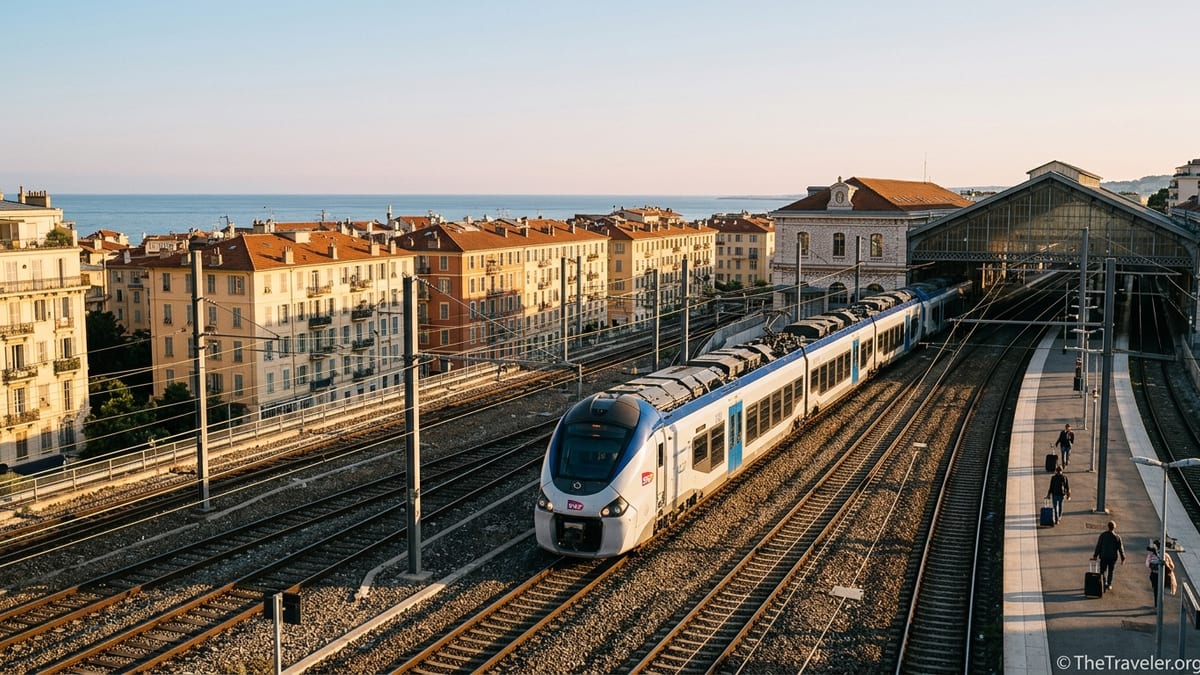
How the rail network in southern France works
Most long-distance trains in southern France are operated by the national company SNCF. High-speed TGV InOui services run along the main spine from Paris down to Marseille, Montpellier, Toulouse and Bordeaux, and along the Côte d’Azur between Marseille, Cannes and Nice. For most visitors, that means you can comfortably reach your first southern base by TGV from Paris in three to six hours, then switch to slower regional trains for onward hops.
Regional trains are branded TER and are managed by each region. In Provence and the Riviera you will mostly ride TER Provence-Alpes-Côte d’Azur services between Marseille, Aix-en-Provence, Avignon, Toulon, Cannes, Antibes, Nice and the Italian border. In Occitanie, TER services cover the line from Nîmes and Montpellier towards Narbonne and Toulouse. Around Bordeaux you will use TER Nouvelle-Aquitaine to reach places such as Arcachon on the Atlantic coast or the wine towns of Libourne and Pau.
There are also a handful of Intercités services on classic tracks, for example between Bordeaux and Toulouse or from Marseille towards the southwest. These are generally slower than TGVs but can be useful when TGV times do not suit. Internationally branded trains such as Renfe high-speed services into Spain or Trenitalia from Paris to Lyon and onwards to Italy can connect with southern French routes, but most of your city-to-city travel within the south will be on SNCF-operated trains.
Across this network you will not usually need to worry about which company runs each individual train. When planning, think instead in three layers: a high-speed TGV or Intercités to reach the region, a TER for medium hops between major towns, and finally a rental car or local bus to reach villages, hilltop towns and vineyard roads that have little or no rail service.
Key train routes between Marseille, Nice and the Riviera
One of the most scenic and practical routes in southern France is the coastal line between Marseille and Nice. TGVs cover the stretch Marseille to Nice in around two and a half to three hours, stopping at hubs like Toulon, Les Arcs–Draguignan and Cannes. On the same tracks, TER regional trains run more frequently and stop at smaller stations such as Bandol, Saint-Raphaël-Valescure and Antibes. This combination makes it possible to base yourself in one town and take relaxed day trips along the Riviera without ever getting on a motorway.
A common itinerary is to arrive in Marseille on a TGV from Paris, spend two or three nights exploring the old port and nearby Calanques, then board a TER or TGV eastwards to Cannes or Nice. For example, a mid-morning TER might leave Marseille Saint-Charles and reach Cannes in about two hours, giving you time to check into your hotel and stroll the Croisette by late afternoon. Continuing on, Cannes to Nice takes about 30 to 40 minutes on a regional train, with dozens of departures spread through the day.
Nice itself is a strong base for rail day trips. From Nice-Ville station you can take a TER west to Antibes and Cannes, or east to Monaco, Menton and across the border to Ventimiglia in Italy. These short hops usually run at least every hour and tickets can be very affordable if bought as standard TER fares, often just a few euros outside peak summer Saturdays. Intermediate stations such as Villefranche-sur-Mer or Beaulieu-sur-Mer give access to sheltered bays and coastal walks that would be awkward to reach by car due to tight parking.
Note that some construction and timetable changes occur each year, especially around Marseille where track works can affect weekend services. If you are planning a September or winter trip, check schedules a few months in advance and again the week before travel using a current booking app such as SNCF Connect or a major international agency. This helps avoid surprises like replacement buses on part of the route between Marseille and smaller coastal towns.
Avignon, Aix-en-Provence and Marseille: high-speed vs classic lines
Avignon and Aix-en-Provence are both served by two types of stations. Avignon TGV lies on the high-speed line a few minutes outside the city, while Avignon Centre is the traditional station right by the old town walls. Similarly, Aix-en-Provence TGV stands in the countryside north of Marseille, with Aix-en-Provence Ville closer to the historic center. When you buy tickets from Paris you will normally arrive at the TGV stations, then connect on a short TER shuttle or local bus to the central station.
For example, a typical route from Paris to Avignon uses a TGV to Avignon TGV taking about two hours and forty minutes, followed by a 5 to 10 minute TER hop to Avignon Centre. The TER shuttles usually run two to three times per hour through most of the day. Likewise, travelers heading for Aix-en-Provence’s old town might take a TGV from Paris to Aix-en-Provence TGV, then transfer to a frequent coach into the city. This split station arrangement can look confusing in search results, so pay attention to whether your final stop is labeled TGV or Centre/Ville when booking.
Marseille Saint-Charles is simpler, acting as the main hub for both TGV and TER services. From here, high-speed trains run directly to Paris, Lyon and sometimes further north, while frequent TERs fan out along the coast and inland to Aix-en-Provence, Avignon, Arles and the Camargue gateway of Nîmes. The station sits on a hill above the city; escalators and stairs lead down towards the Vieux-Port in about 15 to 20 minutes on foot, or you can use the metro lines that start directly under the main concourse.
When planning day trips, consider mixing TGV and TER. For instance, you might take a morning TGV from Marseille to Avignon TGV, then a shuttle TER into the city and later a slower, cheaper TER back from Avignon Centre to Marseille following the Rhône valley. On paper this looks slightly longer than a return TGV, but it may give you more time options and more flexible pricing, while also letting you depart directly from the old town station without going back out to the high-speed terminal.
Montpellier, Toulouse and Bordeaux: crossing to the Atlantic
Moving west from Provence, the line through Nîmes and Montpellier connects the Mediterranean with the southwest. High-speed trains sprint along a modern route between Nîmes and Montpellier, while regional TER services continue on classic tracks that serve towns such as Sète, Béziers and Narbonne along the coast. From Montpellier, it is about two hours by train to Toulouse and a little over four hours to Bordeaux, depending on whether you find a direct TGV or need to change in Narbonne or Toulouse.
Montpellier Saint-Roch station sits in the heart of the city and works well as a base for a few nights. From here you can ride a TER to the fishing town of Sète in about 15 minutes, or to the walled fortress of Carcassonne in roughly one hour and twenty minutes with a change in Narbonne. These are straightforward day trips that rarely require advance reservations on the TER segments, making them ideal for flexible travelers who prefer to decide on the day based on weather.
Toulouse Matabiau and Bordeaux Saint-Jean are the key hubs further west. Trains between Toulouse and Bordeaux include both Intercités and TER options, usually taking a little over two hours. This is a useful link if you are crossing between the Mediterranean and the Atlantic on a multi-city itinerary. For example, a two-week trip might chain together Marseille, Montpellier, Toulouse and Bordeaux entirely by rail, with smaller diversions by local bus or rented car into wine regions such as Gaillac or Saint-Émilion.
Because some improvements to the southwest high-speed network are still underway, journey times and the balance between TGV and Intercités can change from year to year. Before fixing non-refundable tickets, compare a couple of different departures on your travel date. Sometimes an Intercités booked early can be nearly as fast and significantly cheaper than a peak-hour TGV on the same corridor.
Tickets, passes, reservations and luggage
For most visitors staying under one month, point-to-point tickets combined with occasional regional fares are the simplest way to travel. TGV and Intercités services on popular routes like Paris to Marseille or Bordeaux almost always require seat reservations. Booking a few weeks ahead usually gives access to lower fares and more choice of departure times. Regional TER trains, by contrast, generally have fixed prices with no compulsory seat reservation, so you can often buy those closer to departure without a penalty except on a few peak weekends.
Rail passes can work if you are planning many long-distance days, but they are not a magical shortcut. A Eurail France or Global Pass typically includes travel on SNCF-operated TGV, Intercités and TER services, but high-speed trains still require separate seat reservations that cost extra and can sell out on popular dates. Recent travelers in 2025 and 2026 have reported that on some routes roughly half the departures they tried to book were already at their pass-holder quota, especially around holidays and long weekends. A pass can save money if you are taking frequent long hops in a short time, yet still demands careful advance planning.
Budget airlines and long-distance coaches do compete with the train on some longer jumps, for example between Bordeaux and Nice or Marseille and Barcelona. However, when you factor in airport transfers, security time and baggage rules, trains remain the most time-efficient and comfortable option for most inland routes within southern France itself. If your itinerary strings together cities that sit on the same rail corridor, rail usually wins for convenience.
Luggage is comparatively straightforward. On almost all French trains you carry your bags on board and store them in overhead racks, between-seat spaces or larger racks at carriage ends. There are no formal weight limits for ordinary luggage, though you must be able to lift your suitcase safely. On busy summer TGVs, larger suitcases can fill up the communal racks quickly, so boarding early helps. Many major stations, including Marseille Saint-Charles and Nice-Ville, have staffed left-luggage services or lockers where you can securely leave a suitcase for a few hours while you explore between trains. Expect to show ID and pay per item, with day rates that are usually modest compared to hotel prices.
Stations, connections and practical details in each city
Marseille Saint-Charles is the principal southern hub. The station hall is compact enough that even with a rolling suitcase you can usually reach any platform within five to ten minutes, though you should allow longer if you rely on elevators instead of stairs. A staffed left-luggage office operates inside the station, allowing you to drop bags before heading down to the old port or up to the Basilica of Notre-Dame de la Garde. Taxis and rideshare pick-up points stand just outside the main exit, and the metro entrance sits beneath the concourse.
Nice-Ville, the main station in Nice, feels smaller and more relaxed. Most TGVs and many TER trains use the main through platforms, and connections between regional trains are often just a short walk along the same island platform. Several independent luggage-storage businesses operate within a few minutes’ walk of the station, alongside the official left-luggage service in partnership with SNCF. From Nice-Ville you can walk straight down Avenue Jean Médecin to the seafront in about twenty minutes, or connect to the city tram for a faster ride with heavy bags.
Avignon Centre and Aix-en-Provence Ville stations both sit near their historic cores. From Avignon Centre it is a brief stroll to the famous bridge and the Palais des Papes, while Aix-en-Provence Ville opens onto streets lined with cafes and fountains within minutes. Montpellier Saint-Roch and Toulouse Matabiau are also centrally located, with tram or metro stops integrated into the station area. Bordeaux Saint-Jean lies slightly further from the old town than some, but modern tram lines run directly outside the station, so you can be at the riverfront quays in roughly fifteen minutes.
All of these stations have ticket machines that accept major credit cards, and most now support digital tickets on smartphone apps as standard. For peace of mind, especially when making a tight connection or switching between a TGV and a local TER, aim to arrive at your departure station at least 20 to 30 minutes early. This gives you time to find your platform, locate your coach number on the platform display and settle into your seat without rushing, even if you need to navigate lifts or escalators with luggage.
When and where a rental car becomes useful
Within the cities themselves you rarely need a car. Marseille, Nice, Toulouse, Montpellier and Bordeaux all have dense public transport and walkable centers, while parking garages in historic districts can be costly and stressful. A car becomes useful when you want to string together smaller villages or remote natural areas that do not sit near a train line or frequent coach. Common examples include the Luberon hill villages behind Aix-en-Provence, the Alpilles around Saint-Rémy-de-Provence, the wild Camargue wetlands near Arles, and many of the wine routes near Bordeaux and Toulouse.
A practical approach is to rely on trains to move between major cities, then pick up a car for two or three days at a smaller hub. For instance, you could travel by train from Paris to Avignon Centre, stay in town the first night, then rent a car from a depot near the station for a circuit through Gordes, Roussillon and Bonnieux in the Luberon before returning it in Avignon. Similarly, from Bordeaux Saint-Jean station you might rent a car to explore Saint-Émilion, the Médoc châteaux or Arcachon’s dune country, returning to Bordeaux in time for an onward TGV.
Rental depots are easiest to access at large stations such as Marseille Saint-Charles, Nice-Ville, Avignon TGV, Aix-en-Provence TGV, Toulouse Matabiau and Bordeaux Saint-Jean. If you prefer not to drive in heavier city traffic, consider picking up at an outlying TGV station with big parking areas, then heading straight onto ring roads and countryside highways. In Provence, for example, collecting a car at Avignon TGV or Aix-en-Provence TGV can feel calmer than driving out of central Marseille, though Marseille’s station also has on-site agencies.
Factor in local driving rules and seasonality. In July and August, narrow roads in the Luberon and on the Riviera fill with visitors, and parking in cliffside villages or calanques trailheads can be tight by mid-morning. Late spring and early autumn often offer a better balance between open roads and good weather. If you are uncomfortable with mountain roads and hairpin bends, you might prefer to reach certain perched villages by organized tour from a rail hub instead of driving yourself.
Planning sample itineraries by rail
A classic one-week itinerary might start with a TGV from Paris to Marseille, followed by a TER along the Riviera and a final TGV out of Nice. For example, spend three nights in Marseille, using a TER to visit Cassis or Arles, then ride a mid-morning TER to Cannes for two nights and finish with two nights in Nice. Along the way you rely entirely on trains, using local buses and ferries for side trips to the Calanques, Antibes or Saint-Paul-de-Vence.
For a two-week cross-country journey, you could structure the route as Marseille, Avignon, Montpellier, Toulouse and Bordeaux, all by rail. Start with a Paris to Marseille TGV, then a short TER to Avignon Centre for two or three nights, perhaps with a one-day rental car to loop through the Luberon. From Avignon, take a TER or Intercités to Montpellier for a taste of Languedoc wines and the nearby coast, then continue by train to Toulouse and on to Bordeaux. Finish with a few days exploring Bordeaux’s wine regions via day tours or a short-term rental car.
Travelers who favor slower trips might skip some big cities and blend longer stays with countryside time. For instance, base yourself in Nice for five nights with day trips along the coast, then board a TGV to Avignon for four nights and rent a car for two days in the Alpilles and Luberon. End in Bordeaux for three nights focused on food and wine, reached via a combination of Intercités and TGV through Toulouse. In such an itinerary the train handles the long hauls, while a car is used sparingly for targeted rural segments.
When planning, consider travel days as part of the experience rather than dead time. Routes such as Marseille to Nice, Avignon to Montpellier and Toulouse to Bordeaux offer windows onto changing landscapes, from limestone cliffs to rice paddies and vineyards. Booking daytime trains with window seats on the coast or in river valleys can turn each transfer into a moving viewpoint, which is one of the pleasures of crossing southern France by rail instead of by motorway or plane.
The Takeaway
Southern France lends itself naturally to train-first travel. The combination of fast TGV links and dense regional TER lines makes it straightforward to move between Marseille, Aix-en-Provence, Avignon, Nice, Cannes, Montpellier, Toulouse and Bordeaux without a car. Point-to-point tickets booked a little in advance usually work better than complicated pass setups, and station facilities in major hubs make luggage, connections and ticketing manageable even for first-time visitors.
Instead of renting a car for the entire trip, most travelers will benefit from short, focused car rentals out of rail hubs such as Avignon, Aix-en-Provence or Bordeaux when they want to delve into hill villages, vineyards or coastal areas beyond the reach of trains. Used this way, the car becomes a flexible tool for rural days, not a burden in city centers. With a bit of timetable checking and an eye on seasonal crowding, you can enjoy a relaxed, scenic journey across southern France that leans on trains where they work best and turns to the open road only when it truly adds value.
FAQ
Q1. Do I need to book train tickets in advance for southern France?
It is strongly recommended to book TGV and Intercités tickets in advance, especially in summer and on weekends, to secure lower fares and guaranteed seats. Regional TER tickets can often be bought closer to departure, since they usually have fixed prices and do not require seat reservations.
Q2. Are rail passes worth it for a southern France itinerary?
Rail passes can be good value if you plan many long-distance days in a short period, such as moving cities every day or two. However, passes still require paid seat reservations on most TGVs, and popular departures can sell out of pass-holder quotas, so passes work best for flexible travelers who can adjust timings.
Q3. How much time should I allow to change trains in Marseille or Nice?
In medium-sized stations like Marseille Saint-Charles or Nice-Ville, 20 to 30 minutes is usually enough to change between trains with luggage. This gives you time to find your new platform, use elevators if needed and adjust if the incoming train is a little late.
Q4. Is it safe to leave luggage on French trains and at stations?
Most travelers ride French trains without incident, but you should keep valuables with you and avoid leaving bags unattended. On board, store luggage where you can see it or in nearby racks; in stations, use official left-luggage services or reputable locker facilities rather than leaving suitcases in public areas.
Q5. When is a rental car better than the train in southern France?
A rental car becomes more useful when you want to visit small villages, hilltop towns or rural wine areas that lack train stations or frequent buses. Examples include the Luberon villages near Aix-en-Provence, parts of the Camargue near Arles and certain wine routes around Bordeaux and Toulouse.
Q6. Can I pick up a rental car directly at train stations?
Yes, many major stations have on-site or nearby car rental agencies, including Marseille Saint-Charles, Nice-Ville, Avignon TGV, Aix-en-Provence TGV, Toulouse Matabiau and Bordeaux Saint-Jean. Booking in advance lets you coordinate your train arrival time with car collection.
Q7. Do I need a car to explore the French Riviera?
Not necessarily. The coastal rail line between Marseille, Cannes, Antibes, Nice and Monaco is frequent and convenient, and many beaches and town centers lie within walking distance of stations. A car can help for remote coves or hilltop villages, but it is not essential for a classic Riviera stay.
Q8. How early should I arrive at the station before departure?
Arriving 20 to 30 minutes before departure is generally sufficient for domestic trains. This allows time to find your platform, locate your coach and settle in, even if you need to navigate escalators or lifts with luggage.
Q9. Are French trains accessible for travelers with limited mobility?
Many modern TGV and TER trains have dedicated spaces for wheelchairs and accessible toilets, and larger stations offer ramps or lifts between platforms. However, accessibility can vary by station and train type, so it is wise to check details in advance and allow extra time for transfers.
Q10. What is the best season to travel southern France by train?
Late spring and early autumn often offer the best balance of pleasant weather, moderate crowds and comfortable train conditions. July and August can still be enjoyable, but trains and popular routes may be busier and require earlier booking for seats and accommodations.